


The regulatory landscape around cryptocurrency is shifting, and civil litigation is moving with it. Courtney Werning, who leads Meyer Wilson Werning’s cryptocurrency fraud practice, has been direct about what brought her to this work. “I did not come to this work as a crypto enthusiast,” she told Authority Magazine. “I came to it as a lawyer who saw people getting hurt and believed they deserved someone willing to hold powerful platforms accountable.”
Through Crypto.court, Meyer Wilson Werning is pursuing claims against exchanges that allegedly failed their customers, and that work is helping establish what reasonable security and accountability standards should actually look like in practice, not just in policy proposals.
If you have lost money to cryptocurrency fraud, a platform failure, or digital asset theft, you can find more information about your recovery options on our page covering cryptocurrency fraud and digital asset loss claims.
Why Cryptocurrency Industry Reform Matters Now
The push for cryptocurrency industry reform has accelerated as regulators, lawmakers, and international policy organizations respond to billions of dollars in investor losses tied to exchange collapses, security breaches, and fraud schemes. Courtney Werning, who leads Meyer Wilson Werning’s cryptocurrency fraud practice through Crypto.court, recently addressed this moment directly in a feature for Authority Magazine, laying out the specific reforms she believes are most urgent for protecting everyday investors.
At the state level, New York Attorney General Letitia James has proposed a nation-leading cryptocurrency regulation bill, which would require independent public audits of exchanges, impose know-your-customer requirements on crypto brokers, establish stricter conflict-of-interest rules, create reimbursement obligations for certain fraud-related losses, and limit use of the term “stablecoin” to fully backed tokens.
Internationally, the International Organization of Securities Commissions has issued 18 policy recommendations covering conflicts of interest, market manipulation, cross-border cooperation, custody protections, and retail investor suitability. The International Monetary Fund has similarly called for comprehensive crypto frameworks grounded in sound macroeconomic policy, clear legal treatment of crypto assets, and strong supervisory and enforcement capacity.
“The growth of the crypto industry, and the rise of artificial intelligence, is creating a perfect storm of fraud that is overtaking American households.”
– Courtney Werning, Authority Magazine
Recent U.S. legislative proposals have focused on giving the Commodity Futures Trading Commission clearer authority over spot crypto markets and defining regulatory boundaries between the SEC and CFTC, with provisions designed to preserve fraud enforcement and private rights of action.

We Have Recovered Over
$350 Million for Our Clients Nationwide.
How Proposed Regulations Could Change Exchange Accountability
Regulatory proposals moving through state legislatures and international bodies would impose on cryptocurrency exchanges many of the same duties traditional financial institutions already bear, including mandatory asset segregation, independent auditing, conflict-of-interest disclosures, and reimbursement obligations for unauthorized or fraud-induced transfers.
The SEC maintains a running list of SEC enforcement actions involving crypto asset securities and digital asset fraud, and large-scale enforcement results illustrate what exchange accountability can look like in practice. Binance’s criminal and regulatory resolutions produced approximately $4.3 billion in penalties and forfeiture, while CFTC actions against the platform resulted in more than $2.7 billion in penalties and disgorgement.
While some high-profile crypto registration cases against major exchanges have been dismissed or narrowed, fraud-focused actions by agencies and the Department of Justice continue. For investors, the practical significance is straightforward. If enacted and enforced, these proposals would give digital asset holders stronger recourse when platforms fail, are breached, or facilitate fraud, and would establish clearer benchmarks against which exchange conduct can be measured in civil litigation.
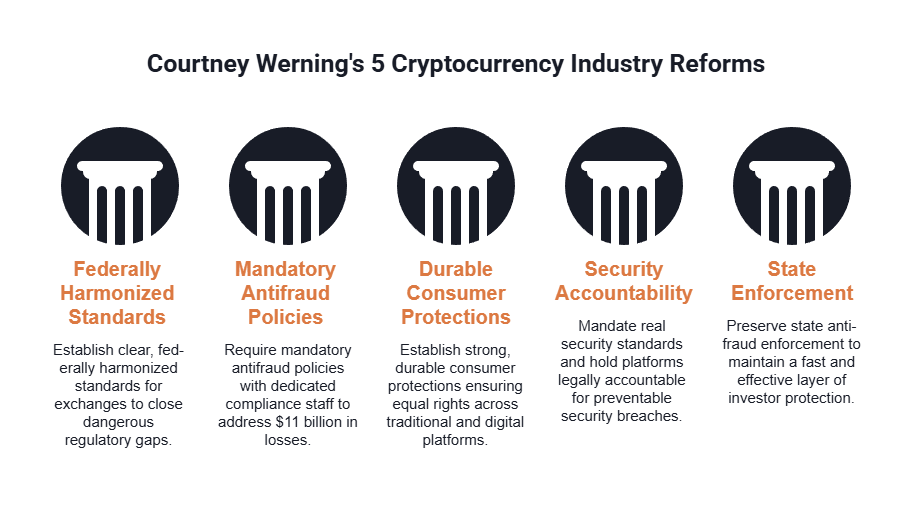
Courtney Werning’s 5 Recommendations for Cryptocurrency Industry Reform
In her interview, Courtney Werning outlined five specific reforms she believes are essential to protecting investors in the digital asset space. Drawing on her work through Crypto.court and her positions on FINRA’s National Arbitration and Mediation Committee and PIABA’s crypto task force, she offered these recommendations:
- Establish clear, federally harmonized standards for exchanges. The current regulatory patchwork leaves investors exposed, and bad actors exploit those gaps deliberately. A consistent federal baseline for how exchanges hold and protect customer assets would close the most dangerous of them.
- Require mandatory antifraud policies with dedicated compliance staff. Broker-dealers have been required to maintain anti-fraud policies and supervision for nearly a century. With Americans reporting more than $11 billion in cryptocurrency-related fraud losses in 2025 alone, crypto platforms should be held to no lesser standard.
- Establish strong, durable consumer protections. Technology should not determine the scope of investor protection. Retail investors deserve the same rights whether an investment is offered through a traditional brokerage account or a digital platform.
- Mandate real security standards and hold platforms accountable for breaches. The number of cases traceable to preventable security failures is staggering. Legal accountability is the fastest way to make the industry take security seriously.
- Preserve state anti-fraud enforcement. State regulators are often faster on their feet than federal agencies. Retail investors need that layer of protection, and any federal framework should preserve it rather than preempt it.
Our lawyers are nationwide leaders in investment fraud cases.
Pig Butchering Scams and the Real Cost of Weak Oversight
One of the most damaging fraud patterns that cryptocurrency industry reform aims to address is the pig butchering scam. In a pig butchering scheme, scammers spend weeks or months building trust with a target through social media, dating apps, or unsolicited messages before directing the person to transfer money into what appears to be a profitable cryptocurrency trading platform. Victims are shown fabricated account balances encouraging larger deposits until the platform blocks withdrawals or disappears entirely. Some drain retirement accounts or take on debt before realizing what happened.
“20 year olds are having their accounts hacked and assets stolen. 90 year olds are the victims of pig butchering scams, believing they are successfully trading cryptocurrency on a legitimate platform, while scammers carefully and methodically extract every dollar they can.”
– Courtney Werning, Authority Magazine
Government impersonation variants of this fraud have also emerged, with scammers posing as federal agents and pressuring investors into moving savings into cryptocurrency on the pretext of “protecting” their assets. Meyer Wilson Werning has documented cases in this category, including one in which a 93-year-old investor allegedly lost $1.5 million to a government impersonation pig butchering scheme. More detail is available in the firm’s reporting on government impersonation pig butchering scams targeting older investors.
The firm has also documented how meme coins and tokens launched on platforms like pump.fun can function as speculative schemes in which creators hype assets with little underlying value and then exit while retail investors absorb sudden losses.
Anyone who suspects they have been targeted should stop sending money, preserve all communications and transaction records, report the crime to the FBI’s Internet Crime Complaint Center, and consult qualified legal counsel about potential recovery options.
Crypto Investor Protection is Failing: Here are 5 Reforms That Could Change That
byu/Crypto_Court inCryptoCourtLaw
We Are The firm other lawyers
call for support.
How Meyer Wilson Werning and Courtney Werning Are Advancing Crypto Investor Protection
Meyer Wilson Werning’s cryptocurrency practice, led by Courtney M. Werning, pursues claims against exchanges where internal security failures, data breaches, or negligent protocols allegedly allowed hackers or scammers to steal investor funds. The firm has reported recovering $4 million for a group of investors targeted in a pig butchering scheme involving a fraudulent crypto platform.
The Crypto.court platform serves as a dedicated resource for cryptocurrency fraud claims and reflects the firm’s broader commitment to using civil litigation to establish meaningful standards for how exchanges treat customer assets.
Courtney Werning has also expanded public awareness of these fraud patterns through media work, including Courtney Werning’s Spectrum News interview on social media crypto scams and Courtney Werning’s Easy Prey podcast discussion of pig butchering schemes. Through her positions on FINRA’s National Arbitration and Mediation Committee and PIABA’s crypto leadership initiatives, she also contributes directly to the policy conversations shaping investor protection in digital asset markets.
The firm is currently reviewing exchange-specific cryptocurrency fraud and hacking investigations.
How Meyer Wilson Werning Can Help
With more than $350 million recovered for investors nationwide since 1999, Meyer Wilson Werning represents clients in cryptocurrency fraud, digital asset theft, and exchange accountability claims. All cases are handled on a contingency fee basis, meaning clients pay nothing unless the firm recovers money for them.
If you or someone you know has lost money through a cryptocurrency exchange failure, pig butchering scam, or digital asset fraud, and a licensed financial professional, broker, or registered platform facilitated your investment, contact us today for a free and confidential consultation.
Frequently Asked Questions
What does cryptocurrency industry reform mean for everyday investors?
Cryptocurrency industry reform refers to efforts by lawmakers and regulators to bring crypto platforms and exchanges under clearer legal frameworks, giving investors better disclosures, safer asset custody, and stronger recourse when fraud occurs. Proposals from regulators and international bodies such as IOSCO and the IMF have called for rules addressing conflicts of interest, market manipulation, and retail investor protection, all aimed at reducing losses in opaque, poorly supervised markets.
What is a pig butchering scam in the context of cryptocurrency investing?
Pig butchering is a relationship-based investment fraud in which scammers spend weeks or months building trust with a target before pressuring them to deposit money into a fake cryptocurrency platform. Victims are shown fabricated profits that encourage larger deposits until the platform blocks withdrawals or disappears entirely. Law enforcement urges victims to stop sending money, preserve evidence, report the crime to the FBI’s Internet Crime Complaint Center, and consult qualified legal counsel.
Can you hold a cryptocurrency exchange responsible if your digital assets are stolen?
Whether an exchange can be held responsible depends on its security practices, how the theft occurred, and what representations it made to customers. U.S. regulators including the SEC and CFTC have brought enforcement actions against exchanges that allegedly failed to register properly, misled investors, or violated anti-fraud rules. Investors who suffer losses often consult cryptocurrency fraud attorneys to evaluate whether negligent security or internal failures could support a civil claim.
How are cryptocurrency fraud attorneys involved in shaping industry reform?
Cryptocurrency fraud attorneys contribute to reform by bringing civil claims that test exchange accountability, participating in regulatory committees, and educating policymakers about emerging fraud patterns. Meyer Wilson Werning, through Courtney Werning and the Crypto.court platform, pursues cases against exchanges where security failures allegedly allowed fraud and advocates for harmed investors. Attorneys active in organizations such as PIABA’s crypto initiatives also provide direct input on arbitration rules and investor-protection standards.
Recovering Losses Caused by Investment Misconduct.