


Most investors picture the stock market as an open, transparent system where prices are displayed in real-time for everyone to see. However, that picture has not been accurate for years. Today, more than half of all U.S. stock trading happens in private, off-exchange venues known as dark pools. While these systems are marketed as tools for efficiency, they can often lead to significant financial harm when firms engage in deceptive practices.
What Is a Dark Pool and Why Does It Operate in Secret?
A dark pool is a private trading platform, technically called an Alternative Trading System (ATS), that operates outside of public exchanges like the New York Stock Exchange or Nasdaq. Unlike public exchanges, trades executed in dark pools are not visible to the public before they occur. Prices, order sizes, and the identities of the parties involved remain hidden from the broader market until after the trade is completed.
Originally, these platforms were designed to allow large institutional investors, such as pension funds and mutual funds, to execute massive trades without moving market prices against themselves. However, the lack of transparency has created significant risks. By January 2025, dark pools accounted for 51.8% of all U.S. stock trading volume, marking a major shift away from public, transparent markets. When the majority of trading happens in the shadows, the process of fair price discovery is compromised, often to the detriment of ordinary investors.

We Have Recovered Over
$350 Million for Our Clients Nationwide.
A History of Deception: Major Dark Pool Penalties and Misconduct
Dark pool fraud typically involves a firm misrepresenting how its platform operates. The Securities and Exchange Commission (SEC) and other regulators have documented a recurring pattern of misconduct at some of the world’s largest financial institutions.
Important Points Regarding Past Regulatory Actions:
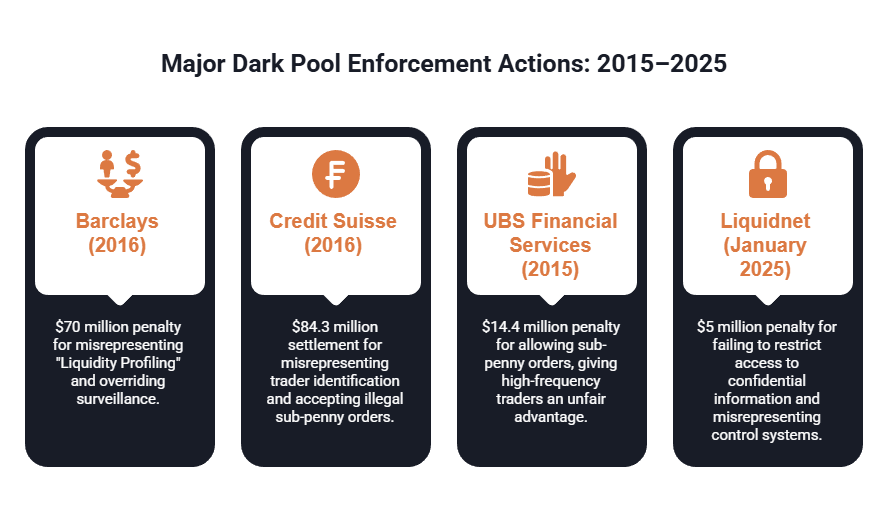
- Barclays (2016): The firm paid a $70 million total penalty after telling subscribers its LX dark pool used “Liquidity Profiling” to police for predatory trading. In reality, Barclays secretly overrode its own surveillance tools, exposing subscribers to the very aggressive traders they had elected to block.
- Credit Suisse (2016): The firm settled charges for $84.3 million related to its Crossfinder dark pool. Credit Suisse misrepresented how it identified “opportunistic” traders and accepted over 117 million illegal sub-penny orders, essentially allowing high-frequency traders to take advantage of customer orders.
- UBS Financial Services (2015): UBS was hit with a $14.4 million penalty for allowing certain customers to submit orders in sub-penny increments. This practice, which is prohibited by SEC rules, gave specific high-frequency traders a structural advantage that was never disclosed to regular customers.
- Liquidnet (January 2025): In one of the most recent actions, Liquidnet (owned by TP ICAP) paid a $5 million penalty. The SEC found the firm failed to restrict access to confidential trading information and misrepresented its control systems. This followed a previous $2 million fine in 2014 for similar failures.
How Dark Pool Misconduct Impacts Individual Investors
You may not trade in dark pools directly, but your investments are likely affected by them. When you place a trade through a brokerage account, your broker decides where to route that order. Many firms route customer orders to their own dark pools or those operated by affiliates, creating a clear conflict of interest.
If a dark pool operator misrepresents who is allowed to trade on the platform or fails to protect your order information, you may receive worse execution prices. This type of misconduct can lead to “unexplained” investment losses that stem directly from a firm’s failure to operate as advertised. Brokers have a legal duty to act in their clients’ best interests and disclose these types of risks.
Our lawyers are nationwide leaders in investment fraud cases.
Can You Recover Losses From Dark Pool Misconduct?
When a brokerage firm misrepresents how it handles your trades, fails to protect your order information, or allows predatory traders access to your orders without disclosure, that is actionable broker misconduct. Most investor claims against brokerage firms are resolved through arbitration. private, structured process that moves faster than traditional court litigation and is specifically designed to level the playing field between individual investors and large financial institutions.
Claims of this nature have real deadlines. Statutes of limitations apply, and waiting too long can cost you the right to recover entirely. If something about how your trades were executed has never added up, whether that’s unexplained losses, poor execution prices, or a broker who couldn’t clearly explain where your orders were going, it’s worth having an experienced attorney review your situation now.
Meyer Wilson Werning has represented investors against the industry’s most powerful institutions for more than 25 years, recovering over $350 million for clients nationwide. We work on a pure contingency fee basis, meaning you pay nothing unless we recover for you. Contact us today for a free, confidential case evaluation.
We Are The firm other lawyers
call for support.
Frequently Asked Questions
Why are dark pools considered risky for individual investors?
Dark pools lack the transparency of public exchanges, meaning investors cannot see order flow or pricing before a trade occurs. This opacity can allow firms to favor high-frequency traders or misrepresent how they protect customer data, leading to poor execution prices for retail investors.
How do I know if my broker is routing my trades to a dark pool?
Brokerage firms are required to disclose their routing practices. Many firms route orders to “internalizers” or dark pools they control to capture fees, which can create a conflict of interest. An experienced attorney can help you review your trade data to identify these patterns.
Can I recover losses caused by dark pool fraud?
Yes. If a firm made material misrepresentations about its dark pool operations or failed to supervise the platform, investors may pursue compensation through arbitration. These claims often center on breach of fiduciary duty or negligence.
Recovering Losses Caused by Investment Misconduct.