

The financial well-being of numerous investors, including high-profile professional athletes, has been jeopardized following the alleged misconduct of former Morgan Stanley financial advisor Darryl Matthew Cohen (also known as Darryl M. Cohen). Previously based in Westlake Village, California, Cohen has been at the center of a series of investor complaints, federal criminal charges, and a permanent industry bar.
If you or a family member suffered significant losses while working with Darryl Cohen or another Morgan Stanley advisor, our unauthorized trading attorneys at Meyer Wilson Werning can help you evaluate your options. Contact us today for a free and confidential consultation to determine whether your losses are the result of actionable misconduct or supervisory failures — you pay nothing unless we recover for you.
What Does BrokerCheck Show About Darryl Matthew Cohen?
Darryl Matthew Cohen was a registered representative in the securities industry for 24 years, with his final tenure at Morgan Stanley lasting from June 5, 2015, to April 8, 2021. According to his BrokerCheck record (CRD #: 2786613), Cohen’s history is marked by 19 total disclosures, which include 14 customer disputes.
The sheer volume of these disputes is highly irregular. FINRA Notice to Members 03-49 notes that a review of registered representatives showed that only 0.41% had three or more customer complaints on their record. Having 14 such disputes places Cohen in the top one-hundredth percent of all registered representatives for customer complaints. Morgan Stanley discharged Cohen on March 9, 2021, following allegations relating to his facilitation of outside client business and transactions that were not disclosed to or approved by the firm.

We Have Recovered Over
$350 Million for Our Clients Nationwide.
A Timeline of Claims and Multi-Million Dollar Settlements
The allegations against Cohen have led to significant legal actions and massive financial settlements. Investors have consistently claimed that Cohen engaged in unauthorized transfers, charged excess fees, and pressured them into using the Morgan Stanley Liquidity Access Line (LAL) for transactions they did not fully understand or authorize.
Important Points Regarding Recent Settlements:
- November 24, 2024: A dispute alleging excess fees and unnecessary borrowing on a credit line settled for $275,000.00.
- February 21, 2024: A claim involving selling away recommendations for an outside business investment and unauthorized transfers resulted in a settlement of $250,000.00.
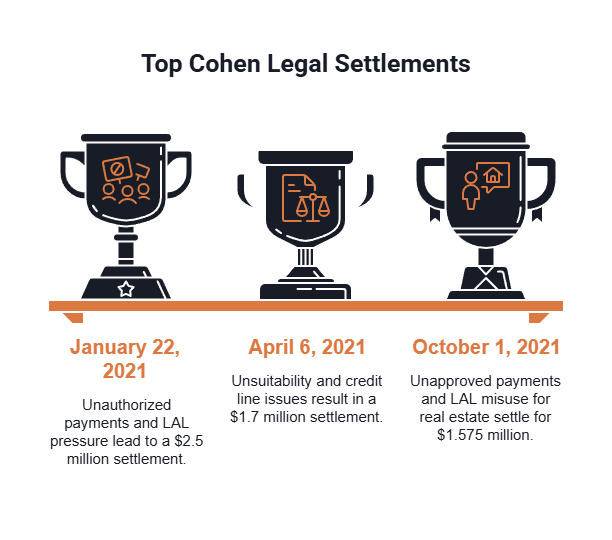
- October 1, 2021: A filing regarding payments made without prior approval and the misuse of a Liquidity Access Line for real estate and life insurance policies settled for $1,575,000.00.
- April 6, 2021: A dispute alleging unsuitability regarding investments and a credit line settled for $1,700,000.00.
- January 22, 2021: A matter involving unauthorized payments and pressure to use a Liquidity Access Line settled for $2,500,000.00.
Red Flags of Broker Misconduct and Investor Harm
The conduct alleged in the Darryl Cohen matter serves as a warning for investors regarding the importance of firm supervision under FINRA Rule 3110 and suitability standards under FINRA Rule 2111. When these rules are ignored, retirees and professional athletes alike can lose control of their financial future.
- Unauthorized Transfers: Moving client funds to outside accounts or investments without express consent.
- Unsuitability: Recommending high-risk strategies or credit lines that do not align with the investor’s goals or risk tolerance.
- Selling Away: Promoting “off-the-books” investments that have not been vetted or approved by the brokerage firm.
- Misappropriation: The alleged theft of funds for personal benefit, including home renovations or personal debt payments.
- Lack of Disclosure: Failing to explain the material risks or conflicts of interest associated with a recommended transaction.
- Supervision Failures: Failing to maintain a system to monitor for risky concentrations or suspicious money movements.
Our lawyers are nationwide leaders in investment fraud cases.
Federal Allegations and Criminal Charges Against Darryl Cohen
The situation escalated significantly in 2023 when federal authorities intervened. On March 23, 2023, a permanent industry bar was joined by “Regulatory” and “Criminal” entries on Cohen’s record. The SEC initiated a civil enforcement action alleging that between October 2017 and April 2020, Cohen breached his fiduciary duties and defrauded three clients—current and former NBA players—of at least $1 million.
The SEC complaint alleges that Cohen misappropriated these funds through unauthorized transfers to outside investments and expenditures that personally benefited him, such as building a gym at his house and funding home improvements. Simultaneously, the Department of Justice (DOJ) filed criminal charges including:
- Wire Fraud
- Conspiracy to Commit Wire Fraud
- Investment Advisor Fraud
Media reports, including from CNBC, indicate that the broader fraud scheme may have involved transferring approximately $13 million from professional athlete clients for personal uses, such as paying off personal credit card bills and giving money to a romantic partner.
We Are The firm other lawyers
call for support.
Seeking Recovery for Losses Related to Darryl Matthew Cohen
Investors who suffered losses due to the actions of Darryl Matthew Cohen may have grounds to pursue recovery through arbitration. These claims typically focus on the advisor’s misconduct and the firm’s failure to supervise the advisor’s activities and the movement of funds. Morgan Stanley has a legal obligation to monitor its representatives to prevent the very type of unauthorized transfers and unsuitable recommendations alleged here.
Meyer Wilson Werning is prepared to assist you in investigating these claims and pursuing the recovery you deserve. Contact us today for a free and confidential consultation to explore your path forward and protect your financial future.
Frequently Asked Questions
Why was Darryl Matthew Cohen barred by FINRA?
FINRA permanently barred Cohen in December 2021 after he failed to respond fully and completely to multiple requests for documents and information. These requests were part of an investigation into possible conversion and improper use of customer funds.
What is a Liquidity Access Line and how was it allegedly misused?
A Liquidity Access Line (LAL) is a credit line that allows investors to borrow money using their securities as collateral. Allegations against Cohen claim he encouraged clients to use these lines for real estate and life insurance policies in which they now claim they hold no interest, often without prior approval.
Can I recover money if the broker is facing criminal charges?
Yes. While criminal cases involve prison time, civil arbitration is the primary forum for recovering financial losses from brokerage firms. Investors can pursue recovery from the firm that employed the advisor for failing to supervise their representative’s activities.
How do I know if I was a victim of “selling away”?
Selling away occurs when an advisor recommends or sells an investment not authorized or approved by their employing firm. In Cohen’s case, claimants alleged he recommended outside business investments not authorized by Morgan Stanley.
What should I do if I suspect my advisor misappropriated funds?
Gather all monthly account statements, emails, and any documents promising “guaranteed” returns. Contacting a securities attorney to evaluate these records is an essential step toward pursuing recovery.
What are the “red flags” of broker misconduct?
Common warning signs include unauthorized activity in your account, an advisor who becomes unavailable, or the recommendation of a strategy that is unnecessarily high-risk for your financial goals. Patterns of multiple customer complaints on a broker’s record are also significant indicators of risk.
Recovering Losses Caused by Investment Misconduct.