


When investors discover that a fund they were sold turned out to be a fraud, the natural instinct is to pursue the person who ran the scheme. That is the right instinct. But it is often not the only option, and for many defrauded investors, it is not the most promising path to actual recovery.
There is a second party worth examining closely: the licensed broker who recommended the investment in the first place. If a FINRA-registered broker introduced you to a fund that turned out to be fraudulent, that broker may share legal responsibility for your losses. This is not a technicality; it is a core principle of securities regulation and the basis for hundreds of investor recovery claims filed in arbitration every year.
If a licensed broker recommended an investment that turned out to be a fraud, the attorneys at Meyer Wilson Werning can help evaluate whether your losses qualify as a fraudulent pre-IPO investment claim. Contact us today for a free and confidential consultation, and you pay nothing unless we recover for you.
Why the Broker Matters in Fraud Recovery
A fraud perpetrator who has spent investor money is often impossible to recover from directly. By the time federal prosecutors make an arrest, the money is gone. Criminal restitution orders can take years to collect, if they are collected at all.
A registered broker-dealer is a different situation. These are licensed, regulated entities. They carry insurance. They maintain accounts at clearing firms. They are subject to FINRA arbitration, which provides investors with a faster, less expensive path to recovery than federal court.
More importantly, a registered broker had specific legal obligations before recommending any investment. When those obligations were not met, the broker and their firm can be held financially responsible for the investor’s losses, even if the broker did not personally commit the underlying fraud.
This principle was central to the Forge Securities situation. Investors who were introduced to the Sestante Capital fund and NextGenTech Investments through Forge brokers had claims not only against Giovanni Pennetta, who pleaded guilty to fraud, but potentially against the registered broker-dealer who placed them into the investment without conducting adequate due diligence.

We Have Recovered Over
$350 Million for Our Clients Nationwide.
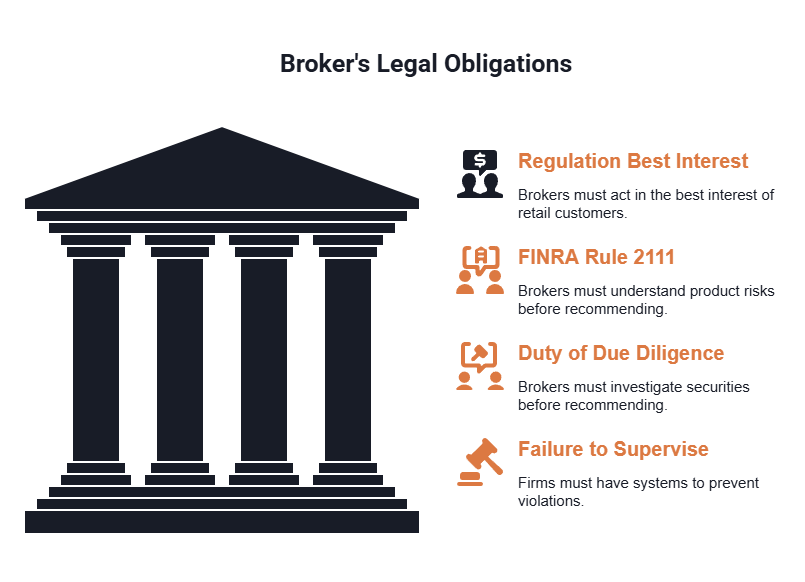
What the Law Requires: The Broker’s Legal Obligations
Registered brokers operate under a layered set of legal obligations before recommending any investment. When those obligations are not met, the broker and their firm can be held liable for resulting losses.
- Regulation Best Interest (Reg BI): Since June 2020, broker-dealers must act in the best interest of retail customers. The Care Obligation requires reasonable diligence before any recommendation. For complex or high-risk products like pre-IPO funds, that means real investigation, not a rubber stamp.
- FINRA Rule 2111 (Suitability): Brokers must have a reasonable basis for understanding a product’s risks before recommending it to anyone. A broker who recommends a private fund without verifying that its assets actually exist has not met this standard.
- Duty of Due Diligence: FINRA has stated plainly that a broker-dealer “has a duty to conduct a reasonable investigation concerning” any security it recommends. That duty is heightened for illiquid, non-public investments. Verifying a fund manager’s claims with the company or its transfer agent is not a high bar, it is a phone call.
- Failure to Supervise (FINRA Rules 3110 and 3120): Liability does not stop with the individual broker. Firms must maintain supervisory systems designed to catch and prevent exactly these kinds of violations. When those systems fail, the firm itself bears liability. A regulated firm is often a far more practical source of recovery than an individual broker.
What Arbitration Means for Your Claim
Most investors who open accounts at broker-dealers sign account agreements that include mandatory arbitration clauses. These clauses require that disputes be resolved through FINRA’s arbitration process rather than in court.
This is not necessarily a disadvantage. FINRA arbitration is typically faster and less expensive than federal litigation. Hearings are conducted before a panel of arbitrators rather than a jury, and the process can move from filing to a final award in a fraction of the time required by the court system.
To pursue a FINRA arbitration claim, an investor files a Statement of Claim with FINRA that describes the facts, the legal theories, and the damages sought. The broker-dealer has an opportunity to respond, and both sides conduct discovery, including the production of trade records, account statements, and internal correspondence.
Unlike criminal proceedings, where the government prosecutes the fraud perpetrator, arbitration is initiated by the investor. The investor controls the timeline and the strategy. Arbitration hearings are typically scheduled within months of the initial filing, not years.
Our lawyers are nationwide leaders in investment fraud cases.
Using the Forge/Sestante Case as a Framework
The Forge Securities and Sestante Capital situation illustrates how broker liability works in practice for pre-IPO fraud.
Giovanni Pennetta, the managing partner of Sestante Capital and NextGenTech Investments, pleaded guilty to defrauding investors who were promised economic exposure to Anduril Industries shares that did not exist. The fraud perpetrator is now in the criminal justice system.
But many investors were introduced to Pennetta’s fund through registered brokers at Forge Securities, a FINRA-member broker-dealer. Those brokers had obligations. They were required under Reg BI and FINRA’s suitability rules to investigate the investment before recommending it. They were required to verify whether the fund’s claimed Anduril share holdings were real. Anduril Industries had publicly stated that any investment offer not coming directly from Anduril is “very likely a scam.” That warning existed before investors lost their money.
The question FINRA arbitration is designed to answer is whether the broker met those obligations. If the broker recommended the fund without performing meaningful due diligence, and if the firm’s supervisory systems allowed that to happen, investors may have a viable claim for their losses regardless of what happens in Pennetta’s criminal case.
We Are The firm other lawyers
call for support.
Evaluating Your Potential Claim
The following Important Points can help you evaluate whether you have a claim against a broker or broker-dealer:
- Registration Status: Was the person registered with FINRA or the SEC? You can verify this through BrokerCheck or the IAPD.
- Active Recommendation: Did the broker specifically suggest the investment?
- Fees and Commissions: Did the broker receive compensation, such as the 7–10% commissions often seen in DSTs or Bluerock funds?
- Accuracy of Information: Were you told the investment was “safe” or “guaranteed” when it was actually high-risk?
- Timeliness: Most claims have a six-year eligibility limit from the date of the event.
Meyer Wilson Werning has recovered more than $350 million for investors across the country. Our team investigates how products were sold and whether firms met their supervisory duties. If a licensed broker recommended a fund that turned out to be fraudulent. Contact us today for a free and confidential consultation.
Frequently Asked Questions

Can I still bring an arbitration claim if the fraudster has been criminally charged?
Yes. Criminal prosecution and arbitration are separate proceedings. The government pursues criminal charges, while you pursue your own civil claim against the broker who recommended the investment.
What if the brokerage firm claims they were unaware the fund was fraudulent?
A firm’s lack of knowledge does not defeat a claim. The issue is whether the broker performed the due diligence legally required before making the recommendation. Failure to investigate is often considered negligence
What is the difference between a criminal restitution order and an arbitration award?
A restitution order depends on the fraudster’s personal assets, which are often depleted. An arbitration award is issued against a regulated broker-dealer, which typically has the financial means or insurance to pay the award.
How long does the arbitration process typically take?
While timelines vary, most arbitration cases reach a final hearing within 12 to 18 months. This is significantly faster than traditional court litigation, which can take several years.
Recovering Losses Caused by Investment Misconduct.