

David P. Dahill, the chief executive of Realized Financial, Inc., has been named in three customer complaints since 2024, each alleging that investors were put into products that weren’t suitable for them or weren’t fully explained. The earliest, involving the NP Skyloft Delaware Statutory Trust, has already settled, while the other two are still pending. Together the three complaints seek nearly $1.4 million in damages.
If you invested through Dahill or Realized Financial, the records below can help you understand what other investors are alleging and whether your own account deserves a closer look. Investors who believe they were harmed by broker misconduct generally have the right to pursue recovery through FINRA arbitration.
What Do Current Disclosures Report About David Dahill?
Dahill entered the securities industry in 2016 and has been registered with Realized Financial, Inc. since 2019. More recent records identify Dahill as CEO and FINOP of Realized Financial, with reported start dates in January 2024 and February 2024. A 2020 SEC Form D filing also lists David Dahill in connection with Thornhill Securities, Inc., a name previously associated with the firm.
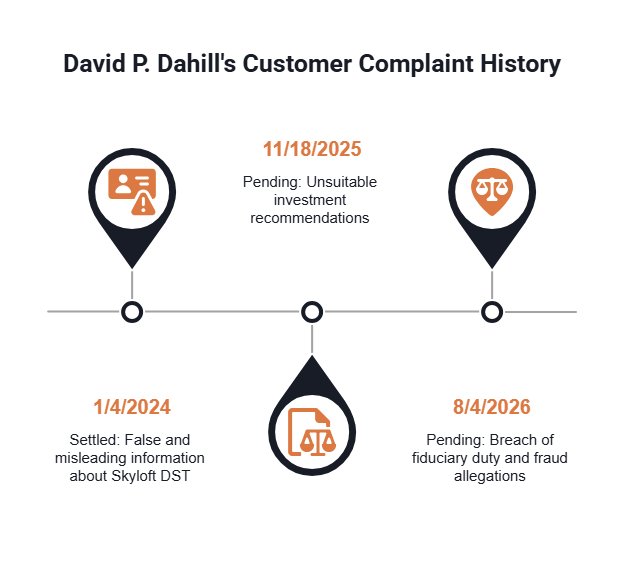
David P. Dahill (CRD# 6581024) has at least 3 customer complaint disclosures on record, based on available reporting:
- 8/4/2026 (Pending): Claimants allege breach of fiduciary duty, lack of suitability, fraud, negligence, misrepresentation, omission of material information, failure to supervise, and breach of contract. Alleged Damages: $280,000
- 11/18/2025 (Pending): Claimant alleges unsuitable recommendations made in connection with their investment. Alleged Damages: $500,000
- 1/4/2024 (Settled): Information provided to claimants was allegedly false and misleading and allegedly failed to fully and properly disclose the risks of investing in Skyloft DST, including a breach of fiduciary duty by withholding information. Alleged Damages: $600,000

We Have Recovered Over
$350 Million for Our Clients Nationwide.
What Do Past Settlements Indicate for Realized Financial Investors?
The complaints against Dahill may raise questions about supervision. Under FINRA Rule 3110, broker-dealers must set up and keep a system to supervise the actions of each associated person. The system must be reasonably designed to help the firm comply with applicable securities laws and regulations. If an associated person allegedly recommended an unsuitable product without adequate investigation or enough risk disclosure, the firm’s supervisory procedures may also be examined.
The complaint’s allegations about misleading statements and inadequate risk disclosures point to a dispute about what investors were told versus what a reasonable review of the underlying offering materials and risks would have shown. While settlement does not prove supervision problems, investors who bought similar Realized Financial investment products may want to review their own account statements, offering documents, and disclosures.
How Meyer Wilson Werning Can Help
Investors who lost money through recommendations made by David Dahill or through Realized Financial, Inc. may have options to pursue recovery. Meyer Wilson Werning represents investors nationwide in arbitration proceedings and has recovered more than $350 million for clients across the country over the last 26 years.
Meyer Wilson Werning uses a contingency fee model, which means there is no cost to you if we are unable to recover your losses. Contact us today for a free and confidential consultation to discuss your options.
Our lawyers are nationwide leaders in investment fraud cases.
Frequently Asked Questions
What allegations were reported against David Dahill?
The reported allegations involve an NP Skyloft Delaware Statutory Trust recommendation and include claims of inadequate or unreasonable product investigation, allegedly misleading or incomplete information, failure to disclose investment risks, unsuitable investment recommendations, and alleged breach of fiduciary duty. The available materials do not identify a final finding that the allegations were proven.
Does Regulation Best Interest apply to recommendations made by David Dahill?
Regulation Best Interest applies to covered recommendations made to retail customers on or after June 30, 2020. Whether it applies to a specific recommendation depends on the recommendation date, the type of transaction, customer classification, and other facts. The available materials do not show when the specific NP Skyloft DST recommendation was made.
What is a Delaware Statutory Trust, and why do these investments lead to complaints?
A Delaware Statutory Trust, or DST, is a legal structure that lets several investors own fractional interests in a large property, such as an apartment complex or commercial building, that is managed by an outside sponsor. DSTs are often sold to investors completing a 1031 exchange, since they allow real estate sale proceeds to be reinvested while deferring capital gains taxes. They can also be illiquid, carry high upfront fees, and leave investors with no say in how the property is managed, which means much of an investor’s outcome depends on how carefully the broker vetted the offering and explained these risks before the sale. When those risks aren’t clearly disclosed, disputes tend to follow.
I invested through Realized Financial, but not in the NP Skyloft DST. Could I still have a claim?
Possibly. A recommendation can be challenged whenever it may have been unsuitable for the investor’s goals, risk tolerance, or financial situation, or when its risks weren’t adequately explained, regardless of the specific product involved. Claims can also be brought against the firm itself if it allegedly failed to reasonably supervise the brokers making those recommendations. Whether you have a viable claim depends on the details of your account, which is why a review of your statements and offering documents is usually the first step.
Recovering Losses Caused by Investment Misconduct.