


The Savannah Shoals conservation easement case reached a new milestone on July 16, 2026, when the U.S. Court of Appeals for the Eleventh Circuit affirmed a Tax Court ruling that cut a claimed $23 million charitable contribution deduction down to $480,000 and kept in place a 40% gross valuation misstatement penalty.
For investors who joined this syndicated land donation through a private placement offering, the appellate decision raises questions about how the deal was structured, how the property was valued, and whether the risks were explained clearly before they invested.
Investors who suffered losses tied to syndicated conservation easement transactions may have options for private placement loss recovery.
What Happened in the Savannah Shoals Case
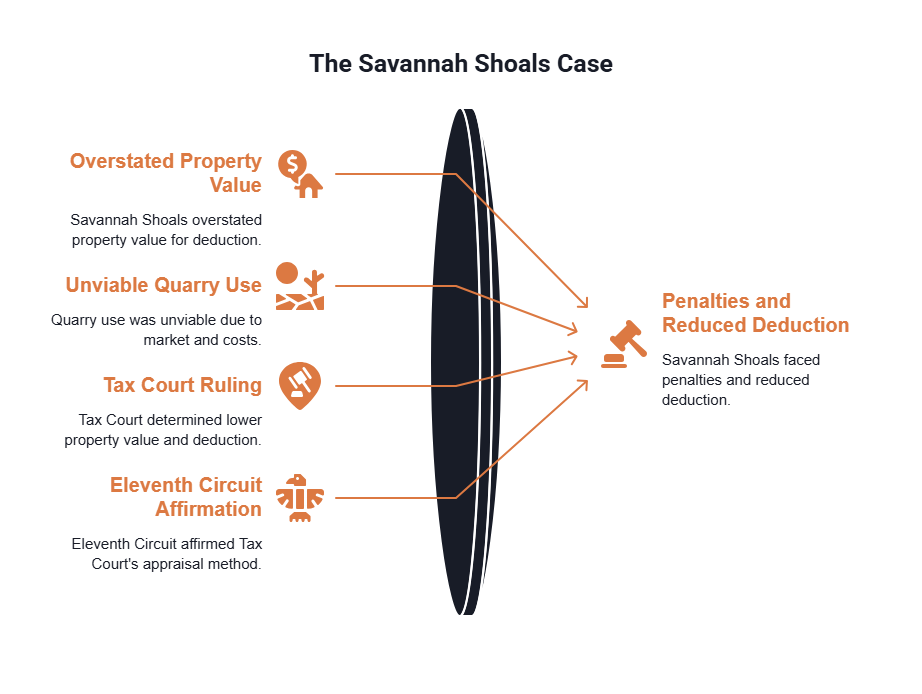
Savannah Shoals, LLC granted a conservation easement over a 103-acre tract in Hart County, Georgia, in 2017. The easement was donated to Southeast Regional Land Conservancy, Inc. On its tax return, the entity said the property’s highest and best use before the easement was as an aggregate or granite quarry and stated the property was worth about $23.1 million before the easement. Based on that appraisal, Savannah Shoals claimed a charitable contribution deduction of $23 million.
The IRS rejected that valuation and assessed a 40% gross valuation misstatement penalty. The case then went to the U.S. Tax Court. The court made these main findings:
- The quarry use was not viable because there was limited market demand, transportation costs were high, there was competition nearby, and the projections used by the taxpayer’s appraisers were not reliable.
- The before-easement value was $580,000, based on low-density residential and recreational uses. The after-easement value was $100,000, which led to a conservation easement value of $480,000.
Because the claimed $23 million deduction was more than 200% of the $480,000 value found by the court, the 40% penalty was upheld.
On July 16, 2026, the Eleventh Circuit affirmed in Savannah Shoals, LLC v. Commissioner, No. 24-12661 (11th Cir. 2026). The appellate court held that the Tax Court was not required to use a strict, fixed four-part appraisal test for highest and best use. Instead, it said the key question is whether a proposed use is reasonably probable, legal, physically possible, financially feasible, able to fit the property, and likely to be needed in the near future. The Eleventh Circuit agreed with the Tax Court’s use of market demand factors and did not require a separate quantitative profitability analysis for the proposed quarry plan.
According to IRS conservation easement guidance, courts have often allowed only a small portion of claimed deductions in disputed syndicated conservation easement transactions and have upheld large penalties.


We Have Recovered Over
$350 Million for Our Clients Nationwide.
What This Means for Investors
The Savannah Shoals appellate decision reinforces a pattern in which courts reject inflated valuations that depend on speculative development plans. If you invested in this or similar syndicated land donation transactions, the ruling can affect you in several ways.
In addition to tax consequences, the difference between the amount claimed and the value the court determined raises questions about how the deal was presented. Available reporting indicates that interests in the Savannah Shoals conservation easement were sold to investors through a private placement offering.
How Meyer Wilson Werning Can Help
Meyer Wilson Werning represents investors nationwide who have experienced losses due to their financial advisors, brokers or brokerage firms. With more than 75 years of combined experience and over $350 million recovered for clients, the firm’s attorneys can review whether investors have investor recovery legal options.
If you invested in a syndicated conservation easement and you are now facing a tax deduction disallowance, penalties, or questions about how the investment was recommended, contact us today for a free and confidential consultation to discuss your options.
Our lawyers are nationwide leaders in investment fraud cases.
Frequently Asked Questions
What happened in the Savannah Shoals conservation easement case?
The Eleventh Circuit affirmed a Tax Court ruling that reduced Savannah Shoals, LLC’s claimed $23 million conservation easement deduction to $480,000 and upheld a 40% gross valuation misstatement penalty. The courts found that the property’s proposed use as an aggregate quarry was not viable and that low-density residential and recreational uses provided the appropriate valuation basis.
Why was the $23 million conservation easement deduction reduced?
The courts rejected the assertion that the 103-acre Georgia property had an aggregate quarry as its highest and best use. The Tax Court determined the property was worth $580,000 before the easement and $100,000 afterward, producing a conservation easement value of $480,000. Factors such as limited market demand, transportation costs, nearby competition, and unreliable projections all contributed to the finding that the claimed syndicated land donation valuation was unsupported.
What does the Savannah Shoals ruling mean for investors in syndicated conservation easements?
The ruling demonstrates that a tax deduction tied to a syndicated conservation easement can be challenged when its valuation depends on a speculative or unsupported development use. Investors who participated in this or similar offerings should preserve offering documents, subscription records, tax materials, and all communications about how the investment’s risks and valuation were presented. These records may be relevant to potential investor recovery legal options.
Recovering Losses Caused by Investment Misconduct.