

Investors who worked with broker John Palma at Spartan Capital Securities or SW Financial are now confronting serious questions about their accounts. In March 2025, FINRA barred Mr. Palma from the securities industry after he allegedly failed to provide information and documents requested during a regulatory inquiry. That action arrived against a backdrop of a pending customer complaint at Spartan Capital Securities and a $10.3 million arbitration award previously entered against SW Financial in a separate dispute. Together, these developments are a clear signal for former clients to review their account records and assess whether they were harmed by excessive trading, unsuitable recommendations, or inadequate firm supervision.
If you held an account at Spartan Capital Securities or SW Financial and experienced losses tied to active stock trading, options strategies, or margin use, you should not wait. The experienced churning and excessive trading attorneys at Meyer Wilson Werning can help evaluate whether your losses are the result of actionable misconduct. Contact us today for a free and confidential consultation, and you pay nothing unless we recover for you.
What FINRA Rule 8210 Is and Why the John Palma Bar Matters
FINRA Rule 8210 is one of the most fundamental tools regulators have. It requires brokers and associated persons to provide information and documents when FINRA requests them during an examination or investigation. Refusing to cooperate, or failing to respond, is treated as a serious violation because it prevents regulators from doing their jobs.
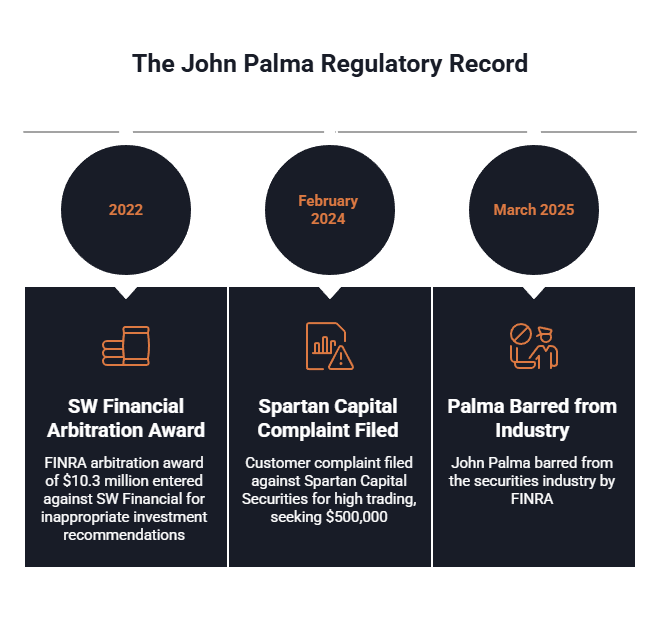
According to FINRA records, Mr. Palma (CRD# 6848651) allegedly did not provide the information and documents FINRA requested. The matter was resolved through a Letter of Acceptance, Waiver, and Consent, AWC No. 2019060753511, which FINRA accepted in March 2025. The underlying inquiry originated during a routine examination of Worden Capital. FINRA imposed an industry bar under Rules 8210 and 2010, which prohibits Mr. Palma from associating with any FINRA member firm in any capacity.
Public records show Mr. Palma held approximately seven years of industry experience as of March 31, 2025. His most recent registration was at Spartan Capital Securities, where he was affiliated from 2022 to 2025, following prior ties to SW Financial. An industry bar does not automatically resolve losses investors may have sustained, but it does give former clients reason to look closely at what happened in their accounts.

We Have Recovered Over
$350 Million for Our Clients Nationwide.
The Spartan Capital Securities Complaint: High Trading Allegations and $500,000 in Claimed Damages
A customer complaint filed in February 2024 against Mr. Palma at Spartan Capital Securities alleges high trading and seeks $500,000 in damages. High trading allegations are the foundation of churning claims, which arise when a broker generates excessive transactions in a client account for the purpose of earning commissions rather than serving the client’s interests.
Mr. Palma disputes the allegations in his FINRA disclosure statement, asserting that the customer authorized the trades, received trade confirmations, and understood the costs of the approach. According to FINRA records, the complaint remains pending. The bar against Mr. Palma also remains in place.
Customer authorization is a common defense in churning cases, but it is not a complete answer. FINRA Rule 2111 imposes a quantitative suitability obligation, which requires a broker to have a reasonable basis for the overall pattern of trading in an account, regardless of whether individual trades were approved. Even authorized trading can be excessive if the cumulative level of activity is inconsistent with the client’s investment profile, risk tolerance, and financial goals.
The SW Financial $10.3 Million Arbitration Award and What It Signals
A 2022 dispute tied to SW Financial involved allegations of inappropriate investment recommendations. A FINRA arbitration panel ordered the firm to pay $10.3 million. In his public disclosure statement, Mr. Palma notes that SW Financial was the only named respondent and states he was not identified in the statement of claim.
Firm-level awards of this magnitude reflect the potential scale of harm when unsuitable recommendations are made broadly. Whether any specific investor’s losses are tied to the conduct alleged in that matter is a factual question that requires account-level review. Former clients of SW Financial who experienced losses in connection with investment recommendations during the relevant period should document their records and consult with counsel about available options.
Our lawyers are nationwide leaders in investment fraud cases.
How High Trading Costs and Churning Harm Investors
Allegations involving excessive trading are measured against objective benchmarks. Experienced securities attorneys and independent analysts typically examine the following:
- Annualized turnover ratio: The number of times an account’s portfolio is bought and sold in a given year. High turnover in a retail account often signals that trading activity exceeded what was reasonably necessary.
- Cost-to-equity ratio: The percentage return an account must generate just to break even after commissions, markups, and fees. When this figure is high, the account is working against the investor from the outset.
- Use of margin: Borrowing to trade amplifies both potential gains and potential losses. When combined with high turnover, margin use can accelerate losses and add interest charges that compound the damage.
When these metrics point toward excessive trading, regulators and arbitration panels look to FINRA Rule 2111, which governs both suitability and quantitative suitability, meaning the overall pattern of recommendations, not just individual trades. Supervision obligations under FINRA Rule 3110 require that brokerage firms detect and prevent this kind of activity. When supervision breaks down, the firm can share responsibility for investor losses.
We Are The firm other lawyers
call for support.
How Meyer Wilson Werning Pursues Recovery for Investors
The FINRA bar entered against Mr. Palma, combined with the pending $500,000 complaint at Spartan Capital Securities and the $10.3 million arbitration award against SW Financial, creates a foundation for a careful account-level review. For investors who experienced losses tied to high-volume trading, margin use, or recommendations that seemed inconsistent with their financial goals, the question is not whether something went wrong. It is whether someone is held accountable for it.
With more than $350 million recovered for investors nationwide, Meyer Wilson Werning has spent over 25 years holding brokers and brokerage firms accountable for exactly this kind of misconduct. If you worked with John Palma at Spartan Capital Securities or SW Financial and suffered losses, contact us today for a free and confidential consultation. You pay nothing unless we recover for you.
Frequently Asked Questions
What led FINRA to bar John Palma from the securities industry?
According to AWC No. 2019060753511, accepted in March 2025, FINRA barred Mr. Palma under Rules 8210 and 2010 after he allegedly failed to provide information and documents requested during a regulatory examination. The inquiry originated during a routine examination of Worden Capital. The bar prohibits Mr. Palma from associating with any FINRA member firm in any capacity.
What does the February 2024 complaint against John Palma at Spartan Capital allege?
The February 2024 customer complaint alleges high trading in the account and seeks $500,000 in damages. Mr. Palma disputes the allegations, stating that the customer authorized the trades and was aware of the associated costs. The complaint remains pending according to FINRA records.
What was the $10.3 million FINRA arbitration award connected to SW Financial about?
A 2022 FINRA arbitration dispute involving SW Financial centered on claims of inappropriate investment recommendations. A FINRA arbitration panel ordered SW Financial to pay $10.3 million. Mr. Palma’s public disclosure states he was not named as a respondent in that claim.
How do I know if my account was churned?
Churning is identified through objective measures including annualized turnover ratios and cost-to-equity ratios. If your account was frequently traded and you consistently paid high commissions while your account value declined or stagnated, those patterns may support a churning claim under FINRA Rule 2111. An experienced securities attorney can conduct a detailed quantitative analysis of your account history.
How long do I have to bring a FINRA arbitration claim?
Under FINRA’s Code of Arbitration Procedure, investors generally have six years from the date of the event giving rise to the claim to file for arbitration. However, specific facts can affect this timeline. Acting promptly to consult with counsel is the safest approach to preserving your right to recovery.
Does it cost anything to have Meyer Wilson Werning review my case?
No. Meyer Wilson Werning operates on a pure contingency fee basis. There is no cost for an initial consultation, and you pay nothing unless the firm recovers for you.
Recovering Losses Caused by Investment Misconduct.