


Investors who participated in real estate debt offerings through Lighthouse Estates LLC may be facing devastating financial consequences. A federal lawsuit has been filed alleging that the company and its leadership orchestrated a Ponzi-style scheme to defraud private money lenders. According to the complaint, more than $1 million in private lender capital is reportedly at risk.
Meyer Wilson Werning is not currently able to represent investors in this specific matter, as the available facts do not indicate the involvement of a registered broker-dealer or brokerage firm. However, if a financial advisor or broker directed you to Lighthouse Estates LLC or a similar Ponzi scheme, you may have a separate claim, and we want to hear from you We are also committed to using our platform to bring public attention to cases like this one, because awareness is often the first line of defense against fraud. Contact us for a free and confidential consultation if a licensed professional was involved in your losses.
What Are the Allegations Against Lighthouse Estates LLC and Van Laurence Barker?
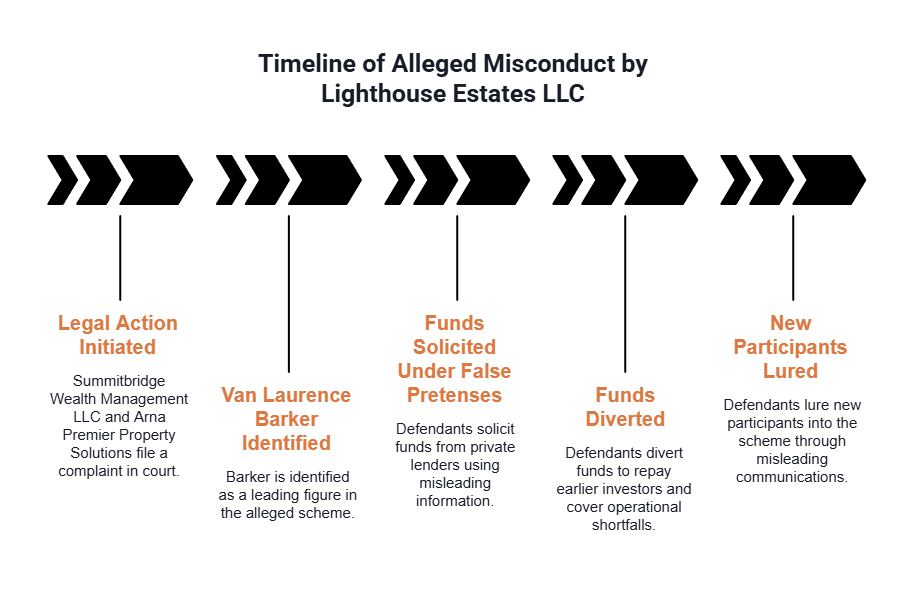
On January 9, 2026, a significant legal action was initiated in the United States District Court for the Eastern District of New York. The plaintiffs, Summitbridge Wealth Management LLC and Arna Premier Property Solutions, filed a complaint against Lighthouse Estates LLC and several associated individuals and entities.
Central to the lawsuit is Van Laurence Barker, who is identified in court filings as a leading figure in the alleged scheme. The complaint alleges that the defendants solicited funds from private lenders under false pretenses, purportedly for the acquisition and renovation of real estate properties.
However, the plaintiffs contend that instead of using the capital for its intended purpose, the defendants diverted incoming funds to:
- Repay earlier investors.
- Cover operational shortfalls within the enterprise.
- Fund activities through misleading communications that lured new participants into the scheme.

We Have Recovered Over
$350 Million for Our Clients Nationwide.
Misrepresentations and “Ponzi-Style” Tactics Revealed in the Complaint
The lawsuit underscores a pattern of deceptive behavior designed to hide the true financial health of the projects. According to the filing, the defendants allegedly misrepresented critical facts about property conditions and deliberately failed to record liens properly.
By failing to record these liens, the defendants could effectively mask the level of risk and prevent lenders from realizing their collateral was not secured as promised. This type of conduct often delays the detection of a failing enterprise, as investors are kept in the dark by a lack of transparency and inaccurate reporting.
The plaintiffs argue that these actions constitute a Ponzi-style scheme, where the survival of the operation depends on a continuous flow of new capital rather than legitimate business profits.
Legal Remedies and RICO Claims in the Eastern District of New York
Because of the alleged organized nature of the misconduct, the plaintiffs are pursuing securities litigation under the Racketeer Influenced and Corrupt Organizations Act (RICO). If liability is proven, RICO allows for treble damages (three times the actual losses), which serves as a powerful deterrent against financial fraud.
In addition to compensatory damages, the lawsuit requests several emergency court orders to protect remaining assets:
- Temporary Restraining Order (TRO) and Preliminary Injunction: To prevent the defendants from further dissipating or hiding assets.
- Appointment of a Receiver or Special Master: To take control of enterprise bank accounts and oversee financial records.
- Full Accounting: A court-ordered review of all funds received by the defendants since their operations began.
- Recovery of Costs: The plaintiffs are also seeking the recovery of legal fees and court costs.
Our lawyers are nationwide leaders in investment fraud cases.
Red Flags of Misconduct in Private Real Estate Notes
The allegations in the Lighthouse Estates LLC case mirror common “red flags” that often appear in fraudulent real estate offerings. Investors should be vigilant if they notice the following in their own portfolios:
- Unsuitability: High-risk private notes recommended to conservative investors or retirees.
- Lack of Transparency: Difficulty obtaining audited financials or verifiable records of how funds are being used.
- “Selling Away“: If a financial advisor promoted these notes without the knowledge or approval of their brokerage firm.
- Broken Promises: Assurances of “guaranteed” returns or “safe” investments that contradict the speculative nature of private real estate.
Brokerage firms have a legal duty to supervise their representatives under FINRA Rule 3110 and ensure all recommendations are suitable under FINRA Rule 2111. When they fail to do so, they may be held liable for the resulting investor damages through arbitration.
We Are The firm other lawyers
call for support.
Increasing Awareness and Support for Impacted Lenders
The allegations against Lighthouse Estates LLC serve as a stark reminder of how quickly private lending arrangements can become vehicles for fraud. We share cases like this one because investors deserve to know the warning signs, and because awareness is often what prevents the next victim.
Meyer Wilson Werning has spent more than 25 years uncovering fraud and holding negligent parties accountable. While the current facts of this case fall outside our direct scope of representation, if a licensed financial professional played a role in directing you to this investment, contact us. We offer free and confidential consultations, and we will tell you honestly whether we can help.
Frequently Asked Questions

What are the core allegations in the lawsuit against Lighthouse Estates LLC?
The plaintiffs allege that the defendants operated a Ponzi-style scheme by soliciting money for real estate projects but diverting those funds to repay other investors and cover operating costs. The complaint also claims the defendants misrepresented property conditions and failed to record liens.
Who is Van Laurence Barker?
Van Laurence Barker is identified in the federal complaint as a central figure who led the alleged fraudulent activities associated with Lighthouse Estates LLC.
What is a RICO claim?
A RICO claim refers to the Racketeer Influenced and Corrupt Organizations Act. In this case, the plaintiffs are using it to seek treble damages, which would triple the amount of their recovered losses if they prove the defendants engaged in a pattern of racketeering activity.
What is the role of a “receiver” in this case?
The plaintiffs have asked the court to appoint a receiver to take over the defendants’ bank accounts. A receiver’s job is to secure remaining assets, trace where the money went, and ensure that funds are preserved for potential distribution to victims.
Recovering Losses Caused by Investment Misconduct.