


On May 6, 2026, the Securities and Exchange Commission charged 21 individuals for their alleged roles in a wide-reaching insider trading scheme that spanned nearly a decade and resulted in millions of dollars in illicit profits. According to the SEC’s press release, the scheme involved the alleged misappropriation of confidential client information from multiple global law firms, then used to trade on more than a dozen pending corporate transactions.
If a licensed financial professional, broker, or advisor facilitated trades connected to this alleged scheme, the experienced securities litigation attorneys at Meyer Wilson Werning can help evaluate whether your losses are the result of actionable misconduct. Contact us today for a free and confidential consultation, and you pay nothing unless we recover for you.
What the SEC Alleges: Inside the Nourafchan Insider Trading Scheme
According to the SEC’s complaint, between 2018 and 2024, Nicolo Nourafchan, a mergers and acquisitions attorney based in Los Angeles, California, allegedly orchestrated a coordinated insider trading operation with his partner Robert Yadgarov, of Long Beach, New York.
The complaint alleges that Nourafchan misappropriated material nonpublic information from his law firm’s clients involving more than twelve pending corporate transactions. According to the SEC, he or Yadgarov then tipped that information to other participants in the scheme, who agreed to kick back a portion of their trading profits, or who in turn passed the information to additional traders.
The complaint further alleges that Nourafchan and Yadgarov recruited a second corporate attorney who also allegedly misappropriated confidential deal information and passed it along to the scheme’s organizers.
“Today’s action highlights the SEC’s unwavering commitment to uncovering sprawling schemes, like the one alleged here, and holding individuals up and down the tipping chain accountable for their fraudulent conduct,” said Joseph G. Sansone, Chief of the Division of Enforcement’s Market Abuse Unit.

We Have Recovered Over
$350 Million for Our Clients Nationwide.
The Scale of the Alleged Scheme: 21 Defendants, 6 Countries
The SEC’s complaint was brought by the Division of Enforcement’s Market Abuse Unit and filed in U.S. District Court for the District of Massachusetts. The charges include violations of the antifraud provisions of the federal securities laws. The SEC is seeking injunctive relief, disgorgement with prejudgment interest, and civil penalties.
In a parallel action, the U.S. Attorney’s Office for the District of Massachusetts announced criminal charges against all defendants named in the SEC complaint.
The case reflects coordination across multiple international regulators, including the Danish Financial Supervisory Authority, the United Kingdom Financial Conduct Authority, the Cyprus Securities and Exchange Commission, the Mauritius Financial Services Commission, and the Swiss Financial Market Supervisory Authority, as well as FINRA and the FBI domestically.
What Is Insider Trading and How Does It Harm Investors?
Insider trading occurs when someone trades on material nonpublic information, information that is not yet available to the general public and that would likely affect a reasonable investor’s decision to buy or sell a security. When insiders trade on this information ahead of public announcements, they gain an unfair advantage over ordinary investors who are trading without that knowledge.
This type of misconduct distorts markets and can cause direct harm to investors on the other side of those trades. It also reflects a broader failure of oversight within the institutions, whether law firms, broker-dealers, or financial advisors, that are entrusted with confidential information.
Our lawyers are nationwide leaders in investment fraud cases.
What Investors Should Watch For
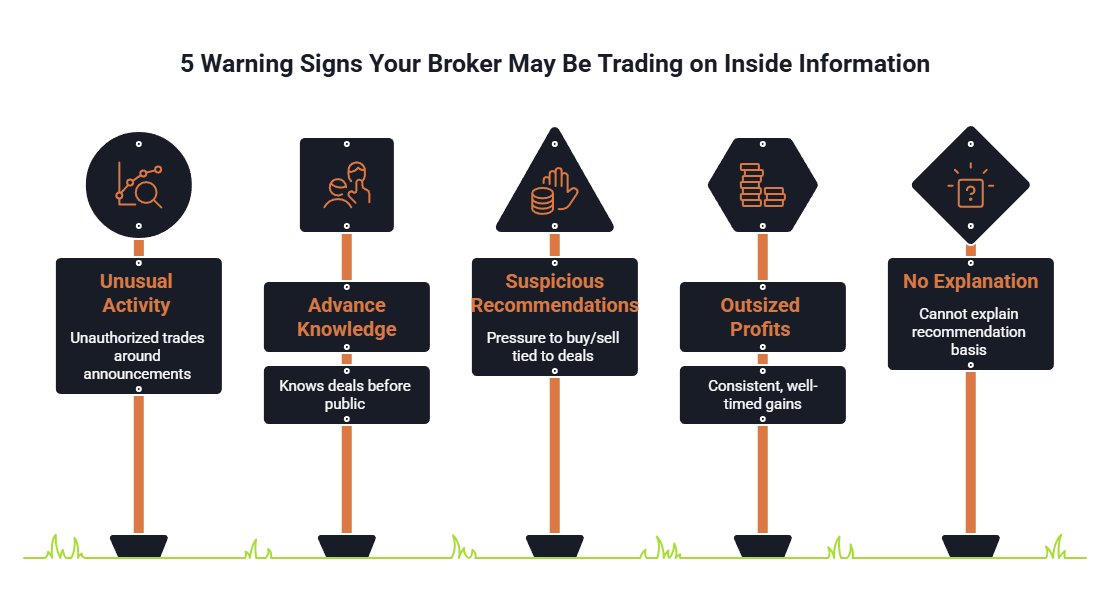
Cases like this are a reminder that securities fraud is not always the work of outsiders. Sometimes it originates within the professional networks that investors trust most. Warning signs that your investments may have been affected by insider trading or related misconduct include:
- Unusual trading activity in your account around the time of corporate announcements
- A broker or advisor who seems to have advance knowledge of deal activity
- Recommendations to buy or sell specific stocks tied to merger or acquisition targets
- Account statements showing trades that generated outsized short-term profits
- A financial professional who cannot explain the basis for a recommendation
If any of these apply to your situation, preserving your account records and contacting experienced counsel promptly is the right first step.
We Are The firm other lawyers
call for support.
How Meyer Wilson Werning Can Help
When securities fraud reaches into the professional networks that investors depend on, the harm to ordinary investors can be real and significant. Individuals who traded in the securities at issue in this matter, or who worked with financial professionals connected to this alleged scheme, may have civil claims worth pursuing.
With more than $350 million recovered for investors nationwide, Meyer Wilson Werning has spent over 25 years holding the individuals and institutions behind securities fraud accountable. If you believe your investments were affected by insider trading or related misconduct by a licensed financial professional, contact us today for a free and confidential consultation. You pay nothing unless we recover for you.
Frequently Asked Questions
What is the SEC alleging in this case?
According to the SEC’s complaint, Nicolo Nourafchan and his co-defendants allegedly misappropriated confidential deal information from multiple global law firms and used it to trade profitably on more than twelve pending corporate transactions between 2018 and 2024. The charges include violations of the antifraud provisions of federal securities laws.
Have any defendants pleaded guilty?
Not as of the time of this writing. The charges and allegations in the complaint are accusations only. All defendants are presumed innocent unless and until proven guilty in court.
What is material nonpublic information?
Material nonpublic information, often called MNPI, is information about a company that has not been disclosed to the public and that would likely influence an investor’s decision to buy or sell its securities. Trading on MNPI is illegal and is the core of any insider trading case.
Can ordinary investors be harmed by insider trading?
Yes. When insiders trade ahead of major corporate announcements, they take positions at the expense of investors on the other side of those trades who are operating without the same information. In some cases, this creates direct financial harm that may support civil claims.
What should I do if I think my broker was involved in this type of activity?
Preserve all account statements, trade confirmations, and communications with your broker or advisor. Then contact an investment fraud attorney to evaluate whether you have actionable claims. Time limits apply to securities claims, so acting quickly matters.
Recovering Losses Caused by Investment Misconduct.