


The U.S. Treasury Department’s Office of Foreign Assets Control (OFAC), in coordination with the State Department has announced a new round of sanctions against the Prince Group, a Cambodia-based network designated as a Transnational Criminal Organization, as part of an ongoing federal enforcement campaign targeting online investment fraud and cryptocurrency money laundering.
This page explains what the Prince Group and Huione Group sanctions mean, how these networks allegedly facilitated pig-butchering schemes and crypto fraud targeting American investors, and what legal avenues may exist for those who suffered losses.
U.S. Sanctions Against the Prince Group: A Timeline of Escalating Enforcement
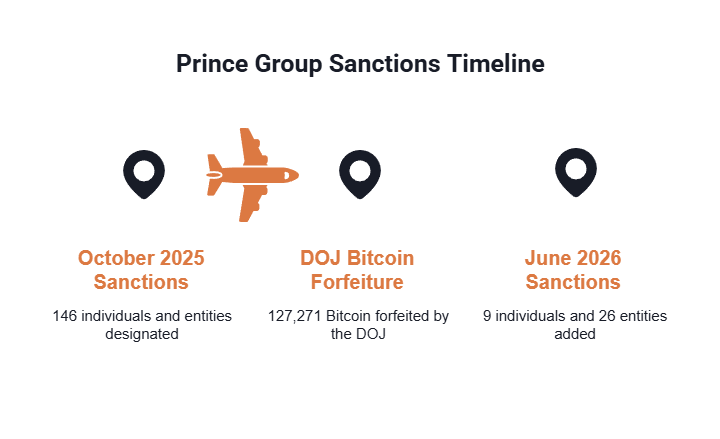
The federal government’s campaign against the Prince Group has moved with unusual speed and scale:
- October 2025: The Office of Foreign Assets Control (OFAC) designated 146 individuals and entities within the Prince Group Transnational Criminal Organization, led by Cambodian national Chen Zhi. The United States and the United Kingdom jointly sanctioned the Prince Group and its chairman, freezing assets and designating affiliated entities, including resorts and casinos allegedly linked to scam compound operations, torture, and human trafficking.
- Department of Justice Forfeiture Action: The DOJ filed a civil forfeiture lawsuit targeting 127,271 Bitcoin allegedly laundered by Chen Zhi and the Prince Group network. According to the U.S. State Department press statement on dismantling Prince Group TCO and Huione Group, this represents the largest cryptocurrency forfeiture actions in DOJ history.
- June 23, 2026: The State Department announced additional Prince Group sanctions on nine individuals and 26 entities tied to the network’s scam compounds and cyber-enabled fraud operations. These actions were taken under Executive Order 14390 on combating cybercrime and fraud against American citizens, and Executive Order 13581 on blocking the property of transnational criminal organizations.
These designations are designed to freeze assets, restrict access to the U.S. financial system, and publicly identify the actors behind the schemes. Sanctions alone do not compensate investors, but they create a foundation that private litigation and asset tracing can build upon.

We Have Recovered Over
$350 Million for Our Clients Nationwide.
Huione Group’s Role in Cryptocurrency Money Laundering
Huione Group, a Cambodia-based financial services conglomerate, allegedly served as the money-laundering backbone for scams run through the Prince Group network. According to federal regulators, Huione Group platforms, including Huione Pay and its successor entity H-Pay Service PLC, allegedly laundered proceeds from virtual currency scams and cyber heists on behalf of malicious actors.
Those actors included criminals linked to the Democratic People’s Republic of Korea. U.S. authorities invoked section 311 of the USA PATRIOT Act to sever Huione Group from the U.S. financial system, and the June 2026 action proposes prohibiting U.S. dollar accounts for H-Pay Service PLC and all successor entities. Scam actors allegedly used these platforms to transfer and conceal stolen assets, layering transactions through offshore entities to obscure the money trail.
For those who lost money in these schemes, the Huione Group sanctions publicly identify the financial infrastructure through which stolen funds allegedly moved. That public record can be critical for civil asset-tracing efforts, a key component of any recovery strategy in cross-border fraud cases.
How Pig-Butchering Schemes and Cambodia Scam Compounds Target American Investors
The Prince Group sanctions have drawn public attention to the mechanics of pig butchering, a form of cyber-enabled fraud in which scammers build fake personal or romantic relationships with victims online before steering them toward fraudulent investment platforms, typically involving cryptocurrency.
Courtney Werning, named principal at Meyer Wilson Werning, recently discussed pig butchering on the Easy Prey Podcast with Chris Parker. Listen or watch the full podcast:
Here is how these schemes typically operate:
- Initial contact: Victims receive unsolicited messages via social media, dating apps, or messaging platforms from individuals posing as friends, romantic interests, or successful investors.
- Relationship building: The scammer cultivates trust over days or weeks, sharing fabricated stories of personal wealth generated through crypto trading or other investments.
- Fake platform introduction: The victim is directed to a fraudulent trading platform, often a convincing replica of a legitimate exchange, where early “returns” are fabricated to encourage larger deposits.
- Escalation: Victims are pressured to invest more, sometimes borrowing money or liquidating retirement accounts. Withdrawal requests are met with demands for additional “fees” or “taxes.”
- Disappearance: Once the victim can no longer contribute funds, the scammer and platform vanish. Funds have already been routed through layered cryptocurrency transactions, often via services like Huione Pay, to wallets controlled by the criminal network.
According to the U.S. State Department, Prince Group TCO members own or profit from scam compounds in Cambodia where workers, many of whom are themselves victims of human trafficking, are forced to carry out these schemes under threat of physical violence. The FBI’s Internet Crime Complaint Center reported that Americans lost more than $8.6 billion to investment fraud in 2025 alone, making it the single largest category of cybercrime loss for the year.
Our lawyers are nationwide leaders in investment fraud cases.
How Meyer Wilson Werning Can Help
Recovering money lost to transnational fraud networks like the Prince Group requires legal counsel that understands both the complexity of cryptocurrency tracing and the realities of cross-border enforcement. Courtney M. Werning, a partner at Meyer Wilson Werning, focuses on representing those harmed by crypto fraud, digital asset scams, and online investment schemes, including pig-butchering operations tied to foreign criminal networks.
Meyer Wilson Werning represents investors through arbitration and securities litigation, which means the firm can pursue claims against licensed brokers, registered investment advisers, and U.S.-regulated platforms that may have played a role in your losses. If a licensed financial professional, broker, or advisor directed you toward an investment that turned out to be connected to a pig-butchering scheme or cryptocurrency fraud network, contact us today for a free and confidential consultation. You pay nothing unless we recover for you.
We Are The firm other lawyers
call for support.
Frequently Asked Questions
What are the recent U.S. sanctions against the Prince Group?
The U.S. has designated the Cambodia-based Prince Group as a Transnational Criminal Organization and imposed multiple rounds of sanctions on its network. In October 2025, OFAC sanctioned 146 individuals and entities tied to the group. In June 2026, the State Department announced additional designations targeting nine individuals and 26 entities connected to Cambodia-based scam compounds.
How is Huione Group involved in the Prince Group sanctions?
Huione Group is a Cambodia-based financial conglomerate that allegedly laundered proceeds from cryptocurrency scams on behalf of actors tied to the Prince Group. U.S. authorities invoked section 311 of the USA PATRIOT Act to propose severing Huione Group, including Huione Pay and H-Pay, from the U.S. financial system.
What are Cambodia scam compounds linked to the Prince Group?
According to U.S. regulators, Prince Group TCO members own or profit from compounds in Cambodia that house large-scale online fraud operations. These compounds have been associated with human trafficking and forced labor, with workers allegedly coerced into running pig-butchering schemes and investment scams targeting victims worldwide.
How do U.S. sanctions on Prince Group and Huione Group affect cryptocurrency money laundering?
The sanctions target the financial infrastructure that allegedly moves stolen cryptocurrency from fraud victims to criminal networks. Stolen funds were reportedly routed through Huione Pay and H-Pay to obscure their origin. Public OFAC designations also create a roadmap that supports civil asset tracing and litigation by those who lost money.
Recovering Losses Caused by Investment Misconduct.