


RBC Capital Markets, one of the largest broker-dealers operating in the United States, was censured and sanctioned by FINRA after the regulator found that the firm failed to maintain an anti-money laundering program reasonably designed to detect and report suspicious transactions.
According to FINRA, the deficiencies persisted from February 2016 through September 2023, a period spanning more than seven years during which three separate transaction-monitoring rules allegedly operated with design and oversight flaws that prevented them from functioning as intended.
Investors who believe they were affected by supervisory or compliance failures at a brokerage firm may want to learn more about broker misconduct and the options available for pursuing recovery.
What Happened With the RBC Capital Markets FINRA Sanction
On July 28, 2026, FINRA published an Acceptance, Waiver, and Consent (AWC) letter in which RBC Capital Markets, LLC (CRD# 31194) consented to a censure and a $275,000 fine without admitting or denying the findings. The matter was assigned case number 2022075967301 and originated from a routine FINRA cycle examination rather than a stated finding that money laundering actually occurred.
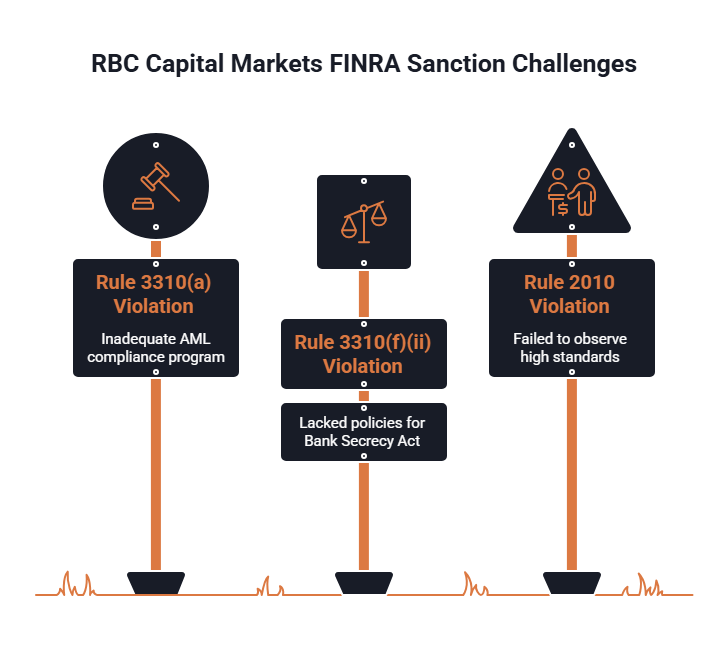
FINRA alleged that RBC violated three rules:
- FINRA Rule 3310(a), which requires member firms to develop and implement a written AML compliance program reasonably designed to detect and cause the reporting of suspicious activity.
- FINRA Rule 3310(f)(ii), which requires firms to include policies, procedures, and internal controls reasonably designed to achieve compliance with the Bank Secrecy Act and its implementing regulations.
- FINRA Rule 2010, which requires member firms to observe high standards of commercial honor and just and equitable principles of trade.
According to FINRA’s September 2026 disciplinary report, the firm introduced three automated transaction-monitoring rules in 2016, each of which was intended to flag different categories of suspicious activity. FINRA found that design flaws and inadequate internal coordination allowed the rules to remain ineffective for years.
“FINRA’s sanction describes long-running gaps in AML governance, including suspicious activity monitoring rules that were not functioning as intended and internal coordination failures that allowed the issues to continue. For affected investors, regulatory findings like these may raise questions about whether account activity was properly reviewed and escalated. Anyone who believes they were impacted should speak with counsel to review the facts and discuss potential options for investor compensation for regulatory violations.”

We Have Recovered Over
$350 Million for Our Clients Nationwide.
How Three Monitoring Rules Failed
FINRA described three monitoring rules and the defects in each.
The rule aimed at accounts moving funds without securities trading was intended to detect money moving in and out without corresponding trading activity, which can indicate use of a brokerage account to move illicit funds. FINRA found it relied on margin balance rather than total account balance, which generally limited its ability to generate useful alerts.
The rule aimed at nearly matching credits and debits was designed to flag accounts where incoming and outgoing transfers were nearly equal in size, a common indicator of pass-through activity. FINRA found the credit threshold was set too high, causing the rule to miss many transactions it was intended to capture.
The rule aimed at high-volume journal transactions was intended to flag accounts with an unusually high number of internal cash transfers, or journal transactions, which can indicate unauthorized movement of funds to third parties. FINRA found it generated excessive false positives by flagging routine transfers between accounts owned by the same customer or related parties, making it harder for compliance staff to distinguish legitimate activity from genuinely suspicious patterns.
FINRA also found a structural coordination failure within RBC’s compliance operation. One internal group assessed the monitoring rules’ effectiveness, while a separate group handled decommissioning rules that were not working properly. FINRA said the groups lacked procedures to coordinate findings or escalate concerns, allowing the defective rules to remain in place for years.

How Meyer Wilson Werning Can Help
A regulatory sanction from FINRA doesn’t automatically mean that individual investors are entitled to compensation. However, investors who suffered losses connected to supervisory or compliance failures at a brokerage firm may have the right to pursue recovery through arbitration or other legal channels.
Meyer Wilson Werning represents investors nationwide and has a proven track record, having recovered more than $350 million for clients across the country over the last 26 years. The firm’s attorneys have more than 75 years of combined experience handling investor claims involving regulatory violations, broker misconduct, and related matters.
If you held accounts at RBC Capital Markets during the period covered by FINRA’s findings and experienced unexplained losses or suspicious account activity, contact us today for a free and confidential consultation to discuss your options.
Our lawyers are nationwide leaders in investment fraud cases.
Frequently Asked Questions

What did FINRA find that RBC Capital Markets did wrong?
FINRA found that RBC Capital Markets failed to maintain an anti-money laundering compliance program reasonably designed to detect and cause the reporting of suspicious transactions. The findings concerned three automated transaction-monitoring rules that were configured or supervised inadequately from February 2016 through September 2023.
How much was the FINRA fine against RBC Capital Markets?
FINRA censured RBC Capital Markets and imposed a fine of $275,000 under an AWC dated July 28, 2026. RBC consented to the sanctions without admitting or denying the findings.
Did FINRA find that money laundering occurred at RBC Capital Markets?
No. FINRA described failures to identify, investigate, and report suspicious transactions that the monitoring rules were intended to detect, but the regulator did not allege that money laundering occurred and did not state how many transactions were missed.
What were the specific problems with the monitoring rules?
One rule used margin balance instead of total account balance as its threshold, a second rule set credit thresholds too high to capture many intended transactions, and a third rule produced excessive false positives from routine internal transfers. FINRA also found that the internal groups responsible for evaluating and decommissioning ineffective rules didn’t coordinate or escalate concerns.
Recovering Losses Caused by Investment Misconduct.