


The Meta-1 Coin fraud case stands as one of the most consequential cryptocurrency enforcement actions in recent federal history. Robert Dunlap, a 55-year-old Houston, Texas man, was sentenced to 23 years in federal prison after a jury convicted him of orchestrating a digital asset scheme that defrauded nearly 1,000 investors out of more than $20 million. What makes this case particularly striking is not just its scale, but the fact that the SEC had already brought a civil action against Dunlap years before federal prosecutors shut him down. Hundreds of people lost money to this scheme even after regulators had raised the alarm.
If you suffered significant losses in a cryptocurrency scheme, the cryptocurrency fraud attorneys at Meyer Wilson Werning can help evaluate whether your losses, particularly if a licensed financial professional, broker, or advisor facilitated your investment, are the result of actionable misconduct. Contact us today for a free and confidential consultation, and you pay nothing unless we recover for you.
What Was the Meta-1 Coin Scheme and Who Was Behind It?
Between 2018 and 2023, Robert Dunlap promoted and sold a digital token called Meta-1 Coin through an investment vehicle he created and controlled called the Meta-1 Coin Trust. He reached potential investors through social media, in-person seminars, and an Internet radio show, casting a wide net designed to reach people searching for the next big opportunity in digital assets.
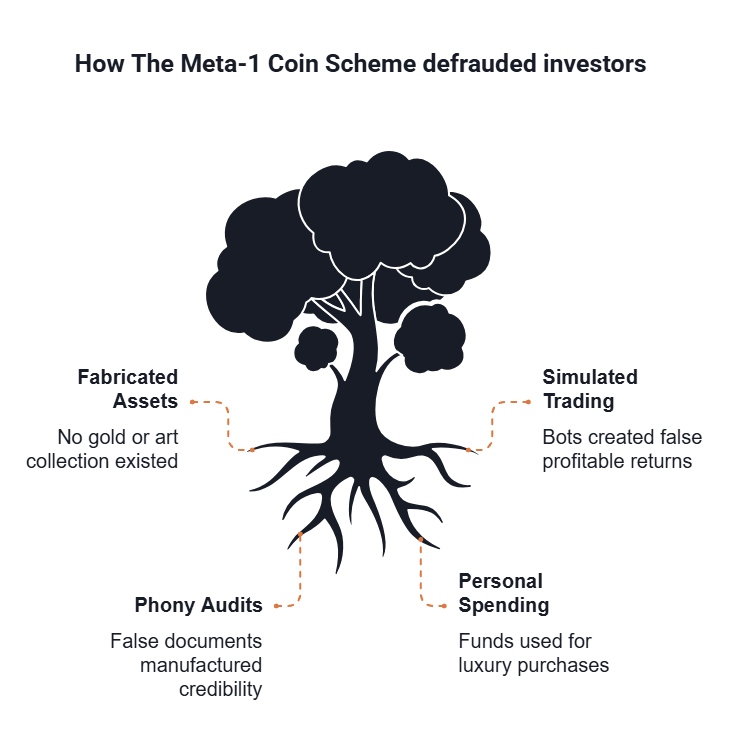
The pitch was built on extraordinary claims. Dunlap told investors that Meta-1 Coin was backed by $44 billion in gold reserves and a $1 billion art collection featuring works by Picasso, Dalí, and Van Gogh. He also told investors the coin was “fully guaranteed” and capable of generating returns of as much as 224,923%. He supported those claims with fabricated audit documents, phony insurance materials, and falsified records of art and gold ownership.
Federal prosecutors established that the entire operation was fraudulent. There was no gold. There was no art collection. The promised asset backing did not exist.

We Have Recovered Over
$350 Million for Our Clients Nationwide.
How Did Dunlap Make the Scheme Appear Legitimate?
The engineering behind the deception was deliberate and layered. Dunlap created a website called Meta Exchange, which used automated trading bots to simulate activity and make it appear that Meta-1 Coin was producing profitable returns. According to the Forbes reporting on the case, coins were never actually distributed to investors at all. The appearance of a functioning marketplace was a fabrication, sustained by software designed to mislead anyone who checked.
To further manufacture credibility, Dunlap provided phony third-party audit documents and false legal certifications attributed to a purported accounting firm. These materials gave investors the impression that an independent professional had reviewed and verified the scheme’s underlying assets, when in reality no such review had occurred. Investor funds were not being managed or invested. According to the evidence at trial, they were being spent on personal luxury purchases, including a Ferrari.
Why Did the Scheme Continue After the SEC Acted in 2020?
This is one of the most sobering dimensions of the Meta-1 Coin case. The SEC filed a civil fraud action against Dunlap in 2020, obtaining temporary orders against him for selling unregistered securities and producing phony audit documentation. That civil action was public. The SEC’s charges were a matter of record.
Yet Dunlap continued to operate his scheme and brought in hundreds more investors after those civil charges were filed. The criminal case that ultimately ended his operation was not commenced until 2024. The gap between the 2020 civil action and the 2024 criminal charges represents years during which people who may not have known about the SEC case continued to place money into a scheme that regulators had already identified as fraudulent.
This underscores a critical investor protection point: a civil regulatory action does not automatically halt an ongoing fraud. Searching the SEC’s Investment Adviser Public Disclosure database and the FINRA BrokerCheck system before investing would have shown that Dunlap was not registered as a broker or investment advisor, and that the SEC had already taken civil enforcement action against him. That information was available to anyone who looked.
Our lawyers are nationwide leaders in investment fraud cases.
How Did the Criminal Case Against Dunlap Proceed?
IRS Criminal Investigation (IRS-CI) led the federal probe, tracing the flow of investor funds and building the evidentiary record that demonstrated the supposed asset backing was entirely fictitious. A federal jury in the Northern District of Illinois convicted Dunlap on mail fraud charges. The prosecution was handled by Assistant U.S. Attorneys Jared Hasten and Paige Nutini.
At sentencing, IRS-CI Special Agent-in-Charge Adam Jobes submitted a memorandum that captured the human dimension of the case plainly: “Robert Dunlap didn’t just take money. He took years of hard work, trust, and financial security from his victims. He used lies and deception to pull in millions, leaving some investors with nothing. Crimes like this don’t just hit bank accounts. They upend lives.”
We Are The firm other lawyers
call for support.
What Sentence Did Robert Dunlap Receive?
U.S. District Judge LaShonda A. Hunt sentenced Dunlap to 23 years, or 276 months, in federal prison. The U.S. Sentencing Commission’s 2024 report on Cyber Technology in Federal Crime places the average sentence for fraud involving cyber technology at 36 months. Dunlap’s term is roughly eight times that benchmark, a direct reflection of the scheme’s duration, its scale of harm, and the calculated use of fabricated documentation to sustain the deception over years.
The court also ordered full restitution to those harmed. However, the practical reality of collecting court-ordered restitution in large-scale fraud cases is frequently sobering. When defendants have spent or hidden assets, restitution orders often result in only partial recovery, regardless of the amount the court decrees.
What to Do If You Lost Money in a Cryptocurrency Scam
If you are trying to determine what to do after losing money in a crypto scam, prompt action is important. These steps are worth taking immediately:
- Report the fraud to IRS-CI, the FBI’s Internet Crime Complaint Center (IC3.gov), the SEC, and the CFTC
- Preserve all records: wallet addresses, transaction IDs, emails, text messages or direct messages, promotional materials, whitepapers, contracts, trust documents, and proof of payment
- Consult an investment fraud attorney to understand your civil recovery options, which exist independently of any federal restitution process
- Do not invest further with the same individuals or platforms while a fraud is under investigation
Federal restitution, even when ordered in full, frequently yields only partial recovery. Independent civil claims may open additional avenues that the restitution process does not reach.
How Meyer Wilson Werning Can Help
The 23-year prison sentence handed down in the Meta-1 Coin case is a stark signal that federal courts are treating cryptocurrency fraud with a severity that matches its societal harm. But for the nearly 1,000 people who lost more than $20 million to this scheme, including those who invested after the SEC had already acted in 2020, the criminal outcome is only one part of the story. The other part is what comes next for those still holding losses.
With more than $350 million recovered for investors nationwide, Meyer Wilson Werning has spent over 25 years holding fraudsters and financial professionals accountable for exactly this kind of misconduct. If you invested in Meta-1 Coin or lost money in a similar Ponzi scheme or fraudulent cryptocurrency offering, contact us today for a free and confidential consultation. You pay nothing unless we recover for you.
Frequently Asked Questions

What Was the Meta-1 Coin Trust?
The Meta-1 Coin Trust was an investment vehicle created and controlled by Robert Dunlap to market and sell Meta-1 Coin tokens. It was presented to investors as a legitimate, well-capitalized trust backed by billions in gold and a fine art collection. Federal prosecutors established at trial that these representations were entirely fabricated and no legitimate backing existed.
Was Meta-1 Coin Ever a Legitimate Cryptocurrency?
No. Meta-1 Coin was never a registered, legitimate, or genuinely asset-backed cryptocurrency. It was not registered with the SEC or any other regulatory body. Coins were never actually distributed to investors. The trading activity displayed on the Meta Exchange website was generated by automated bots, not real market participants.
Did the SEC Take Action Before the Criminal Case?
Yes. The SEC filed a civil fraud action against Dunlap in 2020 and obtained temporary orders against him. Despite that action, Dunlap continued operating the scheme for years, reaching hundreds more investors before the criminal case commenced in 2024. Investors who searched public databases after 2020 could have found the SEC charges before committing any funds.
How Was Robert Dunlap Caught?
IRS Criminal Investigation led the federal probe into Dunlap’s activities. Agents traced investor funds and built a case demonstrating that the purported asset backing was entirely fictitious. A federal jury in the Northern District of Illinois convicted him on mail fraud charges. The criminal case was opened in 2024.
Will Meta-1 Coin Investors Recover Their Money?
The court ordered full restitution, but practical collection depends on what assets the defendant still holds. In large-scale fraud cases, restitution orders frequently result in only partial recovery. Investors should consult an attorney about independent civil recovery options, which can exist separately from the federal restitution process.
Who Else Was Charged in the Meta-1 Coin Case?
The 2020 SEC civil action named Nicole Bowdler and David A. Schmidt of Encinitas, California, a former Washington state senator, as co-defendants alongside Dunlap, each charged with antifraud and securities registration violations. The 2024 federal criminal indictment charged Dunlap alone. Investors seeking full details on the status of any civil or parallel proceedings can search the SEC’s EDGAR system and federal PACER records.
What Should I Do If I Invested in Meta-1 Coin or a Similar Scheme?
Report the matter to IRS-CI, the FBI IC3, the SEC, and the CFTC. Preserve every document related to the investment, including transaction records, promotional materials, and all communications. Then consult an experienced investment fraud attorney to evaluate your civil recovery options.
Recovering Losses Caused by Investment Misconduct.