

A federal court has closed the enforcement chapter on a fraudulent private placement that stripped more than $618,000 from investors. On May 20, 2026, the U.S. District Court for the Central District of California entered a final judgment against Ross Gregory Erskine for his role in the LFS Funding Limited Partnership scheme, an operation built on misleading offering documents, hidden commissions, and a secret control structure designed to keep investors in the dark. The judgment permanently bars Erskine from securities solicitation of any kind and orders him to pay $176,075.03 in disgorgement, interest, and civil penalties.
If a licensed financial professional, broker, or advisor facilitated your investment in a fraudulent private placement, the experienced securities litigation attorneys at Meyer Wilson Werning can help evaluate whether your losses are the result of actionable misconduct. Contact us today for a free and confidential consultation, and you pay nothing unless we recover for you.
How Did the LFS Funding Limited Partnership Scheme Work?
On May 20, 2021, the SEC filed its complaint (Litigation Release No. 25093) against LFS Funding Limited Partnership and four Los Angeles-area individuals: Stephen Michael Thompson, Steven Robert Comisar, Dale Jay Engelhardt, and Ross Gregory Erskine.
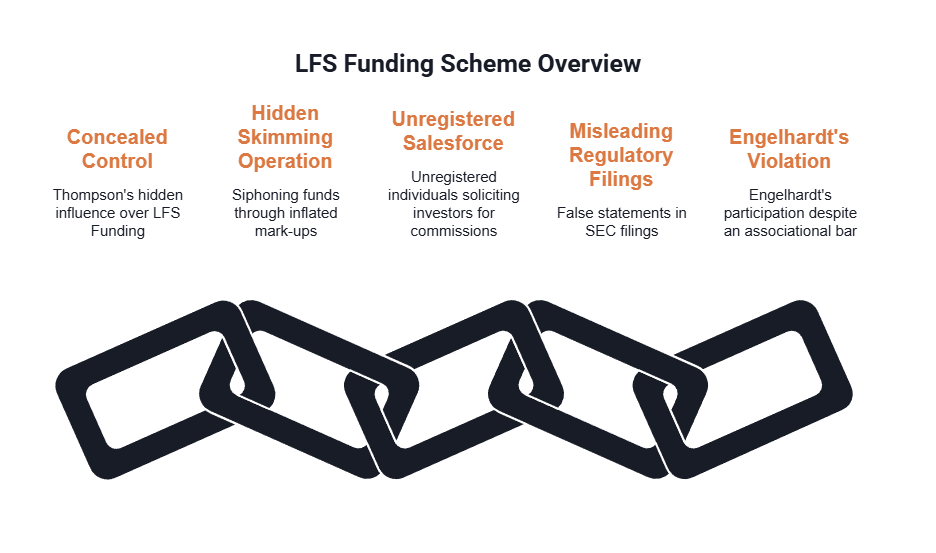
According to the SEC’s complaint, the scheme operated through several interlocking layers of deception:
- Concealed control: Thompson, an individual with a documented history of securities law violations, allegedly exercised de facto control over LFS Funding while others were installed as nominal general partners to conceal his involvement.
- Hidden skimming operation: Thompson allegedly siphoned investor funds through inflated mark-ups on equipment and services from a supplier entity he also controlled, a conflict of interest never disclosed to investors.
- An unregistered salesforce collecting undisclosed commissions: Thompson recruited Erskine, Comisar, and Engelhardt, none of whom held broker or dealer registration, to solicit investors for transaction-based compensation. More than $170,000 of investor money funded these hidden payments.
- Misleading regulatory filings: The Forms D that LFS Funding filed with the SEC allegedly contained materially misleading statements about who controlled the partnership and how salespersons were compensated.
Dale Engelhardt faced an additional charge: the SEC alleged he violated Section 15(b)(6)(B)(i) of the Exchange Act by participating in the offering in defiance of a previously imposed associational bar.

We Have Recovered Over
$350 Million for Our Clients Nationwide.
What Did the Offering Documents Claim, and What Did They Conceal?
The private placement memorandums told investors their capital would fund the opening of two medical clinics. What those documents allegedly concealed was consequential: more than $170,000 (exceeding 27% of the total raised) was actually paid out as commissions to unregistered salespersons, Thompson was simultaneously diverting funds through a controlled supplier, and the individuals named as managing the partnership were nominal figureheads rather than its true decision-makers.
This is a recurring blueprint in private placement fraud: offering documents that describe a legitimate business purpose while omitting the conflicts of interest and diversion of funds that define how the money is actually used. When investors cannot rely on the accuracy of offering materials, they are deprived of the ability to make any meaningful investment decision.
What Did the Court Find Against Ross Gregory Erskine?
On August 25, 2023, the court granted the SEC’s motion for summary judgment, finding that Erskine had violated multiple provisions of federal securities law. On May 20, 2026, the final judgment was entered (SEC Litigation Release No. 26559).
The court found Erskine violated:
- Section 15(a) of the Securities Exchange Act of 1934: Acting as an unregistered broker-dealer by soliciting investors and collecting transaction-based commissions without registration
- Section 10(b) of the Exchange Act and Rule 10b-5: Committing securities fraud through materially misleading statements in private placement offering documents
- Sections 5 and 17(a) of the Securities Act of 1933: Offering and selling unregistered securities and employing fraudulent devices in a securities transaction
The final judgment permanently enjoins Erskine from violating those provisions and from soliciting any person or entity to purchase or sell any security. He was ordered to pay, jointly and severally with Meridian Point, LLC and Personal Group, LLC, $60,625 in disgorgement, $15,450.03 in prejudgment interest, and a $100,000 civil penalty, totaling $176,075.03. The litigation was handled by Charles Canter and supervised by Stephen Kam of the SEC’s Los Angeles Regional Office.
LFS Funding and Thompson settled earlier with the SEC, consenting to permanent injunctions. Thompson’s settlement also barred him from soliciting any purchase or sale of a security, participating in any securities issuance, or acting as an officer or director of any issuer.
Our lawyers are nationwide leaders in investment fraud cases.
What the Erskine Case Reveals About Unregistered Broker Risk
The LFS Funding case reflects a pattern that surfaces regularly in SEC enforcement actions. A few key takeaways for investors:
Private placements carry reduced regulatory oversight. Because they are exempt from full registration requirements, investors depend almost entirely on the honesty of the issuer and the individuals marketing the deal. Unregistered promoters eliminate even that baseline protection.
Unregistered brokers face no supervisory obligations. Registered broker-dealers must supervise their representatives, assess suitability, and maintain compliance programs. Unregistered individuals like Erskine operate outside all of those requirements.
SEC enforcement does not automatically return money to investors. Disgorgement and civil penalties flow through the Commission’s own distribution process. Defrauded investors typically need to bring their own claims through civil litigation or, where a registered firm was involved, through arbitration.
Red flags to watch for in any private placement:
- Vague or unverifiable descriptions of how proceeds will be used
- Undisclosed relationships between the issuer, its principals, and the people selling the investment
- Promoters who cannot be verified as registered with the SEC or FINRA
- Offering documents that lack clear disclosure of all fees, commissions, and conflicts of interest
We Are The firm other lawyers
call for support.
How Meyer Wilson Werning Helps Investors
Investors who placed money in LFS Funding Limited Partnership or a comparable offering marketed by unregistered individuals with misleading documents should not assume the SEC’s enforcement action is their only path forward. Additional claims may exist against any registered firm or licensed financial professional who played a role in recommending or distributing the offering.
For over 25 years, Meyer Wilson Werning has recovered more than $350 million for investors harmed by a licensed financial professional, broker, or advisor. If you believe you suffered losses in a scheme like the LFS Funding offering, contact us today for a free and confidential consultation. You pay nothing unless we recover for you.
Frequently Asked Questions
Who Is Ross Gregory Erskine and What Was His Role in the LFS Funding Limited Partnership Fraud?
Ross Gregory Erskine is a Los Angeles-area individual the SEC charged in connection with the LFS Funding Limited Partnership fraudulent offering. According to the SEC’s complaint, Erskine was recruited by Stephen Michael Thompson to solicit investors despite holding no broker or dealer registration. He allegedly distributed private placement memorandums containing materially misleading statements and received commissions for investors he recruited. In May 2026, a federal court entered a final judgment permanently enjoining him from violating federal securities laws and from soliciting any person or entity to purchase or sell any security.
What Did the SEC Allege About the LFS Funding Limited Partnership Scheme?
The SEC alleged that LFS Funding and its principals raised more than $618,000 from investors through an unregistered, fraudulent offering of limited partnership interests between May 2018 and May 2019. Offering documents claimed the funds would open two medical clinics but concealed that more than $170,000 would go to commissions for unregistered salespersons and that Thompson was simultaneously diverting funds through a supplier entity he controlled. LFS Funding also filed materially misleading Forms D with the SEC obscuring Thompson’s control and salesperson compensation.
What Financial Penalties Did the Court Impose on Ross Gregory Erskine?
The court ordered Erskine to pay $60,625 in disgorgement, $15,450.03 in prejudgment interest, and a $100,000 civil penalty, totaling $176,075.03, jointly and severally with Meridian Point, LLC and Personal Group, LLC. The court also permanently enjoined him from violating federal securities registration and antifraud provisions and from soliciting any person or entity to purchase or sell any security.
How Can Investors Recognize the Warning Signs of Private Placement Fraud?
Key warning signs include unregistered promoters, offering documents that describe a legitimate purpose while concealing commissions and conflicts of interest, and hidden control structures that obscure who is actually running the operation. Investors should verify broker registration through FINRA BrokerCheck, scrutinize offering documents for full disclosure of all fees and compensation arrangements, and consult an independent securities attorney before committing capital to any private placement.
What Can Meyer Wilson Werning Do for Investors Who Lost Money in the LFS Funding Offering or a Similar Scheme?
Investors who suffered losses in LFS Funding Limited Partnership or a comparable private placement fraud may have legal options to pursue recovery through civil litigation or, where a registered firm was involved, through arbitration. Meyer Wilson Werning reviews SEC enforcement records, offering materials, and brokerage documentation to identify every responsible party and build a recovery strategy tailored to the facts of your case. Contact us today for a free and confidential consultation. You pay nothing unless we recover for you.
Recovering Losses Caused by Investment Misconduct.