


On June 4, 2026, the United States Supreme Court issued a landmark ruling on SEC disgorgement, resolving a question that had quietly divided federal courts for years: does the SEC have to prove investors lost money before it can force a fraudster to return what he made?
The answer, delivered unanimously by all nine justices, is no.
The Supreme Court’s ruling in Sripetch v. SEC confirms that the complexity of a fraudulent scheme is no protection against accountability. If a licensed financial professional, broker, or advisor played any role in directing your investment into a pump-and-dump or other fraudulent scheme, the securities litigation attorneys at Meyer Wilson Werning are reviewing claims now. Contact us today for a free and confidential consultation, and you pay nothing unless we recover for you.
What the Case Was About
Ongkaruck Sripetch, a Los Angeles man, ran fraudulent schemes through at least 20 penny-stock companies. The strategy was the classic pump-and-dump: acquire shares, promote the company to inflate the price, then sell, leaving ordinary investors holding stock worth far less than what they paid. He was sentenced to 21 months in prison after pleading guilty to selling unregistered securities.
The SEC separately brought a civil action, charging Sripetch with six counts of securities fraud. He consented to judgment and agreed the court could order disgorgement. When the SEC sought more than $4.1 million, however, Sripetch objected, arguing the SEC had no evidence his schemes caused investors actual financial losses and therefore there were no “victims” to whom disgorgement could be awarded.
A California federal court disagreed. So did the Ninth Circuit. The Supreme Court then took the case to resolve a growing split among the circuits.

We Have Recovered Over
$350 Million for Our Clients Nationwide.
Why the Circuit Split Mattered
The First and Ninth Circuits held the SEC could seek disgorgement without proving investor losses. The Second Circuit, in SEC v. Govil, required that showing before disgorgement could proceed. The result: whether a fraudster could keep illegal profits depended on which circuit heard the case. The Supreme Court granted certiorari to close that gap.
What the Justices Said
Justice Gorsuch wrote the opinion for a unanimous court. Justice Thomas concurred separately.
The core reasoning is rooted in centuries of equity law. Disgorgement is not a damages remedy designed to compensate for a specific loss. Its purpose is to strip a wrongdoer of unjust gains. Under traditional equitable principles, a plaintiff “does not need to prove he has suffered a corresponding loss or, indeed, any loss.”
When a defendant enriches himself through misconduct without visibly reducing a victim’s account balance, a court faces a choice: strip the defendant of his unjust gains, or allow him to benefit from his wrongdoing. As Gorsuch put it, “equity traditionally prefers the first outcome, not the second.”
The Court acknowledged that Liu v. SEC (2020) required disgorgement to be “awarded for victims,” but rejected the argument that “victim” requires provable financial loss. A victim is anyone whose legally protected interests were invaded by the defendant’s conduct, and Sripetch never disputed that his victims’ interests were violated.
Our lawyers are nationwide leaders in investment fraud cases.
The Legal History Behind the SEC Disgorgement Debate
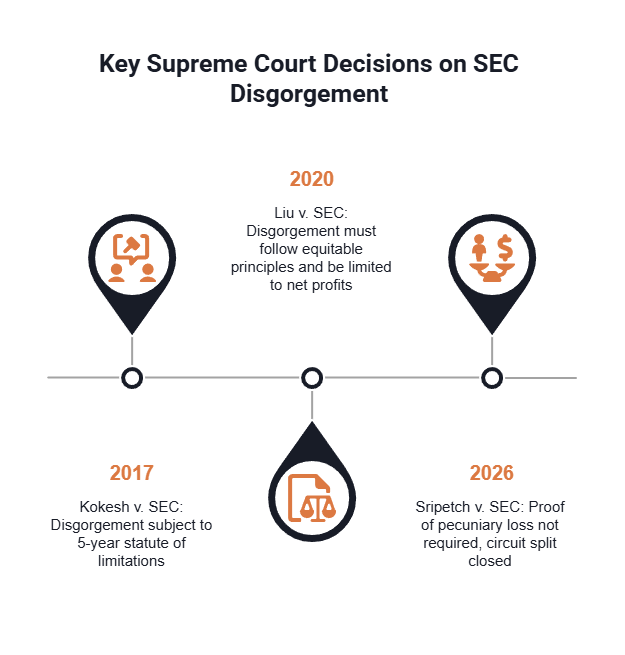
Sripetch is the third in a trilogy of Supreme Court decisions on SEC disgorgement:
- 2017, Kokesh v. SEC: Disgorgement is subject to a 5-year statute of limitations.
- 2020, Liu v. SEC: Disgorgement must follow traditional equitable principles and be limited to the defendant’s net profits, directed to victims, not the Treasury.
- 2026, Sripetch v. SEC: Proof of pecuniary loss is not required. Circuit split closed.
After Liu, Congress acted quickly, adding 15 U.S.C. §78u(d)(7) to expressly authorize disgorgement in enforcement proceedings. Sripetch confirms that this reinforced framework stands.
We Are The firm other lawyers
call for support.
Key Points
- Disgorgement targets the wrongdoer’s gain, not the victim’s loss. Fraud schemes, particularly pump-and-dumps, are engineered to obscure individual harm. The law no longer requires that harm to be precisely quantified.
- A significant loophole is now closed. The Second Circuit defense, that no measurable investor loss means no disgorgement, is gone nationwide.
- The Trump administration sided with the SEC. The New York Times noted the ruling “bolsters the powers of the Wall Street watchdog agency” at a time when the administration has at times been skeptical of financial regulation.
- One question remains open. The Court declined to decide whether §78u(d)(7) frees the SEC from the Liu requirement that disgorgement be directed to victims rather than the Treasury. That issue will be resolved in a future case.
Why This Ruling Reflects Something Larger
The principle in Sripetch applies beyond penny stocks. The same logic governs Ponzi schemes, insider trading, accounting fraud, and cryptocurrency manipulation, all common grounds for securities litigation. Fraudsters have long relied on the complexity of their own schemes as a shield. If the money trail is tangled enough, the argument went, there is no provable loss and no remedy.
For over 25 years, Meyer Wilson Werning has recovered more than $350 million for investors harmed by securities fraud in all its forms. If a broker, advisor, or financial professional facilitated the investment that led to your losses, contact us today for a free and confidential consultation. You pay nothing unless we recover for you.
Frequently Asked Questions

What is disgorgement in a securities fraud case?
Disgorgement forces a person who profited from illegal conduct to return those profits. Unlike damages, it does not require proof of a specific financial loss. It has been an SEC enforcement tool since the 1970s and was expressly authorized by Congress after Liu v. SEC.
What did the Supreme Court decide in Sripetch v. SEC?
The Court held 9-0 that the SEC does not need to prove investors suffered a pecuniary loss before obtaining disgorgement. Being a “victim” means having one’s legally protected interests invaded, not necessarily suffering a measurable financial harm.
What was the circuit split?
The First and Ninth Circuits allowed disgorgement without proof of investor losses. The Second Circuit required it. Sripetch resolved the disagreement in favor of the First and Ninth Circuits.
What is a pump-and-dump scheme?
A scheme in which a person acquires shares, promotes the company to drive up the price, then sells before the market corrects, leaving other investors holding depreciated stock.
What question did the Court leave open?
Whether 15 U.S.C. §78u(d)(7) allows the SEC to retain disgorgement for the Treasury rather than returning it to harmed investors. That was not decided in Sripetch and remains for a future case.
Recovering Losses Caused by Investment Misconduct.