


A corporate insider accused of lying to investors and stealing their money has been the subject of a final civil judgment entered by the U.S. Securities and Exchange Commission. On May 8, 2026, the United States District Court for the District of New Jersey entered a final judgment against Joseph Geromini of Somers Point, New Jersey, closing the SEC’s civil enforcement action that began nearly five years earlier. According to SEC Litigation Release No. 26555, Geromini allegedly disseminated false offering documents, fabricated financial models, and misappropriated more than $200,000 in investor capital for personal use between August 2018 and May 2019, while serving as the Chief Operating Officer of an early-stage medical device company in the Philadelphia area.
If you or someone you know suffered significant investment losses related to alleged securities fraud or misappropriation, and a licensed financial professional, broker, or advisor facilitated your investment, the experienced securities litigation attorneys at Meyer Wilson Werning can help evaluate whether your losses are the result of actionable misconduct. Contact us today for a free and confidential consultation, and you pay nothing unless we recover for you.
What Was Joseph Geromini Accused of Doing?
According to the SEC’s complaint, Geromini occupied a position of trust and authority. As Chief Operating Officer of an early-stage medical device company based in Philadelphia, Pennsylvania, he held direct access to investor capital and controlled the materials investors received when deciding whether to commit their money.
Regulators allege he exploited that access from August 2018 through May 2019. The SEC claims Geromini provided investors with offering documents and financial models that were deliberately misleading. Critically, these materials allegedly contained no reference to the fact that Geromini was actively diverting investor funds to cover his own personal expenses.
The allegations go further. According to the complaint, Geromini made materially false and misleading statements to investors about two metrics that matter most when evaluating any early-stage company: cash burn rate (how fast the company is spending down its capital) and use of proceeds (where investor money would actually go). Investors were told their capital would fund company operations. Prosecutors and regulators allege it was being funneled to Geromini personally.
The total amount allegedly misappropriated across the nine-month scheme was more than $200,000.

We Have Recovered Over
$350 Million for Our Clients Nationwide.
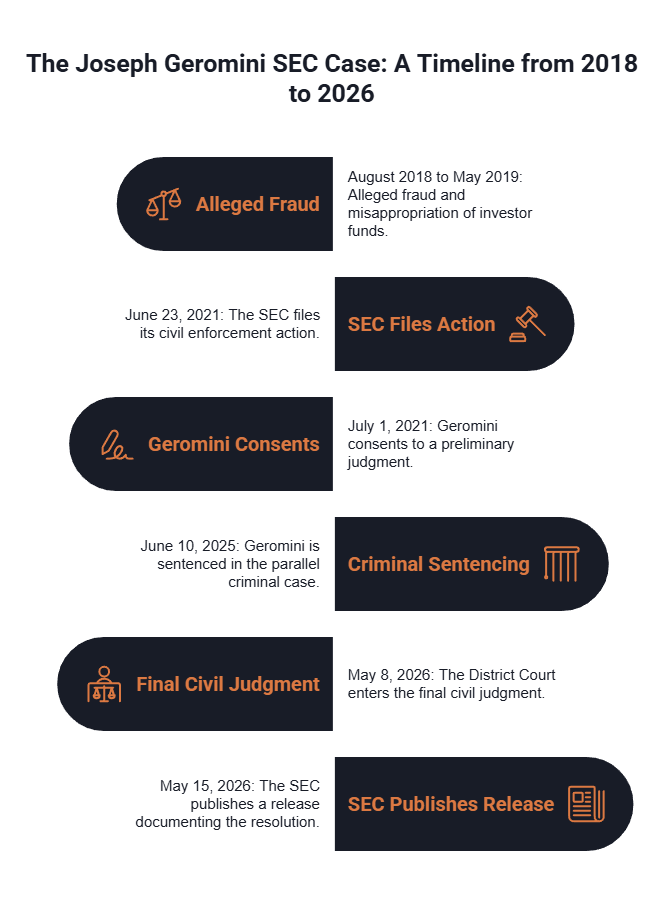
The Complete Timeline of the Joseph Geromini SEC Case
Tracking the sequence of legal events matters for investors seeking to understand how this case reached resolution and what it may mean for their own options going forward.
- August 2018 to May 2019: Alleged fraud and misappropriation of investor funds at an early-stage medical device company in the Philadelphia, Pennsylvania area.
- June 23, 2021: The SEC files its civil enforcement action in the United States District Court for the District of New Jersey (Case No. 1-21-cv-12880, D.N.J.).
- July 1, 2021: Geromini consents to a preliminary judgment that permanently enjoins him from future antifraud violations and bars him from serving as an officer or director of any publicly traded company. He neither admits nor denies the SEC’s allegations at this stage.
- June 10, 2025: Geromini is sentenced in the parallel criminal case, United States v. Geromini, No. 1:21-cr-0048 (D.N.J.), to six months in federal prison, six months of home confinement, three years of supervised release, and $98,083 in restitution.
- May 8, 2026: The District Court enters the final civil judgment, incorporating the previously-ordered injunctive relief and ordering Geromini liable for disgorgement of $98,083, a payment the court deems satisfied by the criminal restitution order.
- May 15, 2026: The SEC publishes Litigation Release No. 26555, publicly documenting the resolution of the civil enforcement action.
The Parallel Criminal Case: Guilty Plea and What It Means
One of the distinguishing features of this matter is the dual-track prosecution. SEC civil enforcement actions and federal criminal prosecutions can proceed simultaneously because they serve different purposes and operate under different legal standards.
In United States v. Geromini, No. 1:21-cr-0048 (D.N.J.), Geromini entered a guilty plea. On June 10, 2025, the sentencing court ordered:
- Six months in federal prison
- Six months of home confinement
- Three years of supervised release
- $98,083 in restitution
The criminal case sought accountability through incarceration and restitution. The SEC’s civil action sought injunctions, disgorgement, and regulatory bars. The combination of both proceedings produces a more complete set of consequences than either track could achieve alone. Critically, the guilty plea means Geromini’s admission of wrongdoing in the criminal case is a matter of public record, even though the civil judgment was entered on a no-admit, no-deny basis.
Our lawyers are nationwide leaders in investment fraud cases.
What the $98,083 Disgorgement Figure Means for Investors
The court ordered disgorgement of $98,083. The SEC’s complaint alleged that more than $200,000 was misappropriated. That gap is real and it matters. The formal legal process captured only a portion of the total alleged investor losses.
Disgorged funds collected in SEC enforcement actions can potentially be distributed to harmed investors through a “Fair Fund,” a mechanism that allows the SEC to return money to those who were deceived. However, not every enforcement action produces a Fair Fund distribution, and the availability and timing of any such distribution in this matter would depend on subsequent administrative decisions by the SEC following the close of litigation. The gap between alleged losses and recovered funds is a recurring pattern in SEC offering fraud cases. The SEC’s recently concluded action involving Spartan Trading illustrates similar dynamics, where the formal enforcement process resolved questions of regulatory liability while leaving individual investor recovery as a separate open question.
Investors who believe they lost money as a result of the alleged conduct in this case and have not sought independent legal counsel should understand that private civil claims are a separate and independent avenue from the SEC’s enforcement process. The conclusion of the SEC’s litigation does not eliminate the right of individual investors to pursue their own recovery. Time limits apply to securities claims, which is why prompt legal consultation is important.
We Are The firm other lawyers
call for support.
What Are the Options for Investors Who Lost Money in This Case?
The investors who trusted Joseph Geromini did so because the offering documents looked legitimate, the financial models appeared credible, and the person delivering the pitch held a title that implied authority. The SEC’s final judgment closes the regulatory chapter of this matter, but for anyone who committed capital based on those materials and has not yet explored their own recovery options, that chapter is not the only one available. Statutes of limitations on securities fraud claims run independently of the SEC’s timeline, and delay can permanently foreclose the right to act.
With more than $350 million recovered for investors nationwide, Meyer Wilson Werning has spent over 25 years holding corporate insiders and financial professionals accountable for exactly this kind of misconduct. If you invested in a private offering based on documents you now believe were false or misleading, and a licensed financial professional, broker, or advisor facilitated your investment, contact us today for a free and confidential consultation. You pay nothing unless we recover for you.
Frequently Asked Questions
Who is Joseph Geromini and what did the SEC accuse him of?
Joseph Geromini is a Somers Point, New Jersey resident who served as Chief Operating Officer of an early-stage medical device company in the Philadelphia area. According to SEC Litigation Release No. 26555, the SEC alleged that between August 2018 and May 2019, Geromini disseminated false and misleading offering documents and financial models to investors while misappropriating more than $200,000 in investor funds for personal use. The SEC filed its civil enforcement action on June 23, 2021 (Case No. 1-21-cv-12880, D.N.J.), which concluded with a final judgment on May 8, 2026.
Did Geromini admit to wrongdoing in the SEC case?
In the SEC civil proceeding, Geromini consented to the preliminary judgment entered July 1, 2021, without admitting or denying the SEC’s allegations. However, in the parallel criminal matter, United States v. Geromini, No. 1:21-cr-0048 (D.N.J.), he entered a guilty plea, which resulted in a criminal sentence of six months in prison, six months of home confinement, three years of supervised release, and $98,083 in restitution.
What is an officer and director bar and why does it matter?
An officer and director bar is a court-ordered prohibition that prevents a person from serving as an officer or director of any publicly traded company. In Geromini’s case, this bar was imposed as part of the preliminary judgment in 2021 and incorporated into the final 2026 judgment. It is designed to protect future shareholders by ensuring Geromini cannot hold a position of authority over a public company’s operations or assets.
The court only ordered $98,083 in disgorgement, but the SEC alleged $200,000 was stolen. What happened to the rest?
The gap between the more than $200,000 alleged misappropriation and the $98,083 disgorgement ordered reflects the difference between total alleged losses and the specific ill-gotten gains the court determined to order returned. Investors who sustained losses exceeding the disgorged amount may have grounds to pursue additional recovery through private civil claims, independent of the SEC’s enforcement action.
What securities laws did Geromini allegedly violate?
The final judgment permanently bars Geromini from future violations of Section 17(a) of the Securities Act of 1933, which prohibits fraudulent conduct in the offer or sale of securities; Section 10(b) of the Securities Exchange Act of 1934; and Rule 10b-5, which broadly prohibits deceptive acts and material misrepresentations in connection with securities transactions. These are the core antifraud provisions of federal securities law.
What should I do if I believe I invested based on false offering documents?
Investors who believe they were provided false or misleading offering materials should consult a qualified securities attorney as soon as possible. Federal securities fraud claims are subject to statutes of limitations, and waiting too long can eliminate recovery options entirely. Meyer Wilson Werning offers free and confidential consultations to evaluate whether your situation gives rise to a viable claim. There is no cost unless the firm recovers on your behalf.
Recovering Losses Caused by Investment Misconduct.