



For most of the last decade, parents were told that heavy phone use was a discipline problem. If a teenager could not put Instagram down, could not sleep, stopped eating normally, or withdrew from everyone who loved them, the assumed cause was the child. Internal company research told a different story. Meta, TikTok, Snapchat, and YouTube studied the effects of their own products on young users, understood what compulsive use was doing to adolescent mental health, and kept building for engagement anyway.
Families are no longer absorbing that alone. More than 3,100 personal injury cases are pending in the federal social media litigation, thousands more are coordinated in California, and in 2026 juries began returning verdicts against these companies for the first time. Twenty-nine state attorneys general are pursuing Meta as well, and the first of those cases is on trial as of August 2026.

Meyer Wilson Werning represents families whose children were harmed by platforms built to hold their attention at any cost. If your child developed depression, anxiety, an eating disorder, or suicidal thoughts during years of heavy social media use, or if you lost a child, this page explains what these cases involve, what the courts have decided so far, and what we would need to understand about your family’s situation. There is no charge to ask us, and no obligation follows the conversation.
The Harm These Lawsuits Cover
These claims are about serious, documented injury to a young person, not ordinary screen time or a household argument about phones. Your family may have a claim if a minor used Instagram, Facebook, TikTok, Snapchat, or YouTube and experienced any of the following.
- A diagnosis of depression, anxiety, PTSD, or an eating disorder. This includes anorexia, bulimia, and body dysmorphia, which appear repeatedly in these cases and are strongly associated with appearance-driven content and comparison features.
- Self-harm behavior or suicidal thoughts. These are among the most serious injuries in the litigation, and they are handled with corresponding care by our team.
- Compulsive use that took over daily life. Sleep loss, inability to concentrate, withdrawal from family and friends, and a sharp decline in school performance are the patterns courts have seen most often.
- Harm from sextortion or predatory contact that began on a platform. Where an adult used a platform’s features to reach your child, that harm belongs in this litigation as well. If the contact began on a gaming platform, your family may also have a claim in the Roblox child exploitation lawsuits.
- The death of a child. Where a young person died by suicide after prolonged platform use, a wrongful death claim may be available to the parents or the estate. We know what it takes to make this call, and we will follow your pace.
Claims can be brought by a parent or guardian on a minor’s behalf, and also by young adults who were harmed while they were minors. The fact that your child is 19 or 24 now does not by itself close the door.

We Are The firm other lawyers
call for support.
What Every Social Media Claim Has in Common
Beyond the injury itself, these cases tend to share three things. None of this is a test you need to pass before calling. It is simply what we will talk through together.
- The heavy use began while your child was a minor. These lawsuits are built on the effect of engagement-driven design on the developing adolescent brain, so the age at which use started matters, and earlier use tends to matter more.
- The harm is documented somewhere. A therapist, a pediatrician, a psychiatric diagnosis, a hospitalization, or school records showing when things changed. Documentation is what separates a claim from a description, and if none exists yet, that is a reason to talk rather than a reason not to.
- You can identify the platforms and roughly when use started. You do not need account exports or exact dates. A parent’s honest account of which apps dominated, and at what age, is usually enough to begin.
What These Companies Are Alleged to Have Done
The central legal theory in this litigation is worth understanding, because it is not what most people assume. These cases do not argue that harmful content appeared on the platforms. They argue that the platforms are defectively designed products, engineered to create compulsive use in minors, and that they should be treated the way courts treat any other dangerous product. That distinction is the reason these lawsuits have survived where earlier attempts failed.
The specific allegations include the following.
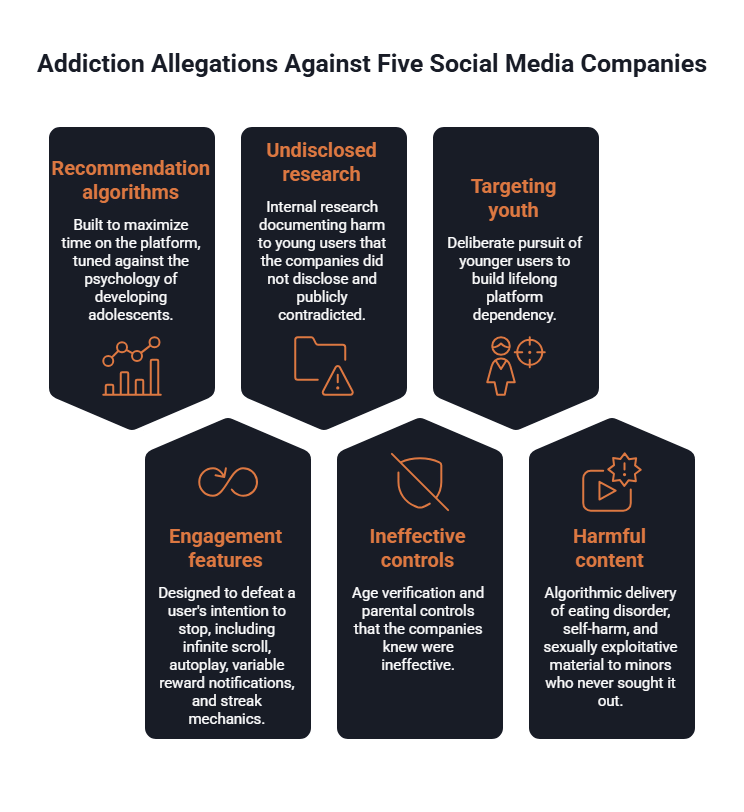
- Recommendation algorithms built to maximize time on the platform, tuned against the psychology of developing adolescents.
- Features designed to defeat a user’s intention to stop, including infinite scroll, autoplay, variable reward notifications, and streak mechanics.
- Internal research documenting harm to young users that the companies did not disclose and, in some instances, publicly contradicted.
- Age verification and parental controls that the companies knew were ineffective.
- Deliberate pursuit of younger users to build lifelong platform dependency.
- Algorithmic delivery of eating disorder, self-harm, and sexually exploitative material to minors who never sought it out.
Judges have allowed the design claims to move forward while dismissing claims that rest on the content itself. That line is why Section 230, the federal statute that shields platforms from liability for what users post, has not ended this litigation. A defect in how a product is built is not a third party’s speech.
We Have Recovered Over
$350 Million for Our Clients Nationwide.
Where the Litigation Stands
The federal cases are consolidated as MDL No. 3047, In re: Social Media Adolescent Addiction and Personal Injury Products Liability Litigation, before Judge Yvonne Gonzalez Rogers in the Northern District of California. As of August 2026, more than 3,100 cases were pending there, up from roughly 2,400 in March, and the number has risen every quarter since the litigation began.
The MDL is organized into four groups: individual claims by injured young people and their parents, claims by school districts, claims by state attorneys general, and a smaller set brought by Native American tribes. Eleven cases were selected as bellwether trials, five personal injury cases and six school district cases, to test how juries respond before the remaining thousands are resolved.
Alongside the federal cases, roughly 1,600 California plaintiffs are coordinated in JCCP 5255 before Judge Carolyn Kuhl in Los Angeles Superior Court, and more than 1,300 school districts nationwide have filed suit over the counseling staff, security personnel, and intervention programs they say a youth mental health crisis forced them to fund.
Our lawyers are nationwide leaders in investment fraud cases.
The Verdicts That Changed This Litigation
For years these companies argued that no jury would hold them responsible for how young people used their products. That argument did not survive 2026.
In March 2026, a Los Angeles jury returned the first verdict in the country in a social media addiction case. The plaintiff, identified as K.G.M., began using YouTube at six and Instagram at nine, and described compulsive use, body dysmorphia, anxiety, depression, and suicidal ideation. The jury found Meta and YouTube negligent in the design of their platforms and found that both failed to warn users of the risks, awarding $3 million in compensatory damages, apportioned 70 percent to Meta and 30 percent to Google, plus $3 million in punitive damages. Mark Zuckerberg testified in person during that trial, the first time he had ever given testimony to a jury. Snap and TikTok settled their part of the case confidentially before the verdict, one before trial and one during jury selection.
One day later, a New Mexico jury found Meta liable for roughly 75,000 violations of that state’s consumer protection law, resulting in $375 million in civil penalties. Meta’s post-trial attempts to undo the California verdict, including a renewed argument under Section 230, were rejected, leaving the punitive damages award intact as the company pursues appeal.
The pattern has continued outside the courtroom. In May 2026, Meta, Snap, TikTok, and YouTube resolved the first federal school district bellwether, brought by the Breathitt County Board of Education in Kentucky, weeks before it was set for trial. TikTok has since settled a series of individual cases scheduled for trial rather than face juries. The next school district bellwether trials, involving Tucson Unified in Arizona and Charleston County in South Carolina, are set for February 2027.
The $17 Billion Settlement Meta Just Agreed To
In August 2026, four state attorneys general took Meta to trial in Oakland. Meta’s former engineer testified about internal research on harm to young users, the head of Instagram was questioned about a safety feature almost no teen used, and midway through the second week, Meta agreed to settle. The proposed deal pays $17 billion over 10 years, resolves 51 attorney general cases, and forces changes within months: a default two-hour daily limit and overnight block for under-18 users that only a parent can lift, no visible like counts on minors’ posts, no cosmetic surgery filters, and an independent auditor reporting to the states. A judge must still approve it.
None of that money goes to families. These are penalties paid to states, not compensation for injured children. It does not resolve the personal injury cases or the school district claims, and does not involve TikTok, Snap, or YouTube. If your child was harmed, your claim is unaffected and still yours to bring.
A company confident of winning does not stop a trial after that testimony.
What Strengthens a Social Media Claim
Families often assume their case is weak because they did not keep records at the time. That is rarely how it works, and the material that matters most usually already exists somewhere.
- Mental health treatment records. Therapy notes, psychiatric evaluations, diagnoses, medication history, and any hospitalization records. These establish both the injury and its timing.
- School records. Grades, attendance, disciplinary files, and counselor notes often show precisely when a child’s trajectory changed, which is exactly the comparison these cases turn on.
- Evidence of platform use. Screen time reports, account creation dates, app history, and your own recollection of which platforms dominated and at what age.
- A sense of the before and after. Your account of who your child was before the heavy use began, and what changed, carries real weight. Parents consistently underestimate this.
What to Do If Your Child Has Been Harmed
Your child’s wellbeing comes first, and everything below is ordered accordingly.
- Get help now if your child is in crisis. If your child is having thoughts of suicide or self-harm, call or text 988 to reach the Suicide and Crisis Lifeline, available 24 hours a day. If there is immediate danger, call 911.
- Connect your child with treatment. Ongoing care from a professional experienced in adolescent mental health is what matters most, and the record it creates also happens to be the backbone of a legal claim.
- Preserve what exists. Keep account information, screen time data, and device records rather than deleting apps or wiping phones. Request school records now, since districts do not keep them indefinitely.
- Be careful about what you post. Once a claim is filed, your family’s own social media can be requested by the other side. This is not a reason for alarm, only for awareness.
- Talk to a lawyer about the specifics. A short conversation is enough to tell whether there is something here worth pursuing.
Contact a Social Media Harm Attorney
If your child’s mental health collapsed during years of heavy social media use, you are not imagining the connection, and you are not the only parent who spent years being told it was something else. Meyer Wilson Werning has built its practice on holding large companies accountable when they knew the harm they were causing and continued anyway, and this litigation is exactly that pattern with children on the receiving end.
Our attorneys understand how much of this is still raw for families, and how often parents carry blame that was never theirs. You will not be rushed, and nothing you tell us leaves this firm, whether or not we take your case. Contact us by phone or through our online form for a free and confidential consultation.
Recovering Losses Caused by Investment Misconduct.