



Gabapentin was supposed to be the safe option. As prescribers pulled back from opioids, gabapentin became the alternative, and it was handed out for back pain, nerve pain, anxiety, fibromyalgia, migraines, hot flashes, and alcohol withdrawal. It is now among the most dispensed drugs in the country. Most of that prescribing is for conditions the FDA never approved it to treat, which also means those uses were never studied for long-term safety.
In July 2025, researchers at Case Western Reserve University published the study that set off this litigation. Looking at patients treated for chronic low back pain, they found that people who received six or more gabapentin prescriptions were meaningfully more likely to be diagnosed with dementia or mild cognitive impairment within ten years, and that the risk was concentrated in adults under 65 rather than in the elderly. That is early-onset cognitive decline in working-age people.

Meyer Wilson Werning is investigating these claims. This page will tell you what the research found, what it did not find, where the litigation actually stands, and what we would need to review. It will also tell you plainly that this science is disputed, because you deserve that before you invest hope in a case. If you or someone in your family currently takes gabapentin, do not stop taking it based on this page. That is dangerous and we explain why below. Whether the prescription history and the diagnosis line up is a separate question, and a free and confidential case review will answer it.
Who May Have a Claim
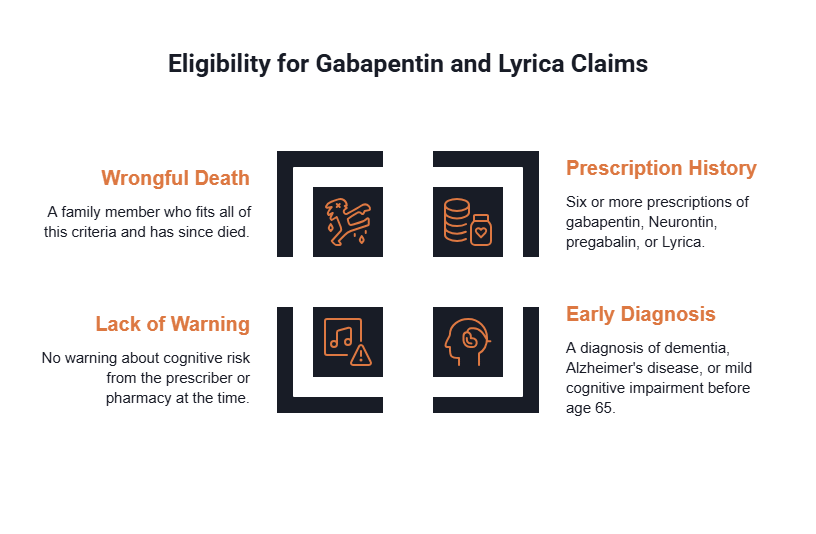
We are evaluating claims where the following are true.
- Six or more prescriptions of gabapentin, Neurontin, pregabalin, or Lyrica. Repeated, sustained use is the pattern the research examined. A short course after surgery is not what these claims are about.
- A diagnosis of dementia, Alzheimer’s disease, or mild cognitive impairment before age 65. The under-65 diagnosis is the center of this litigation, because that is where the research found the largest effect and where the diagnosis is least explained by aging alone.
- No warning about cognitive risk from the prescriber or pharmacy at the time.
- A family member who fits the above and has since died. A wrongful death claim may be available to the estate.
Claims can be brought by the patient, by a spouse or adult child acting under a power of attorney or guardianship, or by the personal representative of an estate. If the person affected can no longer manage their own affairs, that does not close off a claim. It is a common situation in this litigation and there are established ways to handle it.

We Are The firm other lawyers
call for support.
What the Research Found, and What It Did Not
The study driving these cases was published in Regional Anesthesia and Pain Medicine, a peer-reviewed BMJ Group journal, in July 2025. Researchers used a national database of de-identified records from 68 healthcare organizations, comparing 26,414 adults with chronic low back pain who were prescribed gabapentin against an equal number of matched patients who were not, adjusting for demographics, other conditions, and other pain medications.
- Patients with six or more prescriptions were 29 percent more likely to be diagnosed with dementia and 85 percent more likely to be diagnosed with mild cognitive impairment within ten years.
- Adults aged 18 to 64 carried more than twice the risk, and among those aged 35 to 49 the dementia risk more than doubled while cognitive impairment risk more than tripled.
- More prescriptions meant more risk. Patients with 12 or more prescriptions had higher rates than those with three to 11, which is the kind of dose-response pattern researchers look for.
This was an observational study, and it cannot establish that gabapentin causes dementia. Independent experts responding to its publication noted that it did not control for treatment duration or dose, and that other recent studies have found no such link. One professor of clinical pharmacy summarized the state of play by saying the jury is still out. The study’s own authors framed their finding as an association and recommended that physicians monitor patients rather than stop prescribing.
We would rather you hear this from us than from a defense expert. Causation is the central fight in this litigation, it is not yet resolved, and any firm telling you the science is settled is selling you something.
Why Pfizer’s History Matters Here
There is a reason so many people ended up on long-term gabapentin for conditions it was never approved to treat, and it is not accidental.
Beginning in the 1990s, Parke-Davis, a division of Warner-Lambert later acquired by Pfizer, ran a campaign to promote Neurontin for bipolar disorder, back pain, migraines, anxiety, and other unapproved uses. It used paid physician speakers, ghostwritten research, and sales incentives tied to off-label prescribing. Rather than run the trials that would have established long-term safety, the company promoted the drug anyway.
The consequences are documented in the public record. In 2004, Warner-Lambert pleaded guilty to criminal charges and paid $430 million to resolve criminal and civil allegations over that promotion. In 2010, a federal jury found Pfizer violated federal racketeering law in promoting Neurontin for unapproved uses and awarded Kaiser Foundation Health Plan $142 million, a verdict later upheld on appeal. Pfizer subsequently paid $325 million to resolve claims by insurers and health plans. Related matters have pushed the total toward $1 billion.
Those cases were about money, not injury. They compensated insurers who paid for prescriptions that should never have been written. Nobody has yet been compensated for what the drug may have done to them, and the current claims allege that the same off-label campaign is what put millions of patients on the long-term regimens now at issue.
We Have Recovered Over
$350 Million for Our Clients Nationwide.
Where This Litigation Stands
There is no MDL or class action yet and there have been no settlements or verdicts in any dementia case involving these drugs.
What exists is an investigation stage. Firms around the country are evaluating claims and filing individual cases in state and federal courts, and consolidation into a federal MDL becomes more likely as filings accumulate, though nothing guarantees it. If you find a website quoting gabapentin dementia settlement amounts, it is fabricating them.
Early filing does carry real advantages. Statutes of limitations run whether or not a litigation is organized, evidence is easier to gather closer to the events, and cases filed early tend to be better positioned if consolidation happens. Those are honest reasons to act now. The fact that this litigation is young is also a reason to be realistic about how long resolution would take.
Our lawyers are nationwide leaders in investment fraud cases.
Why It Matters Which Product You Took
This is a practical question that determines a great deal.
Pfizer manufactured brand-name Neurontin and Lyrica. Generic versions of gabapentin have been widely available since 2004, and generic pregabalin followed, which means the substantial majority of patients took a generic product made by a different company. Under federal law, claims that a generic manufacturer failed to warn face significant obstacles that claims against a brand-name manufacturer do not, because generic makers are required to use the brand’s label. Failure to warn claims against brand-name manufacturers are the theory behind current litigation such as the GLP-1 drug lawsuits and the Dupixent lawsuits.
This does not mean generic users have no path, and the analysis varies by state and by the theory pursued. Generic manufacturers have faced claims on other grounds, as in the Valsartan lawsuits over contaminated generic blood pressure medication. It does mean the identity of the product you actually took is one of the first things we check, and it is why pharmacy records matter enormously in these cases. If you do not know whether you took brand or generic, that is normal, and it is answerable from records.
What Strengthens a Claim
- Pharmacy records covering the full prescription history. These establish the six-prescription threshold, the duration, the dose, and the manufacturer. Insurance claim histories work when pharmacy records have gaps.
- The neurological or cognitive diagnosis, ideally including neuropsychological testing, imaging, and the specialist’s records rather than a single note from a primary care visit.
- Records showing why the drug was prescribed, which establishes whether the use was off-label.
- Evidence of cognitive baseline before the drug, including work history, education, and how the person functioned before. Families are often the only source for this, and it carries weight.
- Documentation of what the diagnosis has cost, including care needs, lost income, and the practical support the person now requires.
What to Do If You or a Family Member Is Affected
- Do not stop taking gabapentin or pregabalin on your own. Stopping abruptly can cause serious withdrawal, and in people taking these drugs for seizures it can trigger seizures. Any change belongs to you and your prescribing physician, and no potential legal claim justifies the risk.
- Raise cognitive changes with a doctor. Confusion, memory problems, or slowed thinking should be reported to the prescriber. The study’s lead author specifically recommended that patients do this.
- Ask for a proper evaluation. A neurologist and formal cognitive testing produce the documentation these claims require, and more importantly they may identify treatable causes. Memory problems have many causes besides dementia, including medication effects, sleep disorders, depression, and vitamin deficiencies.
- Request pharmacy records now. Pharmacies do not keep records indefinitely, and a full prescription history is harder to assemble years later or after switching pharmacies.
- Address legal authority early. If your family member’s capacity is declining, a power of attorney or guardianship may be needed before anyone can act for them, and that is easier to arrange sooner.
Contact a Gabapentin Dementia Lawyer
If someone in your family took gabapentin or Lyrica for an extended period and was diagnosed with dementia or cognitive impairment in their forties, fifties, or early sixties, that timing is worth examining. They were prescribed a drug promoted for uses it was never tested for over the long term, and nobody told them what it might cost.
Meyer Wilson Werning takes on pharmaceutical manufacturers with substantial resources and long records of defending these products. We will tell you honestly where we think your case stands, including when the evidence is not there yet. Contact us by phone or through our online form for a free and confidential consultation.
Recovering Losses Caused by Investment Misconduct.