


Rule 506(b) is one of the most widely used securities exemptions in the United States, allowing companies to raise capital through private placements without registering the offering with the SEC.
Understanding how this exemption works is directly relevant to evaluating the risks of unregistered securities, recognizing when offering rules may have been broken, and knowing what protections do and do not apply. Because securities sold under Rule 506(b) are restricted and lack the transparency of registered offerings, investors face a distinct set of risks that deserve careful attention.
Investors who have suffered losses in private placements may want to learn more about alternative investment losses and the legal options that may be available.
What Is Rule 506(b)?
Rule 506(b) is a safe harbor under Section 4(a)(2) of the Securities Act of 1933, housed within Regulation D. It permits issuers to sell securities without a full SEC registration, provided the offering meets specific conditions. The SEC describes the exemption in its Rule 506(b) private-placement requirements guidance for small businesses.
There is no cap on the amount of money an issuer can raise under Rule 506(b). However, the exemption imposes strict requirements around who can invest, how the offering is marketed, what disclosures must be provided, and what happens after the sale.
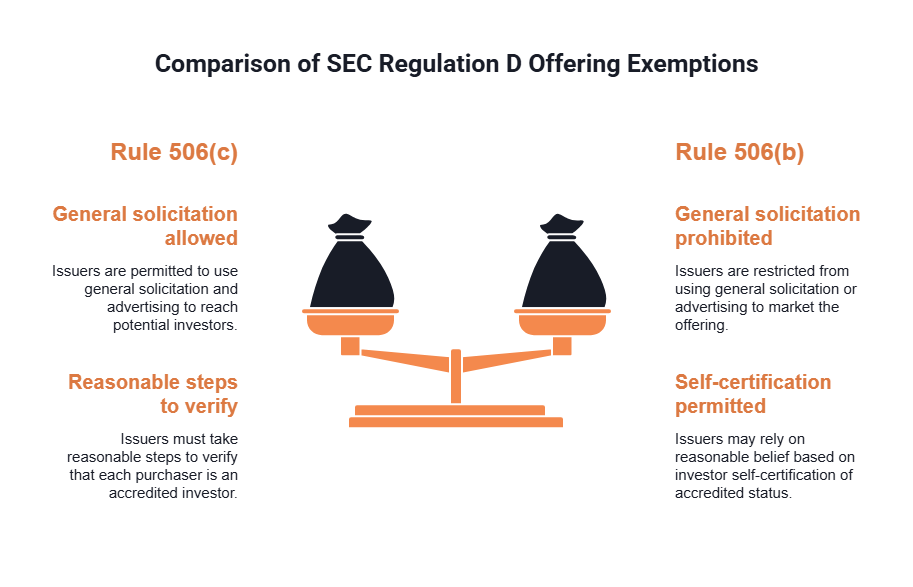
One of the defining features of Rule 506(b) is the prohibition against general solicitation. An issuer relying on this exemption may not use public advertising, mass emails, social media posts, or other broadly distributed communications to attract investors. This stands in contrast to Rule 506(c), which permits general solicitation but requires the issuer to take reasonable steps to verify that every purchaser is an accredited investor.
Rule 506(b) vs 506(c): A Practical Comparison
The distinction between Rule 506(b) and Rule 506(c) matters for investors because it determines how the offering is marketed and who can participate.
- Under Rule 506(b), general solicitation is prohibited. The issuer may offer and sell to an unlimited number of accredited investors and up to 35 non-accredited investors within any 90-calendar-day period. The issuer must ensure that any non-accredited investors have sufficient knowledge and experience in financial and business matters to evaluate the investment, and must provide them with specific disclosures comparable to those in a registered offering.
- Under Rule 506(c), general solicitation is allowed. The issuer must take reasonable steps to verify that every purchaser qualifies as an accredited investor. No non-accredited investors may participate. purchaser qualifies as an accredited investor. No non-accredited investors may participate.
For investors, the method of solicitation can be an early indicator of the exemption the issuer is relying on and, by extension, the investor protections and verification standards that should apply.

We Have Recovered Over
$350 Million for Our Clients Nationwide.
Key Requirements of a Rule 506(b) Offering
A Regulation D private placement conducted under Rule 506(b) must satisfy several requirements. Understanding these can help investors evaluate whether the offering they participated in actually complied with the law.
Accredited Investor Qualifications
Most Rule 506(b) investors are accredited investors. Under SEC Rule 501(a), individuals may qualify based on income or net worth thresholds, among other criteria:
- A net worth exceeding $1 million, excluding the value of a primary residence.
- Annual income of $200,000 (or $300,000 with a spouse or spousal equivalent) for each of the two most recently completed years, with a reasonable expectation of reaching the same level in the current year.
Entities may qualify if they hold $5 million or more in assets, among other tests.
Unlike Rule 506(c), Rule 506(b) does not require the issuer to independently verify accredited-investor status. The issuer may rely on self-certification, which means investors may be accepted without any documentary proof of their income or net worth.
Non-Accredited Investor Disclosure Requirements
In a Rule 506(b) offering that includes non-accredited investors, the issuer must provide disclosures substantially similar to those in a registered offering. This usually means financial information about the company, details about the securities, and risk information.
The issuer must also reasonably believe that each non-accredited purchaser, alone or with a purchaser representative, has enough sophistication to understand the investment. This is a fact-based, subjective standard.
Form D Filing Rules
The issuer must file Form D electronically with the SEC on EDGAR no later than 15 days after the first sale of securities. The filing provides basic information about the issuer, the exemption claimed, and the offering size.
A Form D is not SEC approval, and the SEC does not review the merits of a Rule 506(b) offering when the form is filed. Investors should also be aware that states may require separate notice filings and fees.
Investors can review Regulation D investor questions for additional context, and the FINRA private-placement filing guidance for how broker-dealers handle private-placement filings.
Restricted Securities and Bad-Actor Disqualification
Securities sold under Rule 506(b) are restricted and generally cannot be freely resold. Resale timing and eligibility depend on Rule 144 and other conditions, making liquidity a major risk.
Rule 506(b) also includes bad-actor disqualification rules. The exemption may be unavailable if specified covered persons have certain disqualifying criminal, regulatory, or other events.
How Meyer Wilson Werning Can Help
Meyer Wilson Werning represents investors nationwide who have been harmed by unsuitable or improperly sold private placements, including offerings conducted under Regulation D. With more than 75 years of combined experience and over $350 million recovered for clients across the country, the firm’s attorneys understand the regulatory framework surrounding Rule 506(b) and the ways that issuers and brokers may fail to meet their obligations.
If you invested in a private placement with a registered financial advisor and suffered losses, or if you believe an offering was marketed or sold in a way that violated securities regulations, contact us today for a free and confidential consultation to discuss your options.
Our lawyers are nationwide leaders in investment fraud cases.
Frequently Asked Questions
What is Rule 506(b)?
Rule 506(b) is a Regulation D safe harbor under Section 4(a)(2) of the Securities Act. It allows an issuer to sell securities without registering the offering with the SEC, provided the issuer does not use general solicitation or advertising and follows specific investor, disclosure, and filing requirements.
How many investors can participate in a Rule 506(b) offering?
An issuer may sell to an unlimited number of accredited investors and up to 35 non-accredited investors during any 90-calendar-day period. Non-accredited investors must meet the applicable sophistication standard and receive additional disclosures comparable to those in a registered offering.
Can a Rule 506(b) offering be advertised to the public?
Generally, no. Rule 506(b) prohibits general solicitation and general advertising. Public websites, advertisements, and broadly distributed communications may be incompatible with the exemption when they constitute an offer or are used to condition the market for the securities.
Does a Rule 506(b) offering require a Form D filing?
Yes. The issuer must file a Form D electronically with the SEC within 15 days after the first sale of securities. States may also require separate notice filings and fees. A Form D is a notice, not SEC approval of the offering.
Recovering Losses Caused by Investment Misconduct.