

When Kris Sampson answered her phone in Missoula, Montana, the caller ID showed her adult daughter’s name and photo. She heard what sounded like her daughter crying. “It was her voice, I know her scared cry,” Sampson told CNBC. “I thought maybe she’d been in a car wreck.” The voice was fake. It was generated by AI.
AI-enabled imposter scams are now targeting families across the country, and the financial losses are real. If a licensed financial professional, broker, or advisor facilitated your investment or transfer of funds as a result of coercion or fraud, the experienced cryptocurrency fraud attorneys at Meyer Wilson Werning can help evaluate whether your losses are the result of actionable misconduct. Contact us today for a free and confidential consultation, and you pay nothing unless we recover for you.
How Kris Sampson’s Call Unfolded
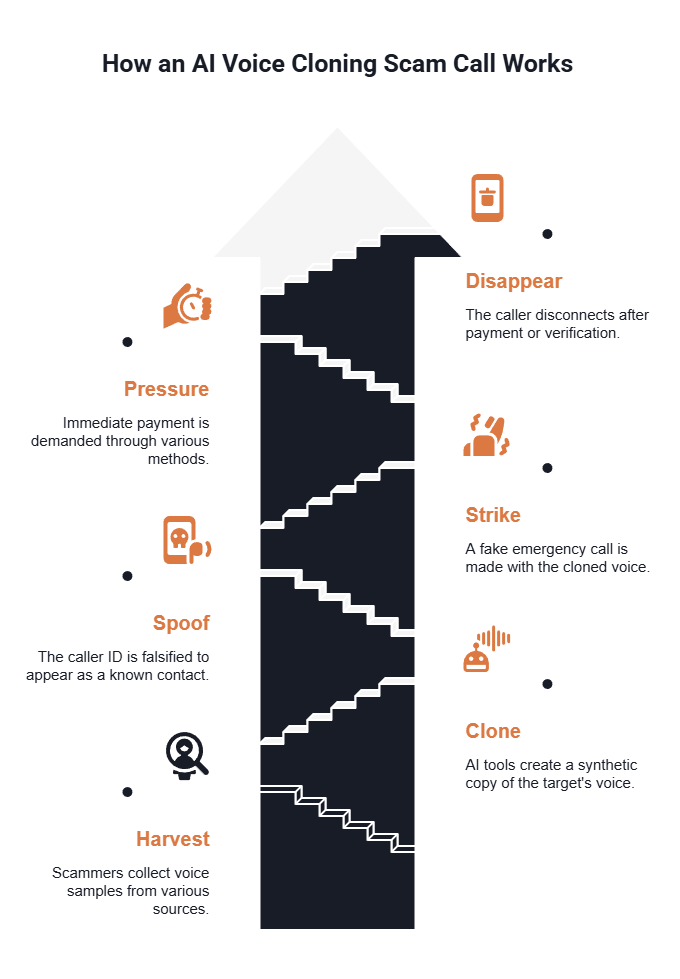
The call came in on a normal workday. Sampson’s phone displayed her daughter’s name and the familiar ringtone sounded. When she answered, she heard crying she recognized as her daughter’s voice. A man then came on the line. He spoke calmly at first, using Sampson’s first name before his tone shifted to shouting, threats, and demands for money through PayPal. He warned her not to contact police.
Sampson had heard about similar scams. But the voice sounded so real, she says, she did not want to be wrong. Then she heard her daughter say “mom,” which she says made it even harder to believe it was a fraud. “It was the most afraid I’ve ever experienced in my life,” Sampson told CNBC.
Her sister called 911 while the caller periodically hung up and called back. In those gaps, Sampson tried to reach family members and her daughter’s workplace in Helena, about two hours away. About 15 to 20 minutes after the first call, her daughter was located at her workplace after briefly stepping away from her desk. The calls stopped. The caller was never identified.
Detective investigators later told Sampson there was little police could do because the calls were difficult to trace. “What has evolved in recent years is the level of sophistication,” said Officer Whitney Bennett, a spokesperson for the Missoula Police Department.

We Have Recovered Over
$350 Million for Our Clients Nationwide.
Why Voice Cloning Has Changed Phone Security
For decades, hearing a familiar voice or seeing a known number was enough to signal trust. That assumption is now actively exploited.
Voice-based scams are changing how people use the phone entirely, says Ian Bednowitz, general manager of identity and privacy at LifeLock. Short clips pulled from social media, voicemails, or other recordings can be used to generate a synthetic version of someone’s voice, Bednowitz explains. That audio is then paired with spoofed caller ID and personal details, including names, workplaces, and family relationships, to create a call that feels immediate and specific.
Voice-cloning tools can now work with audio samples as short as three seconds, says Michael Bruemmer, vice president of global data breach and consumer protection at Experian. The entry barrier has essentially disappeared.
Bednowitz advises against answering unknown or unexpected calls, including calls that appear to come from banks or the Internal Revenue Service. The IRS typically initiates contact through mail and does not call to demand immediate payment or threaten arrest.
The Scale of the Threat: By the Numbers
The Sampson story is not an isolated incident. Imposter scams were the most reported type of fraud complaint in 2025, according to the Federal Trade Commission. Cases jumped approximately 19% to roughly 1 million last year, while total losses climbed to more than $3.5 billion.
Social media scam losses grew eightfold since 2020, reaching $2.1 billion in 2025, according to the FTC. Meyer Wilson Werning principal attorney Courtney Werning recently warned Spectrum News viewers about this directly: “They weaponize your credibility and the influencer’s credibility to defraud their entire network.” Those same platforms are also the source of the voice samples now powering AI imposter calls. More than 75% of cybercrime now stems from scams and social engineering tactics, according to Bednowitz’s testimony before a House Financial Services subcommittee in September 2025.
The scale is changing as well. Bednowitz describes fraud as “industrialized,” with organized networks running coordinated operations across borders, many based in Asia and Africa, operating like businesses with workers, scripts, and outreach infrastructure. In some cases, those workers are themselves people recruited under false pretenses who are forced to carry out scams.
And the technology is advancing further. In a 2025 study from Rutgers University, researcher Sanket Badhe described an AI system capable of carrying out scam phone calls from start to finish, operating with no human involvement at any point. “As the performance of smaller, faster models continues to improve, this will become an imminent threat,” Badhe told CNBC.
Our lawyers are nationwide leaders in investment fraud cases.
How AI Phone Scams Can Lead to Investment Losses
These calls are not only terrifying. They can be financially devastating. Scammers use the pressure of a manufactured emergency to push targets toward fast, irreversible transfers, payments through PayPal, wire transfers, cryptocurrency, or gift cards, often before the target has time to verify anything. These same organized fraud networks also run pig butchering schemes, where the coercion is slower, a weeks-long fake relationship, but the endpoint is identical: a fraudulent crypto transfer the investor believes is legitimate.
When those transfers involve brokerage accounts, retirement funds, or investment assets, and when a licensed financial professional or advisor is part of the chain, there may be a legal path to recovery. Advisors and firms have a duty to supervise account activity and, in some circumstances, flag or question transfers that appear coerced or inconsistent with a client’s normal behavior. When that duty is not met, it may give rise to a claim.
The intersection of AI-enabled fraud and financial accounts is one of the fastest-growing areas of investor harm. Families who lose retirement savings or investment assets to schemes that involve coercion, deception, or third-party facilitation have options worth understanding.
We Are The firm other lawyers
call for support.
How to Protect Yourself When a Distress Call Arrives
Experts and law enforcement agree: preparation before a call lands is the only reliable defense. These steps reduce risk and give you time to verify before acting.
- Hang up immediately on unexpected distress. Do not argue, do not engage, and do not send money while on the call.
- Verify through a different number. Call the person back on a separate number, contact their workplace, or reach a trusted mutual contact.
- Use a prearranged family code word. Sampson’s family now uses one. A question only the real person would know achieves the same result.
- Refuse all payment demands under pressure. Legitimate emergencies do not require PayPal, gift cards, cryptocurrency, or wire transfers arranged in minutes.
- Let unknown numbers go to voicemail. Bruemmer’s approach, which he calls JDA, just don’t answer, is the simplest layer of protection.
- Reduce your public voice footprint. Avoid lengthy public audio recordings, public speaking video, and excessive social media presence where voice samples can be captured and cloned.
- Save every piece of evidence. Voicemails, call logs, texts, and payment records all matter if you later need to file a claim.
Sampson says she is determined to share her account publicly so others recognize the tactics earlier. “I am determined to get the word out,” she told CNBC, “so that some poor mother doesn’t have to live through what I lived through.”
How Meyer Wilson Werning Can Help
Kris Sampson’s daughter was safe. Not every story ends that way, and for families who transferred money before they could verify, the financial damage is real and lasting.
When losses follow coercion, deception, or AI-assisted fraud and a licensed broker, financial advisor, or firm is part of the picture, civil recovery may be available. Advisors and brokerage firms have supervision obligations. When those obligations are not met and a client suffers losses as a result, those losses may be recoverable through arbitration or other legal action.
With more than $350 million recovered for investors nationwide, Meyer Wilson Werning has spent over 25 years holding financial professionals and firms accountable for exactly this kind of harm. If you or someone you know suffered financial losses tied to a coerced or fraudulent transfer involving an investment account or advisor, contact us today for a free and confidential consultation. You pay nothing unless we recover for you.
Frequently Asked Questions

What is an AI voice cloning scam?
AI voice cloning scams use short audio recordings, sometimes as little as three seconds, to generate a synthetic copy of a person’s voice. Scammers pair the cloned voice with spoofed caller ID and personal details gathered from social media to stage a fake emergency, then demand fast payment before the target can verify the situation. The technology has become widely accessible and increasingly convincing.
How do scammers get the audio they need to clone a voice?
Most voice samples come from publicly available recordings, including social media videos, voicemails, podcast appearances, and public speaking events. Scammers do not need long clips. Three seconds of clear audio is often enough to produce a usable synthetic voice.
How can I tell if a distress call is real or AI-generated?
Hang up and call the person back on a different number you know independently. Ask a question only they would know, or use a prearranged family code word. Do not rely on the sound of the voice alone, the caller ID display, or the urgency of the caller to confirm identity.
Can I recover money I sent during an AI imposter scam?
Recovery depends on how the transfer was made and who was involved. If a licensed broker or financial advisor was part of the transfer chain, or if an investment account was accessed, there may be a legal path to recovery through FINRA arbitration or civil action. Preserve all records of the call and transfer immediately and consult an attorney experienced in fraud litigation.
Why don’t police do more to stop these calls?
As Sampson’s experience illustrates, these calls are extremely difficult to trace. Scammers use spoofed numbers, operate across international borders, and disconnect quickly. Law enforcement may have limited jurisdiction and technical capacity. Civil legal remedies are often the more practical avenue for families seeking accountability.
What role do financial firms have in preventing these transfers?
Brokerage firms and financial advisors have supervisory obligations under FINRA rules. When a transfer appears inconsistent with a client’s normal behavior, is made under apparent duress, or involves patterns associated with fraud, firms may have a duty to question or delay it. Failures in that supervisory process can support a civil claim for the resulting losses.
Recovering Losses Caused by Investment Misconduct.