


With U.S. corporate defaults projected at approximately 9.2% in 2025, according to Moody’s, many retirees are taking a closer look at how brokers present bond ladders. While a ladder can be a sound strategy when built with care, investors may face risks that are not obvious at first if the design and underlying costs are overlooked. Understanding the specific risks associated with bond ladders is essential to protecting your retirement savings from hidden financial dangers.
In April 2025, the SEC announced charges in an alleged municipal bond fraud scheme, serving as a warning that fixed-income strategies can carry significant hazards. We are also seeing arbitration filings alleging unsuitable laddering under FINRA Rule 2111 and supervisory lapses under FINRA Rule 3110. These matters point to the need for careful oversight by both investors and the firms managing their portfolios.
What Is a Bond Ladder and How the Reinvestment Strategy Works
A bond ladder spreads maturity dates across several “rungs” to balance cash flow and reinvestment timing. When one rung matures, the proceeds usually roll to the far end of the ladder to maintain the overall length of the investment strategy. This disciplined approach is intended to manage interest rate cycles and meet liquidity needs for investors who require steady income.
The primary goal of a bond reinvestment strategy is to smooth income and reduce timing risk. However, the success of the strategy depends on credit quality, call features, and market liquidity. Common building blocks for these portfolios include:
- U.S. Treasuries, municipal bonds, and corporate bonds.
- Certificates of deposit (CDs) and target-maturity bond ETFs.
- Allocations managed by firms like Merrill Lynch, UBS, Edward Jones, Raymond James, and Morgan Stanley.
Think of the ladder as stepping stones across a river—spaced so there is a next step at predictable times. A $100,000 five-year ladder might place $20,000 in bonds maturing in each of years one through five, then keep extending the long end as bonds mature.

We Have Recovered Over
$350 Million for Our Clients Nationwide.
Laddering Bonds: Hidden Risks Across Bond Ladder Rungs
Risk often sits inside the individual rungs rather than the ladder concept itself. Credit risk can rise if lower-rated bonds—those rated BB+ or below—are used to artificially increase yield. Furthermore, interest-rate risk can cause significant price declines if a bond must be sold before it matures, as bond prices generally fall when market interest rates rise.
Brokers must also account for call risk, where a bond is redeemed early by the issuer, forcing the investor to reinvest in a lower-rate environment. Other critical risks include:
- Limited Liquidity: Difficulty selling certain bonds without widening bid-ask spreads.
- Default Risk: The potential for an issuer to fail to make interest or principal payments.
- Opaque Pricing: Many bonds trade over the counter, making it difficult to verify if you are receiving a fair price.
According to industry reports, only a small share of the roughly 1.2 million bond issues show real-time prices. This lack of transparency can lead to investors being charged excessive markups without their knowledge.
How a Fixed-Income Investment Strategy Can Be Mishandled
In some cases, investors allege that ladders were built with speculative issues, unclear markups, or overconcentration. In October 2024, the SEC charged A.G.P./Alliance Global Partners with allegedly quoting municipal bonds at above-market prices. In July 2024, Western International Securities reportedly reached a partial settlement and faced FINRA penalties tied to the supervision of approximately 100 actively traded accounts.
Furthermore, in April 2025, the SEC charged three individuals in connection with an alleged municipal bond fraud tied to a multi-sports park project in Mesa, Arizona; those bonds reportedly defaulted in October 2022. These incidents highlight why it is critical for firms to adhere to FINRA Rule 3110 regarding supervision. Warning signs of a mishandled strategy include:
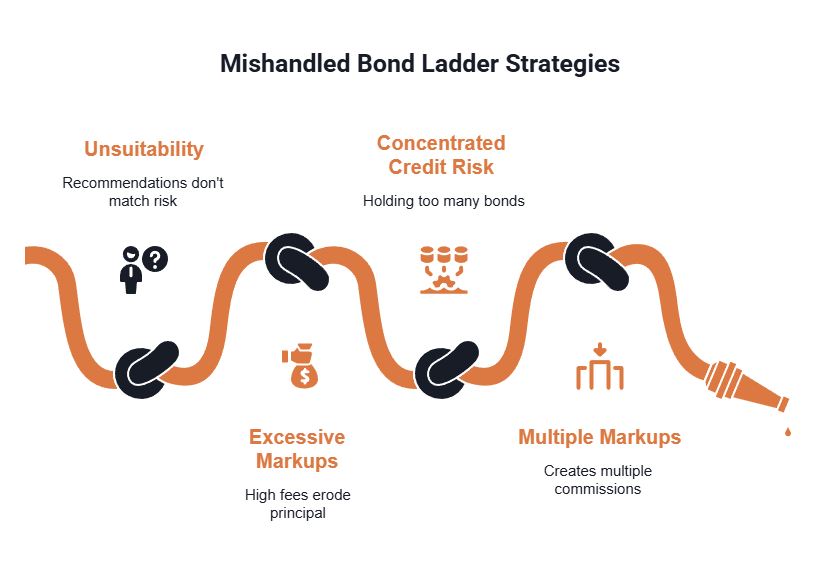
- Unsuitability: Recommendations that do not match your risk profile under FINRA Rule 2111.
- Excessive Markups: High transaction fees that erode principal, potentially violating FINRA Rule 2121.
- Concentrated Credit Risk: Holding too many bonds from the same issuer or high-risk sector.
A multi-rung design can create multiple markups and commissions. A 10-rung ladder with a 2% average markup can remove about 2% of your total allocation before any interest is paid. Regulation Best Interest (Reg BI) requires brokers to act in your best interest and consider lower-cost alternatives.
Our lawyers are nationwide leaders in investment fraud cases.
How Meyer Wilson Werning Supports Investors
Investors who believe they were harmed by abusive ladder structures or misleading sales practices can seek recovery through arbitration. Claims often focus on unsuitable design, hidden costs, and alleged breaches of duty. Build a paper trail of recommendations, markups, and trade timing to strengthen your case.
Meyer Wilson Werning has more than 26 years in business, over 75 years of combined experience, and has recovered $350+ million for thousands of clients nationwide. We represent investors in disputes involving misleading sales practices and unsuitable recommendations. If a broker, financial advisor, or firm recommended or facilitated the construction of your bond ladder, we can evaluate potential recovery options. Contact us today for a free and confidential consultation.
Frequently Asked Questions

Are bond ladders FDIC insured?
No. Ladders built with corporate, municipal, or Treasury securities are not FDIC insured. Only CD ladders carry FDIC insurance, up to $250,000 per depositor per bank.
How can I tell if my broker charged excessive markups on my bonds?
Review trade confirmations for markup disclosures required by FINRA Rule 2232. You can also compare your execution prices using TRACE for corporate bonds or EMMA for municipals to spot significant price differences.
What conflicts of interest can affect a bond ladder investment strategy?
Conflicts may arise if advisors prefer less-liquid bonds that carry higher markups, steering investors toward higher-cost choices that do not align with their conservative goals.
How can I recover losses from a bond ladder?
Many investors seek recovery through securities arbitration against the responsible firm. Preserve all account statements, emails, and trade confirmations. For more information on recovery options, it is advisable to consult with counsel experienced in FINRA matters.
Recovering Losses Caused by Investment Misconduct.