


Carnegie Capital Asset Management, LLC (doing business as Carnegie Investment Counsel) has been found liable for breach of fiduciary duty, civil conspiracy, and other misconduct, resulting in a significant arbitration award for harmed investors. On December 19, 2025, an arbitrator ordered the Ohio-based investment advisory firm to pay $2,324,000.00 in compensatory damages to eleven families who alleged they were misled during a corporate transition.
If you or someone you know suffered losses working with Carnegie Capital Asset Management or a related advisory firm, the attorneys at Meyer Wilson Werning are experienced in breach of fiduciary duty claims and are reviewing investor cases now. Contact us today for a free and confidential consultation, and you pay nothing unless we recover for you.
What Happened: The Case Against Carnegie Capital Asset Management
The dispute centered on a group of eleven Ohio families who were originally clients of a different firm, Private Wealth Consultants (PWC). According to the claims, the owners and operators of PWC had their investment adviser licenses revoked by the Ohio Division of Securities due to wrongful misconduct involving the sale of several private equity funds.
When Carnegie Capital Asset Management acquired PWC’s assets and transitioned these clients to their firm, the families alleged that Carnegie failed to protect their interests. Specifically, the investors claimed that Carnegie made misleading statements and committed material omissions during and after the transition process. Instead of receiving the transparent guidance they were owed, these families suffered significant financial damages.

We Have Recovered Over
$350 Million for Our Clients Nationwide.
Key Allegations and Findings in the Carnegie Arbitration
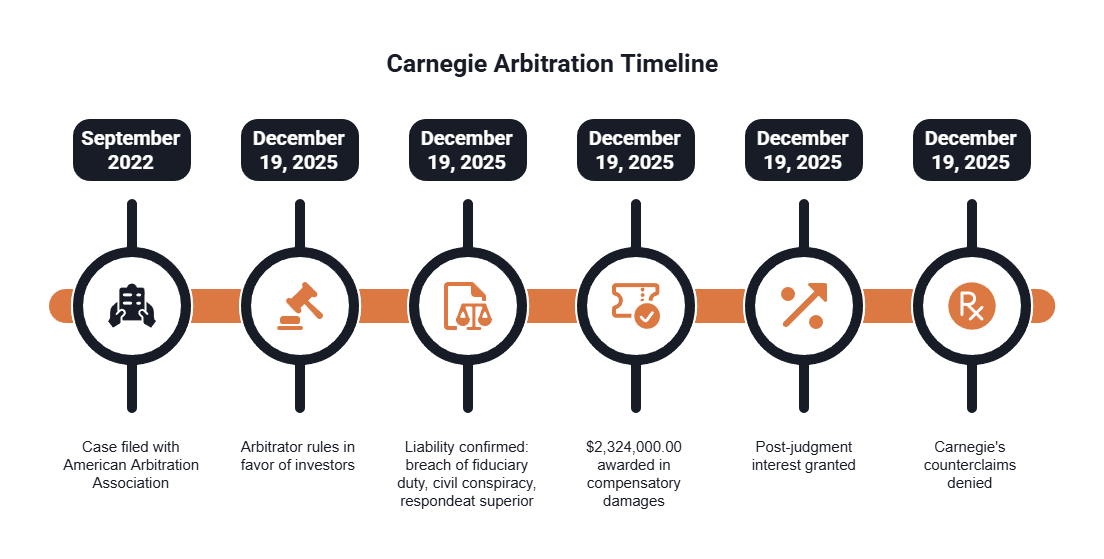
The case was filed with the American Arbitration Association in September 2022. After three years of proceedings, including three full weeks of evidentiary hearings conducted over sixteen days, the arbitrator ruled decisively in favor of the investors on December 19, 2025.
The Final Award confirmed the following:
- Liability: Carnegie was found liable for breach of fiduciary duty, civil conspiracy, and respondeat superior.
- Damages: The arbitrator awarded $2,324,000.00 in compensatory damages to be distributed among the eleven families.
- Interest: The arbitrator granted the investors’ request for post-judgment interest.
- Counterclaims Denied: All counterclaims filed by Carnegie against the investors were denied.
Why Fiduciary Duty Matters in Advisor Transitions
This case highlights a critical risk for investors: the vulnerability of client accounts during corporate acquisitions and transitions. When an investment firm like Carnegie Capital Asset Management purchases the assets of another firm—especially one with a troubled regulatory history like PWC—they assume a heightened responsibility to the incoming clients.
“As investment advisers, Carnegie owed these families the highest duty of loyalty, good faith, and full and fair disclosure known in the law,” said Courtney Werning, counsel for the claimants. “The evidence proved that Carnegie failed to meet this standard”.
Our lawyers are nationwide leaders in investment fraud cases.
The Outcome For Impacted Ohio Families
Following the arbitrator’s decision, Meyer Wilson Werning filed a petition in court to confirm the award. Carnegie subsequently paid the arbitration award in full, bringing closure to a long and difficult chapter for these families.
Important Points from the Case:
- Total Recovery: $2.324 million recovered for clients.
- Duration: The legal battle spanned over three years.
- Hearing Length: Evidence was presented over sixteen days of hearings.
- Key Firms: Carnegie Capital Asset Management (dba Carnegie Investment Counsel) and Private Wealth Consultants (PWC).
We Are The firm other lawyers
call for support.
How Meyer Wilson Werning Helps Carnegie Capital Investors
The misconduct identified in this case serves as a stark reminder that even established SEC-registered investment advisers can fail in their obligations to clients, particularly during complex corporate transactions. When firms prioritize their own expansion or protect their business interests over the financial safety of their clients, they must be held accountable for the resulting harm.
If you believe your financial advisor breached their fiduciary duty or misled you about the risks of an investment or transition, you do not have to face them alone. Meyer Wilson Werning has the experience and resources to level the playing field against powerful financial institutions, having recovered more than $350 million for clients nationwide. Contact us today for a free and confidential consultation to discuss your specific case and learn how the firm can assist in protecting your financial interests.
Frequently Asked Questions
What is a breach of fiduciary duty?
A breach of fiduciary duty occurs when a financial advisor fails to act in the best interest of their client. Investment advisers are legally required to prioritize their clients’ financial well-being, provide full and fair disclosure of all material facts, and act with the utmost good faith. When they fail to do so—by making misleading statements, omitting risks, or prioritizing their own profits—they can be held liable for the resulting losses.
Can I seek recovery if my investment advisor moves to a new firm?
Yes, you may have a claim if you suffered losses related to an advisor’s move or a firm’s acquisition. Corporate transitions can be high-risk periods where critical information is sometimes buried, or where unsuitable investments are pushed to retain assets. If your advisor or the acquiring firm failed to disclose material facts or misled you during the transition, you may be able to recover damages through arbitration.
How do I know if I have a case against Carnegie Capital?
If you were a client of Carnegie Capital Asset Management or Private Wealth Consultants (PWC) and experienced unexpected losses, lack of transparency, or misleading advice, you should have your portfolio reviewed by a legal professional. We offer a free case evaluation to determine if the firm’s conduct violated securities laws or fiduciary standards.
Recovering Losses Caused by Investment Misconduct.