


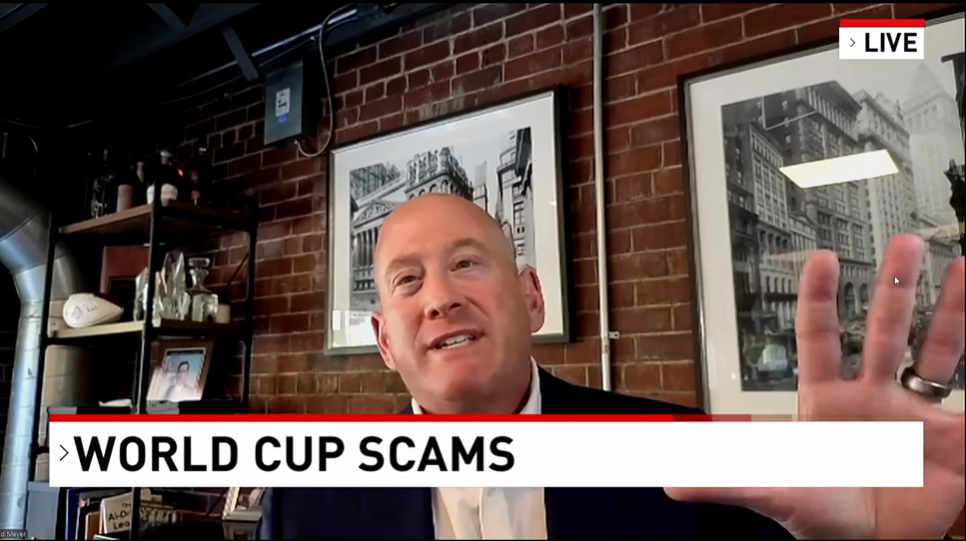
Meyer Wilson Werning founding partner David Meyer appeared on News 3 Las Vegas (KSNV) to sound the alarm on a surge of fraud schemes targeting 2026 FIFA World Cup fans, warning that scammers are deploying fake betting platforms, phishing links, wallet-draining QR codes, and AI-generated fan pages to steal money and personal information from people who are simply following the sport they love.
Las Vegas is one of sixteen cities hosting World Cup matches this summer, making it a focal point for both the excitement and the exploitation that follows global sporting events. David’s message to fans in Las Vegas and across the United States was direct, “Slow down before you click, scan, or pay.” The warning signs that once made fraud easy to detect are gone, and what has replaced them is a more sophisticated, more convincing, and more dangerous threat landscape, one where crypto fraud has become the preferred weapon of choice, than anything most fans have encountered before. You can read the full News 3 Las Vegas report here.
Why the 2026 FIFA World Cup Is a Prime Target for Fraud
The numbers behind this World Cup explain why it attracts scammers as reliably as it attracts fans. This is the largest FIFA World Cup in history, featuring 104 matches across 16 host cities spanning the United States, Canada, and Mexico. FIFA projects that approximately 6.5 million fans will attend matches in person, with a global television and streaming audience in the billions. More than 150 million ticket requests were submitted in the first 15 days of the sales window alone, making this edition roughly 30 times oversubscribed compared to previous tournaments.
That combination of enormous demand, significant financial transactions, and heightened emotional engagement is precisely what fraudsters build their operations around. People who are excited, distracted, and eager to participate in a once-in-a-generation event make decisions faster and verify less carefully than they otherwise would. Scammers understand this better than anyone.
Cybersecurity researchers have documented the scale of the fraud infrastructure already in place. More than 13,000 FIFA-themed domains were registered between January and May 2026 alone. By early May, before a single match had been played, roughly one in 41 of those domains had already been identified as suspicious or malicious.
This is not opportunistic fraud by individual bad actors. It is organized, industrialized, and operating at a scale that no individual fan can be reasonably expected to detect without guidance.

We Have Recovered Over
$350 Million for Our Clients Nationwide.
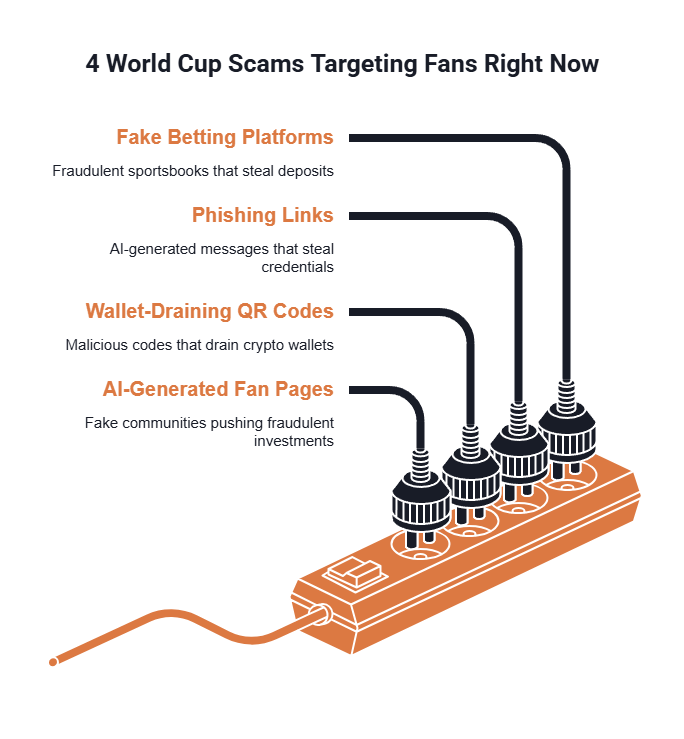
The Four Threats David Meyer Named on News 3
Fake Betting Platforms
Sports betting around the 2026 World Cup is operating at an unprecedented scale, and fraudsters have built fake sportsbooks specifically designed to exploit the millions of fans now comfortable depositing money into online platforms.
These operations are not crude or obviously suspicious. CybelAngel researchers identified one structured entirely around a fake FIFA betting platform, complete with promotional Telegram channels driving traffic, an automated bot handling deposits, and a customer service function managing complaints from people whose withdrawals never arrived. The model is straightforward: inflated bonus offers attract initial deposits, fabricated “withdrawal approved” messages are used as social proof to encourage more, and then the platform simply refuses to pay out. Cryptocurrency payment requirements, which David specifically flagged as a red flag on News 3, ensure that by the time someone realizes something is wrong, the funds are already irreversible.
Phishing Links Tied to Tournament Content
As David told News 3, fans need to be particularly alert when promotions or links appear tied to the World Cup but come from unfamiliar sources. Phishing has been the most prevalent category of online fraud for over a decade, and at the 2026 World Cup it is operating at a new level of scale.
AI is what changed the equation. Fraudsters can now generate massive volumes of highly personalized, professionally written phishing messages that reference real details about their targets, automating what was once a labor-intensive process and reaching millions of people simultaneously. The old verification methods, checking for spelling errors or suspicious domain names, no longer provide reliable protection. Verification now requires going directly to official sources and not following any link or advertisement, regardless of how legitimate it appears.
Wallet-Draining QR Codes
This is the threat David raised specifically for fans attending matches in person, and it deserves close attention from anyone traveling to Las Vegas, Dallas, Atlanta, Los Angeles, New York, or any other U.S. host city.
Attackers are placing malicious QR codes over legitimate ones in bars, restaurants, hotels, and other venues near match sites. Scanning what appears to be a menu, a Wi-Fi login page, or a merchandise offer may instead direct a fan to a site designed to capture payment information or drain a cryptocurrency wallet. The attack is nearly impossible to detect in a loud, crowded venue, and it requires no sophisticated technology on the fraudster’s part. The guidance is simple: do not scan unexpected QR codes in public venues. Ask staff for information directly rather than relying on posted codes.
AI-Generated Fan Pages
The fourth threat David highlighted is AI-generated fan pages that look completely legitimate but exist solely to collect data or funnel fans into fraudulent investment and betting schemes.
These pages take many forms: fake FIFA fan communities on social media, fabricated news and content sites covering the tournament, and deepfake video or audio content featuring athletes, FIFA officials, or celebrities promoting cryptocurrency investments and fake token launches. The deepfake technology behind these endorsements has advanced to the point where even cybersecurity professionals can struggle to distinguish fabricated content from genuine appearances. The only reliable defense is to verify any endorsement through the official channels of the person or organization being impersonated before taking any financial action based on what you see.
Why This Moment Requires Particular Vigilance
The investors and fans most at risk during the 2026 World Cup are not people who ignored warning signs. They are people who followed what appeared to be a reasonable process, clicked a link that looked official, scanned a code in a public place, or responded to a promotion that appeared in their social media feed because an algorithm determined they were interested in soccer. The fraud infrastructure surrounding this tournament has been built specifically to defeat the normal precautions that ordinarily protect people.
This is the context in which AI matters most. AI has not created new categories of fraud. It has made existing fraud nearly undetectable at scale. Fake sites, fake messages, fake endorsements, and fake platforms can now be produced in minutes rather than weeks, at volumes no single security team can track, and with a level of polish that bypasses the visual and linguistic cues that once allowed ordinary people to protect themselves.
The FBI’s 2023 Internet Crime Report flagged artificial intelligence as an accelerant across all major fraud categories. The FTC reported a 14% increase in AI-related fraud complaints in 2023. FINRA issued Regulatory Notice 24-09 specifically addressing AI-enabled misconduct. Regulators across the country are responding to this shift. So is the legal community.
David Meyer has spent over 25 years representing investors who lost money to sophisticated financial fraud, including cases rooted in financial advisor negligence and fraudulent investment schemes promoted through channels that appeared completely legitimate.
Our lawyers are nationwide leaders in investment fraud cases.
What Fans Should Do Right Now
The guidance David provided on News 3 is the starting point, and it is worth repeating:
- Watch for red flags when any promotion or link appears tied to the World Cup but comes from an unfamiliar source. Official communications from FIFA come through FIFA.com and verified social media accounts. Anything else requires independent verification before any financial action.
- Treat cryptocurrency payment requests as an automatic red flag. No legitimate ticket platform, official broadcaster, or FIFA-affiliated service requires payment in cryptocurrency. If a platform insists on crypto payment, treat it as fraudulent until definitively proven otherwise.
- Do not scan unexpected QR codes in venues near match sites. Ask staff for information directly rather than relying on posted codes.
- Verify any endorsement independently before acting on it. AI-generated deepfakes can be indistinguishable from genuine content. An official channel is the only reliable source.
- Act quickly if you suspect fraud. Cryptocurrency transactions are largely irreversible once processed. The window for tracing funds and exploring recovery options closes quickly
We Are The firm other lawyers
call for support.
About David Meyer
David Meyer is the founding partner of Meyer Wilson Werning and one of the most experienced investor protection attorneys in the United States. He won the largest civil jury verdict in Ohio history at age 32, a $262 million verdict against Prudential Securities, and has led his firm to more than $350 million in total recoveries for individual investors, retirees, and fraud-affected families over more than 25 years of practice. He is a past president of PIABA, the Public Investors Advocate Bar Association, and a past president of the Ohio Association for Justice. He is the author of The Investor Protector, an Amazon No. 1 Bestseller that gives everyday investors the tools to recognize, avoid, and fight back against financial misconduct before they ever need an attorney.
Meyer Wilson Werning represents investors nationwide and handles cases involving cryptocurrency fraud, broker misconduct, Ponzi scheme recovery, elder financial exploitation, and the full range of investment misconduct. The firm’s dedicated cryptocurrency claims platform, Crypto.court, was built specifically to pursue claims arising from exchange failures, wallet-draining schemes, and emerging crypto fraud. If you believe a financial professional, brokerage, or exchange played a role in your loss, contact us today for a free and confidential consultation. All cases are handled on a contingency fee basis. Clients pay nothing unless the firm recovers money.
Frequently Asked Questions

What are the most common scams targeting 2026 FIFA World Cup fans?
Cybersecurity researchers and law enforcement have identified four primary fraud categories surrounding the 2026 tournament: fake sports betting platforms that steal deposits, phishing links tied to World Cup content, wallet-draining QR codes placed in venues near match sites, and AI-generated fan pages promoting fraudulent cryptocurrency investments. Each of these was specifically addressed by attorney David Meyer during his appearance on News 3 Las Vegas.
How can you tell if a World Cup betting site or ticket platform is legitimate?
The most reliable indicators of a fraudulent platform are requests for cryptocurrency payment, pressure to act quickly, and bonus offers that seem disproportionately generous. Legitimate FIFA-affiliated platforms and licensed sportsbooks do not require payment in cryptocurrency, and they are verified through official FIFA channels at FIFA.com. Any platform that cannot be confirmed through an official source should be treated with extreme caution before any funds are deposited.
Is it safe to scan QR codes at World Cup venues and surrounding areas?
Not without verification. Fraudsters have been documented placing malicious QR codes over legitimate ones in bars, restaurants, hotels, and other venues near match sites in host cities including Las Vegas, Dallas, Atlanta, Los Angeles, and New York. Scanning one of these codes can redirect a fan to a site designed to capture payment credentials or drain a cryptocurrency wallet. When in doubt, ask staff for information directly rather than relying on any posted code.
What should you do if you sent money to a fake World Cup betting platform or crypto scheme?
Act immediately. Cryptocurrency transactions are largely irreversible once processed, which means the window to trace funds or pursue any form of recovery narrows quickly. Document everything, including screenshots of the platform, any communications received, transaction records, and wallet addresses. Report the incident to the FTC at ReportFraud.ftc.gov and to the FBI’s Internet Crime Complaint Center at IC3.gov. If a licensed financial professional or advisor was involved in directing you toward the platform, legal options may also be available.
Why is AI making World Cup fraud harder to detect in 2026 compared to past tournaments?
AI has not created new fraud categories. It has made existing ones nearly undetectable at scale. Fraudsters can now generate professional-quality fake websites, personalized phishing messages, and deepfake video endorsements featuring athletes or officials in minutes rather than weeks, and at volumes that overwhelm traditional detection methods. The spelling errors, awkward language, and suspicious domain names that once served as warning signs have largely disappeared. As David Meyer noted on News 3, the warning signs that once made fraud easy to identify are gone, and what has replaced them requires a different level of vigilance from fans at every stage of their World Cup experience.
Recovering Losses Caused by Investment Misconduct.