


When bridge loans are presented as “safe,” families often rely on those assurances to fund retirements, college plans, and long-term security. According to the Securities and Exchange Commission (SEC), investors in First Liberty Building & Loan and offerings connected to Edwin Brant Frost IV now face missed payments and frozen accounts tied to alleged misconduct involving more than $140 million.
Three hundred investors. $140 million. A “safe” bridge loan program that was anything but. If you lost money in First Liberty Building & Loan because a licensed financial advisor or registered broker recommended it to you, there may be a path to recovery outside the SEC’s receivership. Our Ponzi scheme attorneys at Meyer Wilson Werning can help determine if the firm that sold you this investment can be held liable for failing to protect you. Contact us today for a free and confidential consultation, you pay nothing unless we recover for you.
What are the First Liberty SEC Charges in the Alleged Ponzi Scheme?
According to the SEC’s complaint, Edwin Brant Frost IV and First Liberty Building & Loan raised at least $140 million through promissory notes and loan participation agreements tied to short-term business bridge loans. The Commission asserts that the defendants allegedly used substantial new investor funds to pay existing investors.
The legal action, filed in the U.S. District Court for the Northern District of Georgia, charges the defendants with violating Section 17(a) of the Securities Act of 1933 and Section 10(b) of the Securities Exchange Act of 1934 and Rule 10b-5. On July 11, 2025, a federal judge granted emergency relief—including an asset freeze and the appointment of a receiver—after regulators alleged that “safe” bridge loans and high yields masked significant loan defaults and the misuse of investor funds.

We Have Recovered Over
$350 Million for Our Clients Nationwide.
What do SEC Filings Reveal About First Liberty Building & Loan and Edwin Brant Frost IV?
Regulatory filings describe a progression from “friends-and-family” investments to broader public outreach through radio, podcasts, and the company website.
Important Points for concerned investors include:
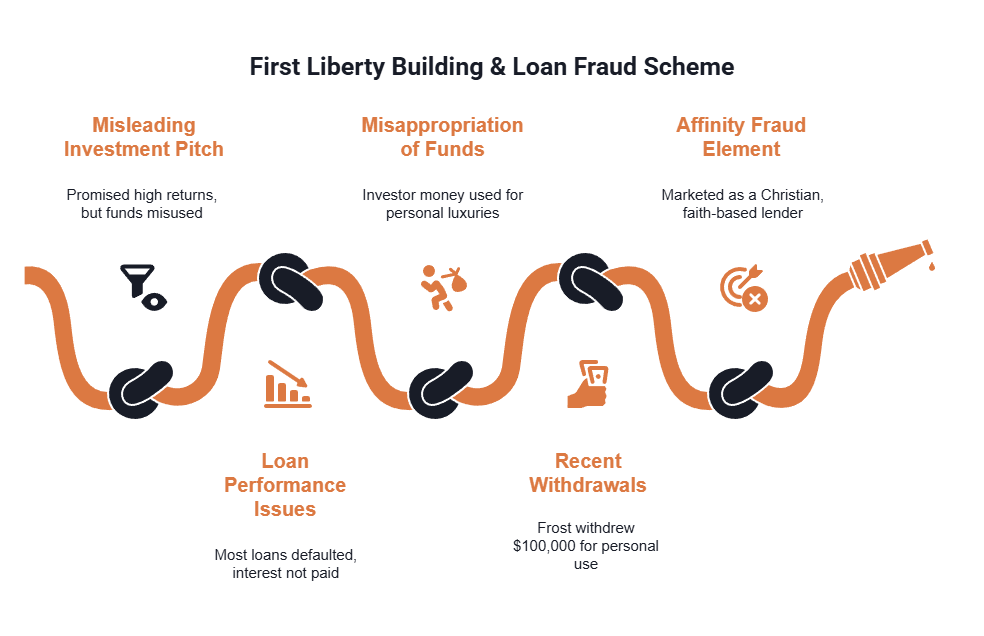
- Massive Fraud Allegations: The SEC alleges that First Liberty Building & Loan, LLC and founder Edwin Brant Frost IV defrauded approximately 300 investors of at least $140 million.
- Misleading Investment Pitch: Funds were purportedly raised to finance “short-term small business loans at relatively high interest rates,” with returns offered up to 18%.
- Loan Performance Issues: While some bridge loans were made, the SEC asserts few were repaid in full; most allegedly defaulted and stopped paying interest, yet investor payments continued via new investor money since at least 2021.
- Misappropriation of Funds: The complaint alleges Edwin Brant Frost IV used investor money for personal luxuries, including more than $2.4 million in credit card payments, $335,000 at a rare coin dealer, and $230,000 on family vacations.
- Recent Withdrawals: As recently as May 24, 2025, Frost reportedly withdrew $100,000 for personal use.
- Affinity Fraud Element: Promotional materials cited by regulators indicate the enterprise was marketed as a Christian faith-based investment, targeting religious communities
How Can a Securities Fraud Lawyer at Meyer Wilson Werning Pursue Recovery?
A court-appointed receiver can freeze assets. It rarely makes investors whole. The families who trusted Edwin Brant Frost IV with their retirement savings, many through faith-based networks that made the pitch feel safe, deserve more than what a receiver can offer.
If a registered broker, financial advisor, or brokerage firm directed you to First Liberty, that referral could be the basis for a separate arbitration claim. Meyer Wilson Werning holds these firms responsible for failing to perform due diligence on the investments they recommend. Contact us today for a free and confidential consultation. We only get paid if you do.
Our lawyers are nationwide leaders in investment fraud cases.
Frequently Asked Questions
What do the First Liberty SEC charges allege about investor funds?
According to the SEC, money raised for bridge loans allegedly supported ongoing payments to earlier investors and personal expenditures for Edwin Brant Frost IV, while the underlying loans underperformed or defaulted.
Can I recover my money from the First Liberty Ponzi scheme?
Often, yes. Depending on your documents and how you purchased, potential paths include court litigation, arbitration, and claims coordinated with the court-appointed receiver. An experienced investor-rights firm can assess your documents to identify all potential defendants and pursue a tailored recovery plan.
What documents should I gather right now?
Investors should preserve all subscription agreements, promissory notes, participation agreements, account statements, payment records, tax forms (including any 1099s), and communications such as emails or text messages.
My advisor or a contact recommended First Liberty—could they be liable?
Possibly. If a registered broker, adviser, or firm recommended the investment, duties related to suitability and supervision may apply. An attorney can review referral communications and compensation arrangements to identify responsible parties.
What is the current status of the legal action?
As of July 11, 2025, the court has granted an asset freeze and appointed a receiver to oversee the entities controlled by Frost. The SEC investigation is ongoing.
Recovering Losses Caused by Investment Misconduct.