


Giovanni Pennetta, the managing partner of Manhattan-based Sestante Capital LLC, has been sentenced to four years in federal prison for wire fraud by U.S. District Judge Jed S. Rakoff in the Southern District of New York. The court also ordered Pennetta to pay $11,928,266.25 in restitution and $12,546,279.86 in forfeiture. For investors who lost money through Sestante Capital and its related fund, NextGenTech Investments LLC, the sentence closes one chapter, but it does not return a single dollar to their accounts.
If you invested in Sestante Capital or NextGenTech Investments, including through a Forge Securities broker, the attorneys at Meyer Wilson Werning are actively reviewing pre-IPO investment fraud losses and can help evaluate whether your losses are the result of actionable misconduct. Contact us today for a free and confidential consultation, and you pay nothing unless we recover for you.
The Mechanics of the Sestante Capital Pre-IPO Scheme
From 2019 through late 2025, Pennetta orchestrated a multi-million dollar fraud through Sestante Capital LLC, which also managed the private fund NextGenTech Investments LLC. Investors were lured with promises of early access to fast-growing private technology companies, the kind of exclusive opportunities that are rarely available to individual investors.
According to federal prosecutors, Pennetta’s pitches centered on access to shares of Anduril Industries, Inc., a private defense technology company valued at approximately $30 billion, as well as SpaceX. He allegedly told investors he had obtained this access through personal connections and offered to sell them economic exposure by purchasing membership interests in specific NextGenTech fund series.
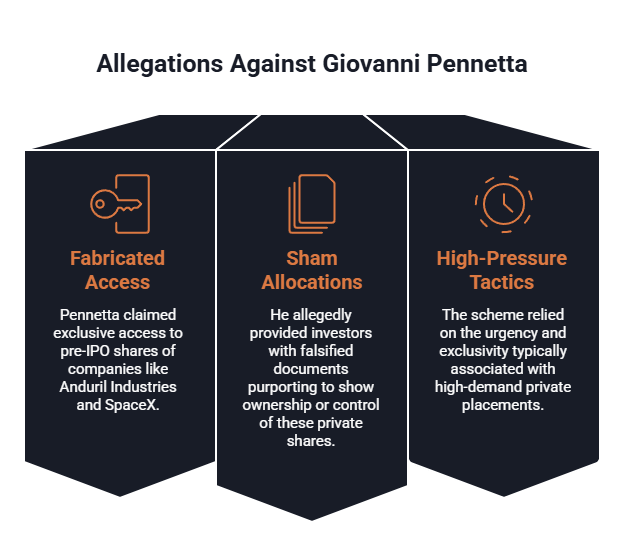
Key Points of the Allegations:
- Fabricated Access: Pennetta claimed exclusive control over pre-IPO shares he did not own or have any right to sell.
- Sham Allocations: He allegedly provided investors with falsified documents purporting to show legitimate ownership of or exposure to private company shares.
- Misappropriated Funds: Rather than investing client money, prosecutors allege Pennetta moved more than $10 million in investor funds directly into his personal bank account.
- High-Pressure Tactics: The scheme relied on urgency and the illusion of exclusivity typically associated with high-demand private placements.
Notably, Anduril Industries itself had publicly warned that unauthorized parties were attempting to sell fabricated investment opportunities involving its shares, stating plainly that any offer not originating directly from Anduril is “very likely a scam.” Investors looking for guidance on how to spot schemes like this one can review the top warning signs of investment fraud. The SpaceX pre-IPO fraud landscape has also drawn significant regulatory attention as fraudsters increasingly exploit household-name private companies to attract victims.

We Have Recovered Over
$350 Million for Our Clients Nationwide.
Understanding the Pennetta Sentencing Date and Criminal Restitution
Pennetta was arrested at John F. Kennedy International Airport on December 15, 2025, and a federal indictment was unsealed shortly thereafter by the U.S. Attorney’s Office for the Southern District of New York. He was charged with securities fraud, wire fraud, and aggravated identity theft. Each securities fraud and wire fraud count carried a potential maximum sentence of 20 years. The case was handled by the Securities and Commodities Fraud Task Force.
On March 5, 2026, Pennetta entered a guilty plea to wire fraud. At sentencing, U.S. District Judge Jed S. Rakoff imposed the following:
- Prison term: Four years in federal prison
- Restitution ordered: $11,928,266.25
- Forfeiture ordered: $12,546,279.86, representing proceeds of the fraud
- Guilty plea: Wire fraud, entered March 5, 2026
- Presiding judge: U.S. District Judge Jed S. Rakoff, Southern District of New York
Why the Restitution Order Is Not Enough
A restitution order and an actual payment are two very different things. Criminal restitution orders direct a convicted individual to repay stolen funds, but collection depends entirely on what assets remain. By the time a defendant like Pennetta is sentenced, most of the stolen funds have typically been spent or moved. With more than $10 million already misappropriated and largely untraceable, many investors may see little to nothing from the criminal process alone.
Restitution also targets only the individual wrongdoer. It does not reach the brokerage firms and financial intermediaries that may have enabled the fraud, entities with far greater financial resources than an incarcerated defendant. That is precisely why civil claims through arbitration remain the more realistic path to meaningful investment loss recovery for most investors.
Our lawyers are nationwide leaders in investment fraud cases.
The Civil Case Against Forge Securities
Many investors who lost money through NextGenTech Investments did not deal directly with Pennetta. They were directed into the scheme through brokers at Forge Securities LLC, a FINRA-registered broker-dealer and a wholly owned subsidiary of Forge Global Holdings, Inc. (NYSE: FRGE). For background on Forge Global’s operations and its pending acquisition by Charles Schwab, see MWW’s Forge Global investigation page.
Registered brokers have legal obligations that extend well beyond processing paperwork. Under Regulation Best Interest and FINRA Rule 2111, a broker who recommends an investment must conduct meaningful due diligence, including verifying that a fund actually holds the assets it claims to hold. A broker cannot simply accept a fund manager’s claims at face value, particularly when those claims involve access to shares of a private company that strictly controls its own share distribution.
A broker exercising reasonable care would have investigated whether Pennetta’s claimed access to Anduril shares was legitimate. The central question for affected investors is whether their Forge broker did so. If the firm’s supervision systems failed to catch these red flags, that may give rise to a failure-to-supervise claim against Forge Securities directly. Investors should also consider whether misrepresentations or omissions were made about the nature and risks of the NextGenTech fund series.
If Forge Securities brokers failed that standard, affected investors may have viable FINRA arbitration claims against the firm, entirely separate from the criminal case against Pennetta and against a respondent with actual assets to satisfy a judgment.
We Are The firm other lawyers
call for support.
How Meyer Wilson Werning Helps Giovanni Pennetta Investors
The federal action against Sestante Capital LLC highlights the hidden risks of opaque private placements and pre-IPO schemes. This case demonstrates that exclusive investment opportunities are sometimes designed to deceive, reinforcing the reality that brokerage firms have a strict duty to properly supervise their representatives and protect their clients.
Meyer Wilson Werning demands accountability from financial institutions that fail to prevent these destructive schemes. With more than 25 years in the industry and over $350 million recovered for clients, our legal team provides the aggressive representation required to pursue your claim. Contact us today for a free and confidential consultation to learn how our firm can assist in protecting your financial interests.
Frequently Asked Questions

What sentence did Giovanni Pennetta receive for the Sestante Capital fraud?
Pennetta was sentenced to four years in federal prison for wire fraud by U.S. District Judge Jed S. Rakoff in the Southern District of New York. The court also ordered him to pay $11,928,266.25 in restitution and $12,546,279.86 in forfeiture representing proceeds of the scheme.
Will the criminal restitution order return my investment losses?
Not necessarily. A restitution order requires Pennetta to repay investors, but collection depends on what assets remain. With more than $10 million already misappropriated and spent, many investors may see little to nothing from the criminal process. Arbitration claims against the brokerage firms that facilitated the investments are typically a stronger path to recovery.
Can I hold my broker responsible for recommending Sestante Capital or NextGenTech Investments?
Yes. Financial advisors and brokerage firms have a strict regulatory duty to perform due diligence on every product they recommend. Under Regulation Best Interest and FINRA Rule 2111, a broker cannot simply accept a fund manager’s claims at face value. If Forge Securities brokers failed to identify the red flags of this multi-million dollar pre-IPO scheme, they could be held financially liable for your losses through arbitration.
Can I still pursue a civil claim after the sentencing?
Yes. The criminal sentencing does not affect investors’ rights to pursue separate arbitration claims against Forge Securities LLC or any brokers who directed them into Sestante Capital or NextGenTech Investments. These claims are evaluated entirely independently of the criminal case. Time limits apply, so early action is important.
Recovering Losses Caused by Investment Misconduct.