


California Assembly Bill 871, signed by Governor Newsom in September 2026, rewrites the obligations of mandated reporters of suspected financial abuse of an elder or dependent adult at banks, credit unions, broker-dealers, and other financial institutions. Starting January 1, 2028, every officer and employee of a covered financial institution who files a state report under Welfare and Institutions Code Section 15630.1 must also file a separate report with the FBI’s Internet Crime Complaint Center (IC3) within two working days, and then notify the affected individual within 48 hours. The law adds a federal reporting layer, along with training and penalty provisions, that applies to every institution doing business in California.
Investors and families concerned about broker misconduct or suspicious account activity affecting an older adult should understand how this new law changes the reporting process and what protections it creates.
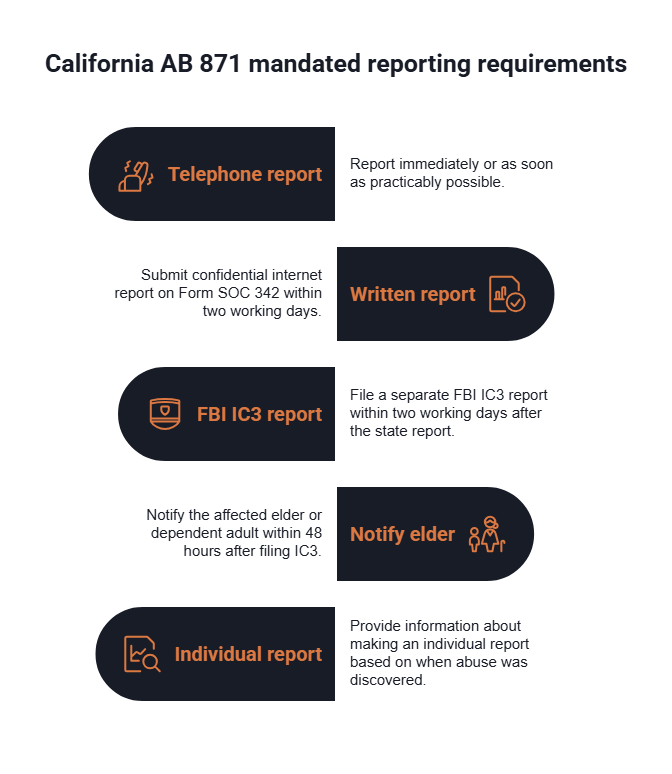
What California AB 871 Requires (Effective January 1, 2028)
AB 871, introduced by Assembly Member Catherine Stefani, moved through the Assembly Banking and Finance Committee, cleared the full Assembly, passed the Senate Judiciary Committee, received Senate approval, secured Assembly concurrence, and was signed by Governor Newsom on September 20, 2026, according to the Governor’s September 20, 2026 legislative update. Chaptered as Chapter 360, Statutes of 2026, it has an operative date of January 1, 2028.
Under existing California law, mandated reporters at financial institutions must make a telephone report immediately or as soon as practicably possible when they suspect financial abuse of an elder or dependent adult, with a written or confidential internet report using Form SOC 342 to follow within two working days. AB 871 preserves these obligations in full.

We Have Recovered Over
$350 Million for Our Clients Nationwide.
New Requirements Added by AB 871
The new law adds two requirements:
- IC3 report within two working days. After completing the state report, the mandated reporter must file a separate report with the FBI’s IC3 portal within two working days. This is the first time California has directed a state-mandated elder-abuse report into the federal IC3 system.
- 48-hour notice to the affected adult. After filing the IC3 report, the financial institution must generally notify the affected elder or dependent adult within 48 hours and provide information about making an individual report, including when the suspected abuse was discovered within 48 hours of a transaction.
The California Senate Judiciary analysis of AB 871 also states that the bill requires training programs for officers and employees on how to identify suspected elder financial abuse and comply with the new IC3 and notification procedures. The California AB 871 requirements apply to every officer and employee at a covered institution, not only compliance departments or management.
The state and federal reports serve different functions. The state report is directed to the local adult protective services agency or law enforcement, while the IC3 report goes to a federal clearinghouse that feeds data to the FBI and other federal agencies. Before this law, a California state report did not automatically trigger federal filing. AB 871 closes that gap.
Penalties for failing to report elder financial abuse in California already include potential misdemeanor liability under the Welfare and Institutions Code. AB 871 extends potential exposure by making the IC3 filing and notification steps part of the mandated reporting obligation, so an institution or individual reporter who completes the state filing but neglects the IC3 report or the 48-hour notice may face separate liability once the law takes effect.
What This Means for Investors Under California AB 871
Elder financial abuse often occurs in accounts held by brokerage firms, banks, and advisory practices. When a financial professional engages in unauthorized trading, excessive fees, or account manipulation targeting an older client, the institution’s own employees may be among the first to detect it. Under AB 871, those employees must file reports not only with California authorities but also with the FBI.
For retirees and their families, the elder financial abuse 48-hour notice provision is significant. Under current law, an elder or dependent adult may not learn that their financial institution filed a suspicious-activity report on their behalf. AB 871 changes that by requiring direct notification and information about filing an individual IC3 complaint.
Suspected financial advisor negligence or a breach of fiduciary duty that targets an elder client could trigger the new reporting chain. If an institution does not follow these obligations, that failure may become evidence of supervisory breakdowns in a later investment loss recovery claim or arbitration proceeding.
Mandated reporter training for financial institutions should cover warning signs such as sudden changes in account beneficiaries, large unexplained withdrawals, new powers of attorney granted under unclear circumstances, and patterns of transfers to unfamiliar third parties. If you or a family member have experienced any of these situations, the institution handling the account may already have reporting obligations under existing law and, after January 1, 2028, under AB 871.
Our lawyers are nationwide leaders in investment fraud cases.
How Meyer Wilson Werning Can Help
Meyer Wilson Werning represents investors nationwide, including retirees and older adults who have suffered losses from financial abuse, unauthorized transactions, and supervisory failures at brokerage firms and financial institutions. With more than 75 years of combined experience and over $350 million recovered for clients, the firm’s attorneys understand how institutional failures to detect and report elder financial abuse can compound investor harm.
Contact us today for a free and confidential consultation to discuss your options.
We Are The firm other lawyers
call for support.
Frequently Asked Questions

Who is a mandated reporter under California AB 871?
The law identifies all officers and employees of financial institutions as mandated reporters of suspected financial abuse of an elder or dependent adult under Welfare and Institutions Code Section 15630.1. This includes personnel at banks, savings associations, credit unions, broker-dealers, and other covered entities.
What does AB 871 require financial institutions to report to the FBI?
When a mandated reporter files a required state report of suspected elder or dependent-adult financial abuse, AB 871 adds a separate obligation to file a report with the FBI’s Internet Crime Complaint Center (IC3) within two working days. The existing California reporting duties to local adult protective services and law enforcement remain in place and must still be completed.
When does AB 871 take effect?
AB 871 was chaptered as Chapter 360, Statutes of 2026, after Governor Newsom signed it on September 20, 2026. The new IC3 reporting and notification requirements become operative on January 1, 2028, giving financial institutions time to update training and compliance procedures.
What notice must a financial institution provide to an affected elder or dependent adult?
After filing the required IC3 report, the financial institution must generally notify the affected elder or dependent adult within 48 hours. The notice must include information about how the individual can file their own report, including when the suspected abuse was discovered within 48 hours of a transaction.
Can investors pursue a claim if a financial institution fails to report suspected elder financial abuse?
An institution’s failure to follow mandated reporting obligations may be relevant to a broader claim involving supervisory breakdowns, broker misconduct, or negligent oversight. Meyer Wilson Werning has recovered over $350 million for clients and offers free and confidential consultations to evaluate whether a recovery path exists through FINRA arbitration or other proceedings.
Recovering Losses Caused by Investment Misconduct.