


According to public filings and a mounting list of customer claims, Marc Frederick Korsch is at the center of a significant series of regulatory and legal challenges. With more than $7,410,000 in alleged damages across multiple disputes, the Marc Frederick Korsch regulatory and customer dispute disclosures highlight a troubling pattern of suitability concerns and high-risk investment recommendations. If you believe your portfolio suffered losses connected to these issues, you may have options beyond waiting for regulators to act.
If you worked with Marc Korsch and suffered losses tied to unsuitable or illiquid investment recommendations, the alternative investment loss attorneys at Meyer Wilson Werning are reviewing investor claims now. Contact us today for a free and confidential consultation, and you pay nothing unless we recover for you.
Marc Korsch BrokerCheck and CRD #5525226: Current Disclosures
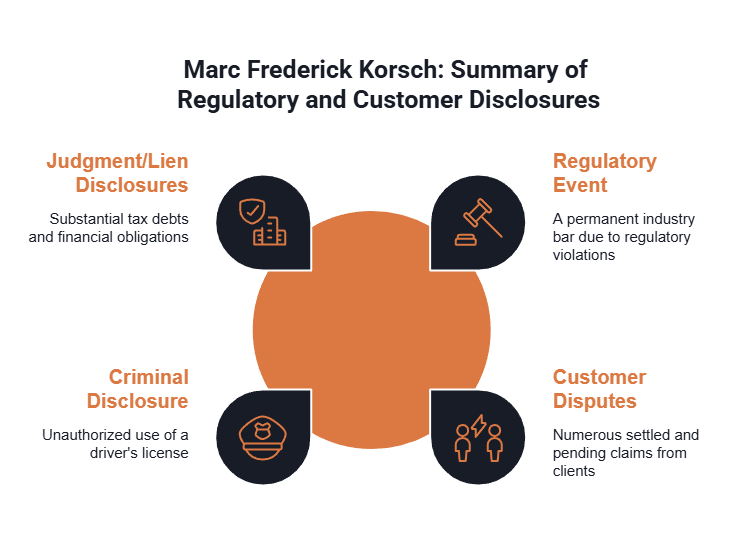
The professional record for Marc Frederick Korsch (CRD #5525226), as reflected in the FINRA BrokerCheck report accessed on January 19, 2026 (with updates noted through January 29, 2026), contains a high volume of red flags. The report currently lists:
- One regulatory event resulting in a permanent industry bar.
- 64 customer disputes, including dozens of settled and pending claims.
- One criminal disclosure involving the unauthorized use or possession of a driver’s license, which a broker comment states involved false identification.
- Five judgment/lien disclosures, including substantial tax debts.
Marc Korsch is not currently registered as a broker. He was previously associated with several firms, including Arkadios Capital, Centaurus Financial, Inc., and Trustmont Financial Group, Inc..
Important Points from Recent Filings
While the record includes dozens of complaints, recent examples illustrate the types of allegations investors are bringing forward:
- January 6, 2026: A customer alleged that in August 2019 and April 2020, Korsch recommended unsuitable, complex investments, requesting $130,000 in damages.
- November 19, 2025: A customer alleged that in early 2020, Korsch recommended an unsuitable, high-risk, and illiquid investment. The claimant is seeking $100,000 in damages in a pending arbitration (Case #25-02450).
- December 30, 2025: A customer alleged a breach of fiduciary duty related to Debt-Corporate products. This matter is also pending arbitration (Case #25-02838).

We Have Recovered Over
$350 Million for Our Clients Nationwide.
Why the Marc Korsch Permanent Bar Elevates Investor Risk
On March 4, 2022, FINRA ordered a permanent bar against Marc Korsch, prohibiting him from associating with any FINRA member firm in any capacity. This extreme disciplinary action followed a December 1, 2021, regulatory filing alleging that Korsch failed to respond to FINRA requests for information.
The Rules Behind the Bar
Under FINRA Rule 8210, the regulator has the authority to require brokers to provide testimony, documents, and records during an investigation. When a broker refuses to cooperate, FINRA may use Rule 9552, an expedited proceeding rule, to suspend or permanently bar the individual to protect the investing public.
For investors, a permanent bar is a severe warning sign. It often indicates that a broker chose to leave the industry rather than answer questions about their conduct or specific transactions.
Understanding Suitability and Regulation Best Interest (Reg BI)
Many of the claims against Marc Korsch center on “unsuitable” recommendations. Historically, the “suitability” standard required that recommendations fit a client’s profile.
As of June 30, 2020, the SEC implemented Regulation Best Interest (Reg BI), which raised this standard. Reg BI requires brokers to:
- Act in the Best Interest of the retail customer at the time of the recommendation.
- Disclose Material Facts regarding fees, conflicts of interest, and the scope of services.
- Exercise Reasonable Care by considering costs, risks, and potential alternatives.
- Mitigate Conflicts that might incentivize a broker to favor one product over another.
Claims involving Marc Korsch frequently reference high-commission or illiquid products. These types of “alternative investments” often carry high internal fees and “lock-up” periods that prevent investors from accessing their cash for years, making them inherently risky for retirees or conservative investors.
Our lawyers are nationwide leaders in investment fraud cases.
Financial Pressures: Liens and Judgments
An advisor’s personal financial stability can sometimes be a red flag for “incentivized” selling. Marc Korsch’s BrokerCheck report lists five active liens or judgments totaling $1,336,366.89. Notable filings include:
- December 15, 2020: A tax lien for $479,998.20.
- March 23, 2021: An IRS tax lien for $392,011.65 filed in Sarasota, Florida.
- April 20, 2021: An IRS tax lien for $47,975.84 filed in Sarasota, Florida.
We Are The firm other lawyers
call for support.
How Meyer Wilson Werning Helps Defrauded Investors
Marc Korsch has 64 customer disputes on record, a permanent FINRA bar, and more than $1.3 million in active tax liens and judgments. The firms that employed him had a legal duty to supervise his activities and protect the clients in his book. For the investors who lost money on illiquid, high-commission products they were told were suitable, the arbitration process may be the most direct path to recovery.
Meyer Wilson Werning has recovered more than $350 million for investors across the country over the past 25 years. If you suffered losses while working with Marc Korsch at any of his affiliated firms, contact us today for a free and confidential consultation. You pay nothing unless we recover for you.
Frequently Asked Questions
What should I do if I find a red flag on my advisor’s BrokerCheck report?
If you discover a permanent bar, multiple customer complaints, or substantial tax liens, you should immediately review your account statements. Look for high-risk products or “overconcentration” in a single sector. It is often wise to seek a second opinion from a qualified legal professional.
How does the FINRA permanent bar affect my ability to recover losses?
A permanent bar stops an advisor from associating with FINRA members, but it does not stop you from pursuing a claim for past misconduct. You can still file an arbitration claim against the brokerage firm that employed the advisor at the time of the misconduct, as firms have a legal duty to supervise their representatives.
What is the difference between a “suitable” investment and one in my “best interest”?
The historical “suitability” standard only required that an investment generally fit your profile. Regulation Best Interest (Reg BI) is a higher standard that requires the broker to prioritize your interests above their own, specifically considering the costs of the investment and potential alternatives.
Are tax liens relevant to an advisor’s professional conduct?
While a tax lien is a financial disclosure, significant unpaid debt may be viewed by some as a potential risk factor. An advisor under heavy financial pressure may be more likely to recommend high-commission products that benefit the advisor’s income more than the client’s portfolio.
Recovering Losses Caused by Investment Misconduct.