


On May 28, 2026, the Securities and Exchange Commission filed a civil complaint against Nathan Fuller, a resident of Cypress, Texas, alleging that he raised approximately $12.3 million from roughly 150 investors across nine states by promising returns of 40% to over 100% in as little as 21 to 45 days through what he described as a proprietary AI-powered crypto trading operation. According to the SEC, only approximately $380,000, roughly 3% of investor funds, was ever used to purchase cryptocurrency, and those trades were executed without the advertised bots and produced no profit.
If a licensed financial professional, broker, or advisor directed you toward Fuller, Privvy Investments, or Gateway Digital Investments, the crypto fraud attorneys at Meyer Wilson Werning are reviewing claims now. Contact us today for a free and confidential consultation, and you pay nothing unless we recover for you.
What the SEC Alleges Nathan Fuller Did
According to the SEC’s complaint, Fuller operated his alleged scheme from at least October 2022 through mid-2024, selling passive joint-venture interests in what he described as a proprietary crypto arbitrage operation. He conducted this business through his company Privvy Investments, LLC and under the assumed business names Privvy Investments and Gateway Digital Investments.
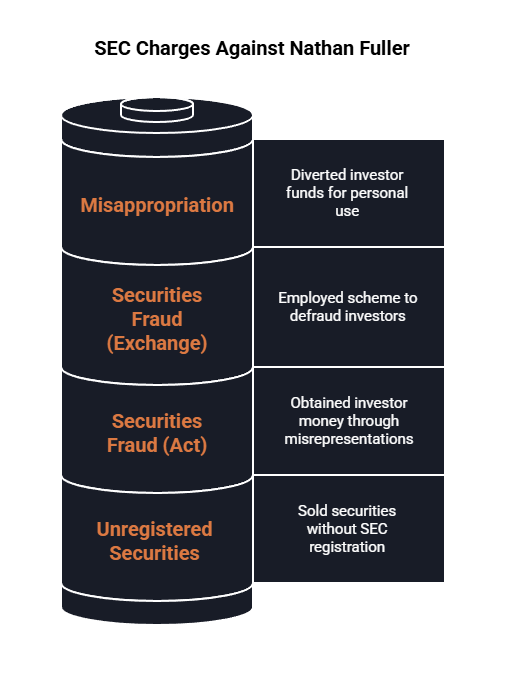
The SEC’s filing sets out several distinct violations:
- Unregistered securities offerings. The complaint alleges Fuller violated Sections 5(a) and 5(c) of the Securities Act of 1933 by offering and selling securities that were neither registered with the SEC nor exempt from registration.
- Securities fraud under the Securities Act. The SEC alleges Fuller violated Section 17(a) by obtaining investor money through material misrepresentations and omissions.
- Securities fraud under the Exchange Act. Fuller allegedly violated Section 10(b) of the Securities Exchange Act of 1934 and Rule 10b-5 by employing a scheme to defraud and making materially false statements to investors.
- Misappropriation. The SEC alleges Fuller diverted at least $6.2 million in investor funds for personal use, including the purchase of a home, casino gambling, travel, and vehicles, while routing approximately $5.5 million into Ponzi-like payments to earlier investors to sustain the appearance of legitimate returns.
Before the SEC filed its complaint, Fuller had already faced scrutiny in another forum: bankruptcy proceedings in which the Department of Justice reported that Fuller was denied discharge of debts exceeding $12.5 million.
The SEC is currently seeking permanent injunctions, disgorgement of ill-gotten gains with prejudgment interest, and civil penalties.

We Have Recovered Over
$350 Million for Our Clients Nationwide.
How the Alleged Scheme Worked: Fake AI Trading Bots and Fabricated Safeguards
The SEC’s complaint describes a scheme built on layered deception rather than any genuine trading activity. According to the filing, Fuller told investors their capital would be deployed through proprietary AI-based bots capable of scanning cryptocurrency exchanges around the clock, executing high-frequency arbitrage trades, and protecting against losses through built-in stop-loss code. The SEC alleges those bots had no stop-loss or AI functionality “to the extent they functioned at all,” and that only about $380,000 of the $12.3 million raised was ever used to purchase cryptocurrency, with those trades producing no profit.
Fuller also allegedly surrounded the scheme with fabricated markers of legitimacy, telling investors their funds were insured by the FDIC, backed by a surety bond, and protected by a professional-liability insurance policy, and that he held a Texas money-transmitter license. The SEC alleges none of these protections existed as represented. Fuller additionally promised some investors returns of 40% to 50% within 30 to 45 days, while telling others they could see gains exceeding 100% in as little as 21 days, promises the SEC treats as a hallmark of fraud.
When investors began requesting withdrawals, the SEC alleges Fuller escalated the deception rather than unwind the scheme. He allegedly provided fabricated account statements showing fictitious gains, created phony correspondence from nonexistent entities, and used artificial intelligence to generate a letter from a purported auditing firm claiming investor accounts were under review. Meanwhile, approximately $5.5 million in new investor funds was allegedly used to pay earlier investors, sustaining the illusion of a profitable program while concealing the scheme’s insolvency.
What This Means for Investors: Red Flags in AI Crypto Trading Offers
The Nathan Fuller case is not an isolated incident. It reflects a documented pattern in which bad actors layer AI branding and cryptocurrency terminology onto investment schemes that have more in common with a classic Ponzi fraud than any technological innovation. Investors evaluating any AI-driven crypto trading opportunity should watch for these warning signs:
- Guaranteed or unusually high returns. No legitimate investment can promise 40%, 50%, or 100% returns within weeks. Guarantees of any kind are a red flag.
- Compressed, specific time frames. Claims that capital will double in 21 to 45 days should prompt immediate skepticism and immediate independent research.
- FDIC insurance on crypto investments. FDIC coverage applies to deposits at federally insured banks, not to cryptocurrency. Any claim otherwise is a misrepresentation.
- “Proprietary” technology that cannot be verified. When an entire investment thesis rests on a system that investors are told they cannot independently inspect, that opacity should be treated as a warning, not a feature.
- False regulatory or licensing credentials. Claims of money-transmitter licenses, surety bonds, or professional liability insurance that are not verifiable through public records deserve serious scrutiny.
- AI-generated documents used to suppress withdrawal requests. The use of fabricated auditing correspondence, reportedly generated using AI tools, represents an emerging tactic investors should be aware of.
- Unregistered offerings. Investors can verify whether a securities offering is registered through the SEC’s EDGAR database, or check whether an individual is registered through FINRA BrokerCheck or the SEC’s Investment Adviser Public Disclosure system.
Anyone who encountered these warning signs in dealings with Nathan Fuller, Privvy Investments, or Gateway Digital Investments should consult with an attorney experienced in crypto fraud recovery before time-sensitive legal options are lost.
Our lawyers are nationwide leaders in investment fraud cases.
How Meyer Wilson Werning Can Help
The Fuller case follows a pattern that is becoming increasingly common: a fraudster uses the credibility of cutting-edge technology, in this case AI trading bots, to make an old scheme feel new. According to the SEC, roughly 97 cents of every dollar raised never reached a cryptocurrency exchange at all. When investors began asking questions, Fuller allegedly responded with fabricated account statements and AI-generated correspondence designed to buy more time. The scheme collapsed anyway. Investors who trusted those assurances are now left trying to recover funds that were allegedly spent on a home, gambling, travel, and vehicles before the money ever had a chance to work for them.
With more than $350 million recovered for investors nationwide, Meyer Wilson Werning has spent over 25 years holding financial professionals accountable. If a licensed broker or advisor played any role in steering you toward this scheme, contact us today for a free and confidential consultation. You pay nothing unless we recover for you.
We Are The firm other lawyers
call for support.
Frequently Asked Questions

Who Is Nathan Fuller and What Did the SEC Allege He Did?
Nathan Fuller is a resident of Cypress, Texas, who the SEC alleges operated a fraudulent crypto asset trading scheme from at least October 2022 through mid-2024. According to the civil complaint filed May 28, 2026 (SEC v. Nathan Fuller, No. 4:26-cv-04237, S.D. Tex.), Fuller raised approximately $12.3 million from about 150 investors across nine states by falsely promising high returns through AI-powered trading bots. The SEC alleges he misappropriated at least $6.2 million for personal use and used approximately $5.5 million to make Ponzi-like payments to earlier investors.
What Were Privvy Investments and Gateway Digital Investments?
Privvy Investments, LLC was Fuller’s primary company. Gateway Digital Investments was an assumed business name under which Fuller also solicited investors, alongside the name “Privvy Investments.” According to the SEC’s complaint, Fuller used joint-venture agreements referencing these names to formalize investor participation in what he described as a high-frequency crypto arbitrage program.
Did the AI Trading Bots Actually Work?
According to the SEC’s complaint, the answer is effectively no. The bots allegedly had no stop-loss or AI functionality “to the extent they functioned at all.” Of the roughly $12.3 million raised, only approximately $380,000 (about 3%) was ever used to purchase cryptocurrency, and those purchases were made without the advertised bots and produced no profit.
Were Investor Funds Actually Protected by FDIC Insurance or a Surety Bond?
The SEC alleges they were not. Fuller reportedly told investors their funds were insured by the FDIC, backed by a surety bond, and protected by a professional-liability insurance policy, and that he held a Texas money-transmitter license. The complaint alleges none of these protections existed as represented. FDIC insurance covers deposits at federally insured banks, not cryptocurrency investments or investment programs of any kind.
Can Investors Recover Money After an AI Crypto Trading Bot Fraud?
Investors may have recovery options through SEC-ordered disgorgement, civil litigation, or other court-directed remedies, depending on the specific claims involved and available assets. In the Fuller case, the SEC is pursuing disgorgement of ill-gotten gains with prejudgment interest and civil penalties. The specific path to recovery will depend on individual circumstances, the ability to trace and identify assets, and the legal claims available. An attorney experienced in crypto fraud recovery can help evaluate those options.
Recovering Losses Caused by Investment Misconduct.