


Recent regulatory disclosures have brought to light serious allegations involving Nouachi Vang, a financial professional currently registered with LPL Financial LLC. According to public records, Vang is the subject of two customer disputes, including a high-value settlement and a pending arbitration claim involving allegations of fraudulent misappropriation. For investors—particularly retirees who rely on the integrity of their advisors to safeguard their lifelong savings—these “red flags” warrant immediate attention.
If you or a family member suffered significant investment losses while working with Nouachi Vang or LPL Financial, you may have legal avenues for recovery. Meyer Wilson Werning can help you determine whether your losses are the result of broker misconduct or supervisory failures — and we handle every case on a pure contingency fee, meaning you pay nothing unless we recover for you. Contact us today for a free and confidential consultation.
What Do the Customer Complaints Against Nouachi Vang Reveal?
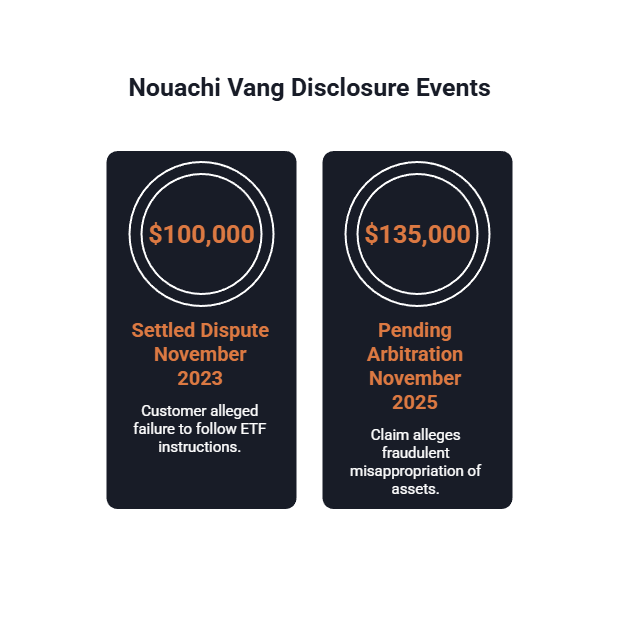
According to FINRA BrokerCheck records for Nouachi Vang (CRD #5090132), the following disclosure events have been reported:
- Settled Dispute (November 2023): A customer alleged that Vang invested in ETF instruments but failed to follow specific instructions. This conduct reportedly resulted in significant unrealized losses between January 25, 2022, and March 10, 2023. The firm settled this matter for $100,000.
- Pending Arbitration (November 2025): A more recent claim alleges the fraudulent misappropriation of assets, resulting in financial losses exceeding $135,000. This dispute is currently pending in arbitration (Case #25-00381).
Vang has provided a statement regarding the pending arbitration, claiming the individual was not a client and that the allegations lack merit. However, the existence of a six-figure settlement and a pending fraud claim may indicate a pattern of behavior that puts investor capital at risk.

We Have Recovered Over
$350 Million for Our Clients Nationwide.
Background Information on Nouachi Vang and LPL Financial
Nouachi Vang has been registered in the securities industry for 19 years and is currently registered with LPL Financial LLC in Maple Grove, MN. His professional history includes several notable affiliations:
- Current Firm: LPL Financial LLC (since August 8, 2024).
- Previous Firms: Kestra Advisory Services, LLC, Kestra Investment Services, LLC, and Vanguard Advisers, Inc..
- Professional Credentials: Vang has passed the Securities Industry Essentials (SIE) exam and several qualifying exams, including the Series 7, Series 52, Series 6, Series 65, and Series 63.
Despite these credentials, the reported allegations touch on fundamental failures to adhere to industry standards and client instructions.
Why Regulatory Rules and “Best Interest” Standards Matter
When a broker is accused of misappropriation or ignoring client instructions, several industry rules and standards of conduct are typically at the center of the legal argument:
Regulation Best Interest (Reg BI)
Effective June 30, 2020, Reg BI requires brokers to act in the best interest of retail customers. They must not place their own financial interests ahead of the customer’s needs. This includes a “Care Obligation” to consider the costs and risks of an investment and a “Conflict of Interest Obligation” to mitigate incentives that favor the firm over the client.
FINRA Rule 2150: Improper Use of Funds
This rule strictly prohibits the misuse, conversion, or misappropriation of a customer’s securities or funds. Allegations of misappropriation, such as those in the pending $135,000 arbitration against Vang, are direct challenges to this foundational protection.
FINRA Rule 3110: Supervision
Brokerage firms like LPL Financial have a legal duty to supervise their representatives. They must have systems in place to detect and prevent misconduct. If a firm ignores “red flags” or fails to monitor account activity, it may be held liable for the investor’s losses even if the firm did not directly authorize the broker’s actions.
Our lawyers are nationwide leaders in investment fraud cases.
Important Points for Investors to Consider
If you are concerned about your investments with Nouachi Vang, look for these common warning signs of broker misconduct:
- Unauthorized Activity: Transactions or strategy shifts that you did not approve.
- Lack of Communication: An advisor who becomes unavailable or provides vague answers to direct questions.
- Misrepresentation: Promises of “guaranteed” returns or the concealment of high fees and risks.
- Unsuitable Risk: A portfolio that is much more volatile or speculative than your stated goals (e.g., a retiree’s funds placed in high-risk ETFs).
We Are The firm other lawyers
call for support.
How Meyer Wilson Werning Recovers Investment Losses
For decades, the attorneys at Meyer Wilson Werning have focused exclusively on representing investors against brokerage firms. We have recovered more than $350 million for our clients by holding firms accountable for supervision failures and broker misconduct.
Most investment disputes are resolved through arbitration, a private process that is often faster and more cost-effective than traditional court litigation. Our team can help you gather documentation—including account statements, emails, and trade confirmations—to build a strong case for recovery.
If you have suffered losses related to Nouachi Vang or LPL Financial, contact us today for a free and confidential consultation to discuss your options.
Frequently Asked Questions
What is the specific nature of the complaints against Nouachi Vang?
The disclosures on Vang’s BrokerCheck report involve a $100,000 settlement regarding ignored client instructions for ETFs and a pending $135,000 arbitration claim alleging the fraudulent misappropriation of assets.
Can I sue LPL Financial for my losses?
Under FINRA Rule 3110, firms are responsible for supervising their brokers. If LPL Financial failed to detect or prevent misconduct by Nouachi Vang, you may be able to pursue a claim against the firm through arbitration to recover your losses.
How do I know if my broker is acting in my “best interest”?
Under Regulation Best Interest, your advisor must disclose all material facts about your relationship, including fees and conflicts of interest. If they recommend a strategy that is unnecessarily expensive or high-risk for your situation, they may be in violation of this standard.
What is the IAPD, and how does it differ from BrokerCheck?
The IAPD (Investment Adviser Public Disclosure) is managed by the SEC and focuses on fee-based advisory services, while BrokerCheck is managed by FINRA and focuses on brokers involved in securities sales. Searching both provides a comprehensive view of an advisor’s disciplinary history.
Recovering Losses Caused by Investment Misconduct.