


For years, residents in and around Columbus, Ohio, trusted a man who called himself an expert in cryptocurrency trading. Rathnakishore “Ravi” Giri, 31, of New Albany, Ohio, promised consistent, lucrative returns from Bitcoin derivatives trading, with investors’ principal guaranteed in full. The pitch was sophisticated. The reality was a textbook Ponzi scheme. In May 2026, a federal court sentenced Giri to nine years in federal prison and three years of supervised release for wire fraud, closing the criminal chapter of one of the most consequential Ohio cryptocurrency fraud cases in recent memory.
If you suffered investment losses in connection with a cryptocurrency scheme, the cryptocurrency fraud attorneys at Meyer Wilson Werning are reviewing claims now. If a licensed financial professional, broker, or advisor facilitated your investment, contact us today for a free and confidential consultation, and you pay nothing unless we recover for you.
How the Bitcoin Derivatives Fraud Actually Worked
Giri’s scheme was active at least as far back as 2019. According to court documents, he solicited investor funds through entities including SR Private Equity, LLC and NBD Eidetic Capital, LLC, presenting himself as a seasoned cryptocurrency trader with specialized expertise in Bitcoin derivatives. That niche, technically complex corner of the market lent his pitch a veneer of credibility. Investors were told their money would generate consistently high returns through sophisticated trading strategies, and, critically, that their original investment amount was safe and fully guaranteed.
None of it was true. Giri had a long record of investment failures and was routinely losing the very principal he claimed to protect. Rather than trading profitably on behalf of clients, he used incoming funds from new investors to pay earlier ones, the defining characteristic of a Ponzi scheme. When investors sought to withdraw funds or recover their “guaranteed” principal, they were met not with money but with fabricated explanations for delays, buying Giri more time to recruit new participants and keep the structure from collapsing.

We Have Recovered Over
$350 Million for Our Clients Nationwide.
The Post-Plea Fraud: Why the Sentencing Outcome Carries Weight
What separates this investment fraud case from a standard prosecution is what Giri did after federal authorities caught up with him. The Commodity Futures Trading Commission filed a civil enforcement action against Giri, his companies, and his parents in August 2022, targeting the fraudulent Bitcoin derivatives scheme. The DOJ indicted Giri in November 2022 on five counts of wire fraud. Despite years of federal scrutiny, Giri pleaded guilty to one count of wire fraud in October 2024.
Then he kept going.
According to the Justice Department, Giri continued to solicit funds from new cryptocurrency investors while on pretrial release, pending his sentencing hearing. He subsequently admitted to this additional post-plea conduct under an amended plea agreement with the Department before sentencing. The brazenness of defrauding new investors after entering a guilty plea in federal court almost certainly shaped the nine-year sentence ultimately imposed, a significant outcome that reflects both the scope of the original scheme and the conduct that followed it.
Federal Charges and What Wire Fraud Means for Investors
Giri was convicted on one count of wire fraud under 18 U.S.C. § 1343, the federal statute that prohibits using electronic communications to execute a scheme to defraud. In cryptocurrency cases, this statute covers the full range of digital solicitation and transfer: emails, messaging applications, online platforms, and electronic fund movements. The maximum penalty for wire fraud is 20 years in federal prison, rising to 30 years and a $1,000,000 fine when the conduct affects a financial institution.
The case was investigated by the FBI Cincinnati Field Office under Special Agent in Charge Jason Cromartie and prosecuted by Acting Deputy Chief Lucy B. Jennings and Trial Attorney Tamara Livshiz of the DOJ Criminal Division’s Fraud Section. The sentencing announcement was made by Assistant Attorney General A. Tysen Duva of the Justice Department’s Criminal Division.
Our lawyers are nationwide leaders in investment fraud cases.
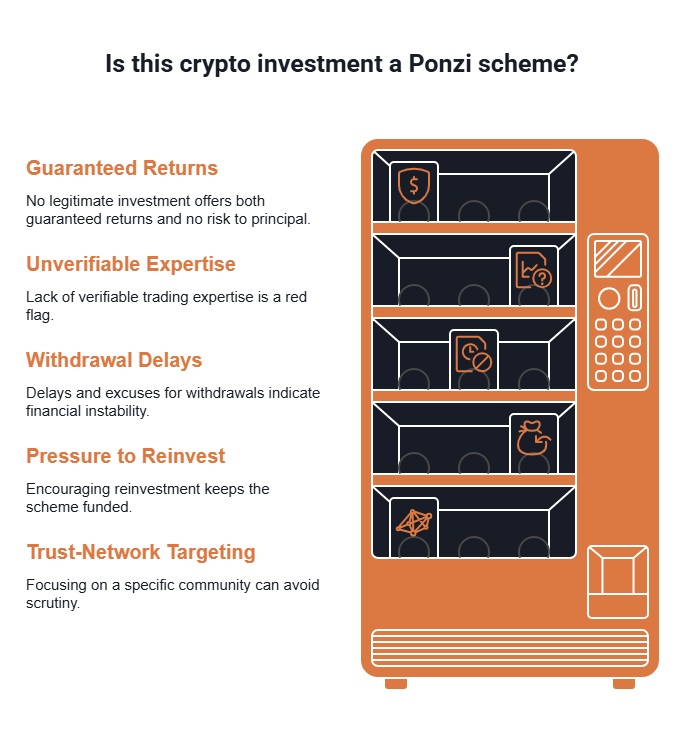
Red Flags: How to Identify a Cryptocurrency Ponzi Scheme Before It Is Too Late
The Giri case is a study in the warning signs that appear in virtually every crypto Ponzi scheme. Recognizing these patterns before placing funds at risk is the most reliable form of investor protection:
- Guaranteed returns with no risk to principal. No legitimate investment can deliver both. This combination, precisely what Giri promised, is the single most reliable indicator of fraud.
- Unverifiable trading expertise. Giri built an entire professional persona around Bitcoin derivatives trading with no credible, independently verifiable track record to support it.
- Withdrawal delays paired with shifting excuses. Ponzi operators cannot afford to let money leave the scheme. When requests to withdraw are met with explanations instead of funds, that is a serious warning sign.
- Pressure to reinvest rather than withdraw. Operators routinely encourage investors to roll over returns rather than cash out, keeping the scheme funded while reducing the risk of collapse.
Trust-network targeting. Giri concentrated his solicitations in the Columbus, Ohio area, relying on personal referrals and community trust to grow his investor base without attracting broader attention.
We Are The firm other lawyers
call for support.
The Broader Cryptocurrency Fraud Crisis
This case is not an isolated incident. Crypto-related fraud reached $11.36 billion in 2025, a 22% year-over-year increase across more than 181,000 complaints filed with federal authorities. Investment scams, predominantly Ponzi-style schemes , accounted for $8.65 billion of those losses, making them the leading driver of crypto-enabled financial harm nationwide.
Federal enforcement is accelerating in response. In April 2026, a Houston-based operator received a 23-year sentence for a separate $20 million crypto Ponzi scheme. The Giri sentence reinforces that courts are prepared to impose substantial prison terms for cryptocurrency fraud, and that defendants who continue defrauding investors after entering guilty pleas face materially more severe outcomes at sentencing.
The DOJ’s Asset Forfeiture Program has returned over $12 billion to fraud victims since 2000. In fiscal year 2024 and early fiscal year 2025 alone, more than $735.3 million was returned to investors defrauded through investment and cryptocurrency schemes.
What Investors Can Do Now
If you believe you lost money in the Giri scheme or a similar cryptocurrency Ponzi, there are concrete steps to take immediately:
File a complaint with the FBI’s Internet Crime Complaint Center at IC3.gov. Include all cryptocurrency wallet addresses, transaction hashes, dollar amounts, and relevant dates.
Contact the SEC or CFTC. Both agencies accept investor complaints involving cryptocurrency fraud and related investment misconduct, and the CFTC was an active participant in the civil enforcement side of the Giri matter.
Consult an investment fraud attorney. Civil recovery options are separate from the federal criminal prosecution and may still be available to investors who suffered losses.
Conclusion
The nine-year federal prison sentence imposed on Rathnakishore Giri sends a clear message: cryptocurrency Ponzi schemes will be pursued aggressively by both the DOJ and the FBI, and defendants who exploit investor trust after entering guilty pleas can expect that conduct to carry real consequences at sentencing. For the investors Giri deceived in and around Columbus, Ohio, the criminal case has reached its conclusion. Civil recovery, where available, may offer another path forward.
For over 25 years, Meyer Wilson Werning has recovered more than $350 million for investors harmed by financial fraud and misconduct. If you suffered losses in a cryptocurrency investment scheme, contact us today for a free and confidential consultation. You pay nothing unless we recover for you.
Frequently Asked Questions
Who is Rathnakishore Giri?
Rathnakishore “Ravi” Giri is a 31-year-old investment manager from New Albany, Ohio, who was sentenced to nine years in federal prison for orchestrating a cryptocurrency Ponzi scheme that raised more than $10 million from investors, many of them located in the Columbus, Ohio area. He pleaded guilty to one count of wire fraud in October 2024.
How did Rathnakishore Giri’s cryptocurrency scheme work?
Giri falsely promoted himself as an expert Bitcoin derivatives trader and promised investors guaranteed returns with no risk to their principal investment. According to court documents, he used money from new investors to repay earlier ones, concealed a long history of investment failures, and misled investors with fabricated excuses when they sought to withdraw their funds.
Why did Giri continue soliciting investors after pleading guilty?
According to the Justice Department, Giri continued soliciting funds from new cryptocurrency investors while on pretrial release following his October 2024 guilty plea, causing additional harm to new participants. He admitted to this post-plea conduct under an amended plea agreement before sentencing. Prosecutors and the court both took this conduct into account.
What is the CFTC’s role in the Rathnakishore Giri case?
The Commodity Futures Trading Commission filed a civil enforcement action against Giri, his companies SR Private Equity, LLC and NBD Eidetic Capital, LLC, and his parents in August 2022 in connection with his fraudulent Bitcoin derivatives scheme. The DOJ separately indicted Giri on five counts of wire fraud in November 2022, and he later pleaded guilty to one count.
What should I do if I lost money in a cryptocurrency Ponzi scheme?
File a complaint with the FBI’s Internet Crime Complaint Center at IC3.gov, including all relevant transaction details and cryptocurrency wallet information. You should also consult with an experienced investment fraud attorney. Meyer Wilson Werning has a history of results recovering losses for investors nationwide and offers a free and confidential consultation to evaluate your potential claim. You pay nothing unless we recover for you.
Recovering Losses Caused by Investment Misconduct.