


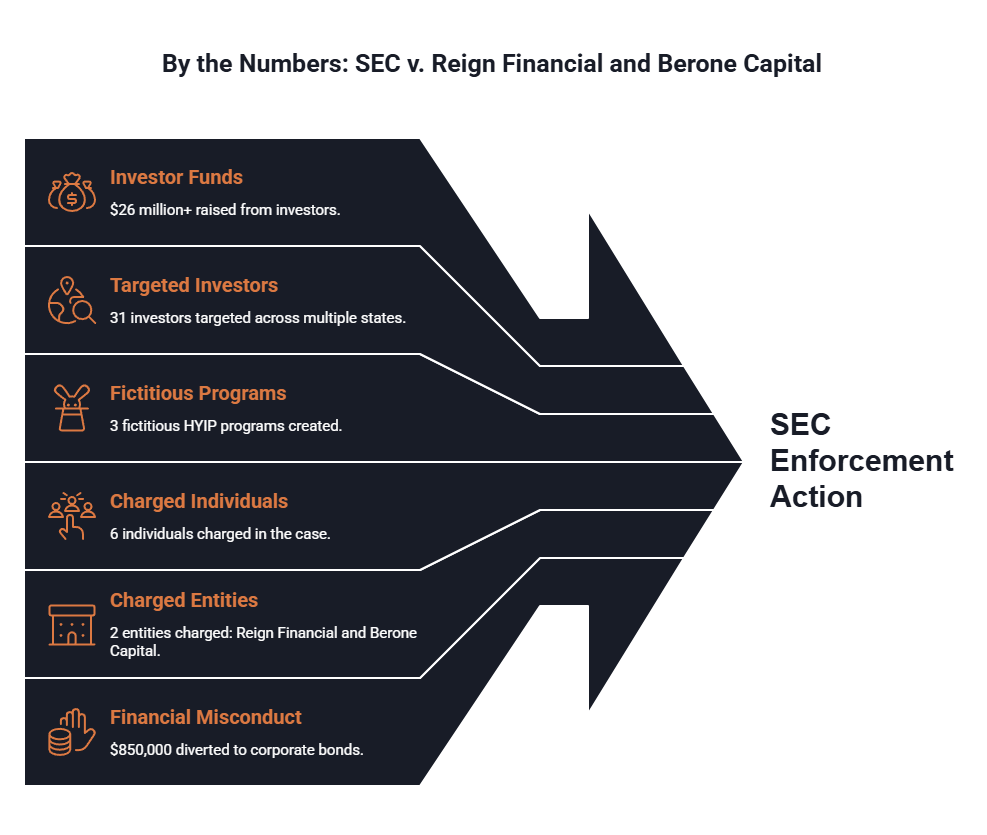
On May 7, 2026, the Securities and Exchange Commission filed charges against two firms and six individuals for allegedly running a series of fictitious high-yield investment programs that raised more than $26 million from at least 31 investors. According to the SEC’s litigation release, the scheme involved false promises of guaranteed returns, funds that were never invested as represented, and money that was allegedly spent on jewelry, luxury vehicles, and private jet travel.
If a licensed financial professional, broker, or advisor facilitated your investment in Reign Financial International, Berone Capital, or any similar high-yield investment program, the experienced Ponzi scheme attorneys at Meyer Wilson Werning can help evaluate whether your losses are the result of actionable misconduct. Contact us today for a free and confidential consultation, and you pay nothing unless we recover for you.
What the SEC Alleges: Three Fictitious Programs and $26 Million Raised
The SEC’s complaint, filed in the U.S. District Court for the Southern District of Florida (Case No. 1:26-cv-23237), charges eight defendants in connection with three purported high-yield investment programs marketed between March 2021 and October 2022.
The named defendants are:
- Reign Financial International LLC and Reign Financial International Inc., along with principals Giorgio Johnson and Gary Mills
- Patrick Allen, a Florida resident
- Berone Capital LLC and its principals Jeremiah Beguesse and Fabian Stone
According to the SEC, the three programs, known as the Compass Program, the PBL & 5Js Program, and the Reign Program, were fictitious. Investors were told their principal would be placed in custodial or hedge fund accounts and routed through European banks into opaque financial instruments. One investor was allegedly promised a 300% monthly return on a $20 million commitment. According to the SEC, none of the promised investment programs existed, no investors received any profits, and many lost their principal entirely.

We Have Recovered Over
$350 Million for Our Clients Nationwide.
How the Alleged Scheme Operated
The SEC alleges that the programs followed a pattern common to HYIP fraud. Investors were told funds were safe with reputable custodians while promoters allegedly controlled access and moved money across related entities.
According to the complaint, before a major wire transfer of approximately $20 million, cash on hand was only about $260,000. After the wire, outflows allegedly funded personal purchases including luxury vehicles, private jet travel, and jewelry. Approximately $850,000 went to corporate bonds that allegedly benefited Beguesse and Stone. The complaint further alleges that Berone Capital, Beguesse, and Stone violated their fiduciary duties as investment adviser and the governing documents of the hedge fund they managed, which held HYIP investor proceeds.
The Berone Capital referenced in these charges is not affiliated with the established European asset manager of the same name.
The Charges and Partial Settlement
The SEC charged Reign, Johnson, Mills, and Allen with violating Section 17(a)(1) and (3) of the Securities Act of 1933 and Section 10(b) of the Securities Exchange Act of 1934 and Rule 10b-5. Berone Capital, Beguesse, and Stone face charges under Sections 206(1) and 206(2) of the Investment Advisers Act of 1940.
Without admitting or denying the allegations, Reign, Johnson, and Mills consented to a judgment that would impose:
- A permanent injunction from future violations
- A permanent officer-and-director bar against Johnson
- Disgorgement of $1,116,650
- Prejudgment interest of $372,420
- Civil penalties of $1,116,650, totaling approximately $2.6 million
The case remains active against Allen, Berone Capital, Beguesse, and Stone. The investigation was conducted by Jason Anthony, Michael Flanagan, and Zachary Scrima, supervised by Paul Pashkoff and Pei Y. Chung.
The full details of the charges and the consented judgment are available in SEC Litigation Release No. 26552
Our lawyers are nationwide leaders in investment fraud cases.
What This Means for Investors With Losses
The SEC’s charges against Reign Financial and Berone Capital reflect a pattern that investor protection attorneys have seen repeatedly: promoters build credibility through titles, state registrations, and foreign-bank stories, then divert investor funds before the scheme collapses.
Investors who sustained losses may have legal options depending on how their investment was facilitated. When a licensed broker or financial professional recommended the program, or when a brokerage firm failed to adequately supervise the sale, civil recovery through arbitration or litigation may be available. Key claims can include unsuitable recommendations, failure to supervise, and breach of fiduciary duty.
Preserving records is critical. Account statements, wire transfer records, offering materials, emails, and any communications with the promoters or a recommending broker all become valuable evidence in building a recovery claim.
We Are The firm other lawyers
call for support.
How Meyer Wilson Werning Can Help
Investors who were drawn into these programs by promises of guaranteed returns did not fail to do their homework. They were targeted by a professionally constructed deception, and FINRA and SEC regulators have confirmed that the structure was built on false representations from the beginning.
With more than $350 million recovered for investors nationwide, Meyer Wilson Werning has spent over 25 years holding firms and individuals accountable for exactly this kind of misconduct. If you sustained losses through Reign Financial International, Berone Capital, or any similar high-yield investment program that was facilitated by a licensed financial professional, contact us today for a free and confidential consultation. You pay nothing unless we recover for you.
Frequently Asked Questions
What is an HYIP and why are they considered fraudulent?
A high-yield investment program, or HYIP, is a scheme that promises extraordinary returns, typically in a short period, while providing little or no transparency about how those returns are generated. According to regulators, the promised trading strategies in genuine HYIP fraud cases typically do not exist. Investor funds are instead misappropriated or used to pay earlier investors in a Ponzi-like structure.
What did the SEC specifically allege against Reign Financial and Berone Capital?
According to the SEC’s complaint, Reign Financial and associated individuals raised over $26 million from at least 31 investors through three fictitious high-yield investment programs between March 2021 and October 2022. The SEC alleges the programs never existed, no investors received profits, and funds were misappropriated for personal use including jewelry, luxury vehicles, and private jet travel.
What was the outcome for Reign Financial’s principals?
Reign Financial, Giorgio Johnson, and Gary Mills consented to a judgment, without admitting or denying the allegations, that includes disgorgement of approximately $1.1 million, prejudgment interest, and civil penalties of approximately $1.1 million, for a total of about $2.6 million. Johnson also faces a permanent officer-and-director bar. The case remains active against other defendants.
Can investors who lost money pursue recovery separately from the SEC action?
Yes. The SEC’s enforcement action seeks injunctions, disgorgement, and penalties for regulatory purposes. Investors with losses may pursue separate civil claims through FINRA arbitration or litigation, particularly when a licensed financial professional or brokerage firm was involved in facilitating or recommending the investment. The statutes of limitations for these claims make prompt action important.
What evidence should investors preserve if they were harmed?
Investors should immediately secure account statements, wire transfer confirmations, offering documents, emails, text messages, and any other communications related to the investment. This documentation is essential for evaluating claims and building a recovery case. An attorney can help assess what records are most relevant based on individual circumstances.
What charges did Berone Capital face compared to Reign Financial?
Berone Capital, Jeremiah Beguesse, and Fabian Stone face charges under the Investment Advisers Act of 1940, specifically for allegedly violating their fiduciary duties to the hedge fund they managed, which held HYIP investor proceeds. The charges against Reign Financial and its principals were brought under the Securities Act of 1933 and the Securities Exchange Act of 1934.
Recovering Losses Caused by Investment Misconduct.