


Regulatory records and public disclosures have brought to light a series of investor concerns regarding Timothy Jan Vanlohuizen, a financial professional previously associated with SagePoint Financial Inc. and Osaic Wealth Inc. According to recent filings, Vanlohuizen has been the subject of multiple customer disputes, including significant settlements involving allegations of unsuitable stock and mutual fund recommendations. For investors, particularly those planning for retirement, these recurring “red flags” can indicate patterns of overconcentration or excessive risk that may not align with long-term financial goals.
If you or a loved one experienced significant investment losses while working with Timothy Vanlohuizen, our experienced financial advisor negligence attorneys at Meyer Wilson Werning can help evaluate whether your losses are the result of actionable broker misconduct or a supervisory failure. Contact us today for a free and confidential consultation, and you pay nothing unless we recover for you.
What Recent Settlements Reveal About Timothy Vanlohuizen’s Sales Practices
Public disclosures reflect a pattern of settled claims and pending disputes spanning several years of Timothy Vanlohuizen’s career. These resolutions, while often occurring without an admission of fault, highlight the specific nature of the allegations made by his clients.
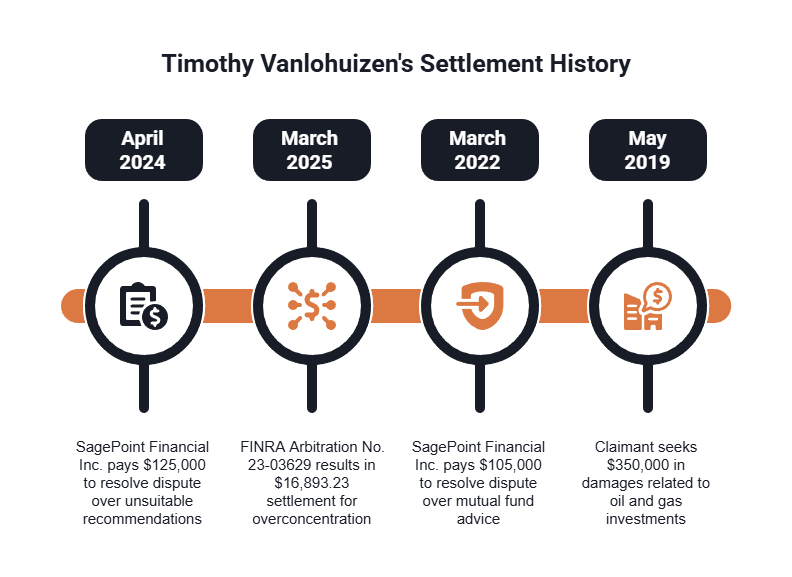
- April 2024 Settlement: SagePoint Financial Inc. reportedly paid $125,000 to resolve a dispute where a customer alleged that Vanlohuizen made unsuitable recommendations and created a portfolio with an excessive amount of risk, specifically tied to stock investments.
- March 2025 Arbitration: FINRA Arbitration No. 23-03629 resulted in a $16,893.23 settlement following allegations that Vanlohuizen overconcentrated managed accounts and recommended investments that were unsuitable for the client.
- March 2022 Settlement: A client contested Vanlohuizen’s advice in FINRA Arbitration No. 20-03556, alleging unsuitable recommendations in mutual fund products. This matter was settled by SagePoint Financial for $105,000.
- Pending Disclosures: As of late 2025, records indicate at least three disclosable events and six customer complaints. This includes a May 2019 matter related to oil and gas investments where the claimant is seeking $350,000 in damages.
Timothy Jan Vanlohuizen (CRD #2166867) is currently listed in Coeur d’Alene, Idaho. His professional history includes nearly 18 years at SagePoint Financial Inc. (2005–2023) followed by a brief period at Osaic Wealth Inc. in late 2023.

We Have Recovered Over
$350 Million for Our Clients Nationwide.
Industry Rules and Broker Responsibilities
When investors suffer losses due to overconcentration or inappropriate risk, several core industry standards are often at the center of the legal argument. FINRA Rule 2111 (Suitability) requires brokers to have a “reasonable basis” to believe that a recommendation is suitable for a customer based on their investment profile, including their age, financial situation, and risk tolerance.
Additionally, FINRA Rule 3110 (Supervision) dictates that brokerage firms have a non-delegable duty to reasonably supervise the activities of their advisors; if a firm fails to detect “red flags” or patterns of unsuitable trading, it may be held liable for resulting investor losses. Finally, under Regulation Best Interest (Reg BI), advisors must act in the best interest of their retail customers at the time a recommendation is made, prioritizing the client’s financial interests over the firm’s incentives.
Important Points for Investors to Consider
If you have concerns about your managed accounts, look for these common warning signs of mismanagement or unsuitable advice:
- Overconcentration: Having a large percentage of your portfolio in a single stock, sector (such as oil and gas), or complex product.
- Risk Mismatch: A portfolio that is significantly more volatile than your stated retirement objectives.
- Lack of Liquidity: Being sold products that “lock up” your capital for long periods without adequate disclosure.
- Misrepresentation: Promises of “safety” or “guaranteed returns” that contradict the actual risk of the underlying investments.
Our lawyers are nationwide leaders in investment fraud cases.
How Meyer Wilson Werning Supports Affected Investors
Multiple settlements, a pending $350,000 oil and gas claim, and a pattern of overconcentration complaints spanning nearly two decades of client work. SagePoint Financial paid $125,000 and $105,000 to resolve disputes over unsuitable recommendations. For the investors who absorbed the losses on the other side of those recommendations, those numbers represent real retirement savings that should not have been put at risk.
For over 25 years, Meyer Wilson Werning has recovered more than $350 million for investors harmed by advisors who recommended products that were never right for their clients. If you suffered losses while working with Timothy Vanlohuizen, contact us today for a free and confidential consultation. You pay nothing unless we recover for you.
We Are The firm other lawyers
call for support.
Frequently Asked Questions
Who is Tim Vanlohuizen and what are the primary allegations?
He is a long-tenured financial advisor formerly registered with SagePoint Financial and Osaic Wealth. Customer complaints allege that he made unsuitable recommendations and overconcentrated client accounts in risky stocks or mutual funds.
What do the settlements at SagePoint Financial indicate?
Recent settlements, including payments of $125,000 and $105,000, indicate that the firm chose to compensate clients following disputes over investment advice and risk levels. While settlements are not an admission of wrongdoing, they reflect serious challenges to the advisor’s sales practices.
Can I still pursue recovery if the broker is no longer with the firm?
Yes. Investors typically pursue recovery from the brokerage firm that employed the advisor at the time the alleged misconduct occurred. Firms can be held legally responsible for failing to properly supervise their representatives if their misconduct results in significant damages.
How do I start the recovery process?
Gather your account statements, trade confirmations, and any written communications with your advisor. Consulting with an experienced securities attorney can help you determine if your losses resulted from actionable misconduct, such as unsuitability or negligence.
Recovering Losses Caused by Investment Misconduct.