

The USQ Core Real Estate Interval Fund officially entered an active wind-down and liquidation on October 31, 2025. Many long-term investors—especially retirees—have been blindsided by substantial losses after a strategy marketed as a stable diversifier faced severe market stress. Rising interest rates and weakness in the commercial office sector have converged, leaving shareholders trapped in a long, uncertain liquidation process.
Suspended redemptions. No distributions since 2025. A liquidation that could drag into 2027. If a financial advisor recommended the USQ Core Real Estate Interval Fund to you as a stable, low-risk investment, that recommendation deserves a hard look. Our real estate investment fraud attorneys can help you determine whether your losses are the result of actionable misconduct, reach out to Meyer Wilson Werning today for a free and confidential consultation. You pay nothing unless we recover for you.
What Is the Current Status of the USQ Core Real Estate Fund Liquidation?
According to fund communications, the board of trustees determined that liquidation was in the “best interests of the fund and its shareholders” following a period of sustained underperformance. The fund has ceased normal operations and will no longer accept new capital. Because the underlying assets are illiquid private real estate holdings, the wind-down is expected to run longer than one year.
Investors should review these Important Points regarding the current restrictions on their accounts:
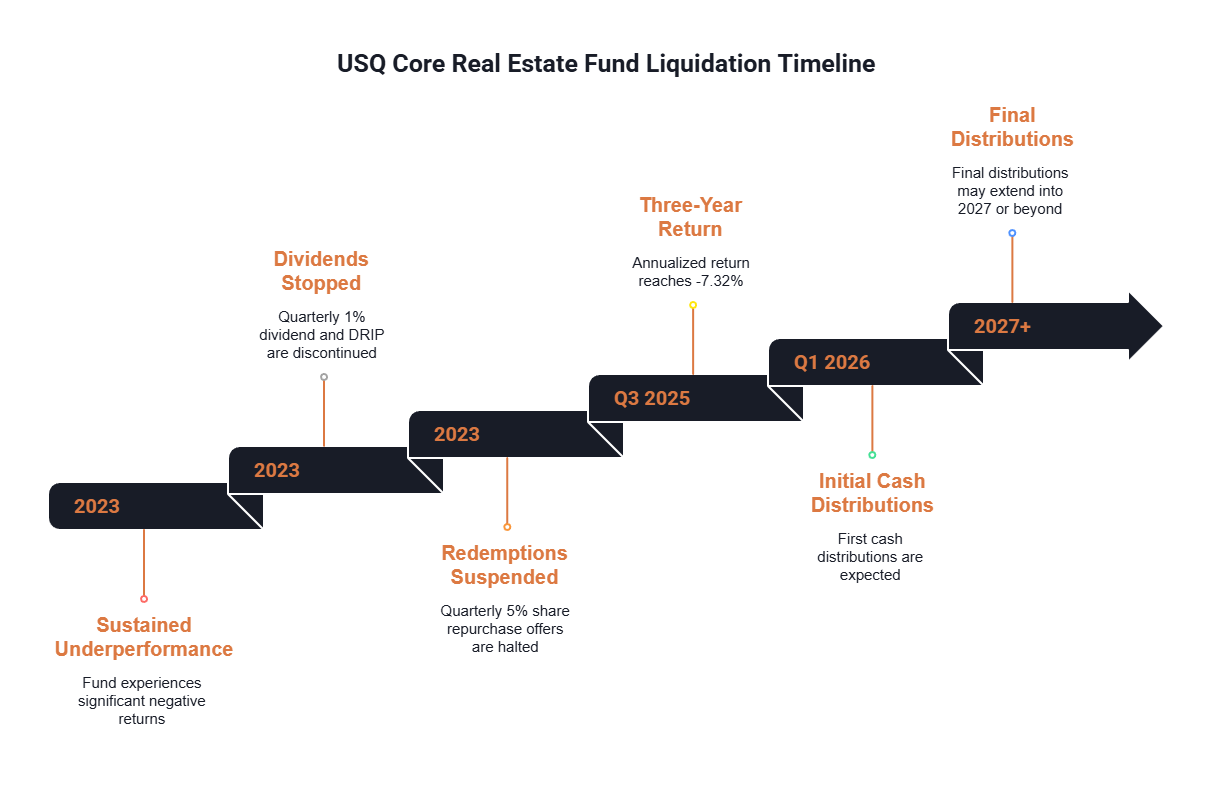
- Discontinued Dividends and DRIP: The targeted 1% quarterly dividend has been stopped, and the Dividend Reinvestment Program (DRIP) has ended.
- Suspended Redemptions: All quarterly share repurchase offers, previously capped at 5%, are now suspended, meaning investors cannot currently access their principal.
- Declining Performance: Returns for Class I shares plummeted to -12.72% in 2023 and -4.22% in 2024, leading to a three-year annualized return of -7.32% by Q3 2025.
- Delayed Payouts: Initial cash distributions are not anticipated until Q1 2026, with final distributions potentially extending into 2027 or beyond.

We Have Recovered Over
$350 Million for Our Clients Nationwide.
Why Did USQ Core Real Estate Investors Lose Money?
The losses in the USQ Core Real Estate Interval Fund were driven by a combination of macroeconomic shifts and structural vulnerabilities. When the Federal Reserve began raising interest rates in 2022, commercial real estate valuations dropped as borrowing costs rose. Simultaneously, the office sector faced a crisis due to remote work trends, causing vacancies to soar and property prices to decline in sectors where the fund had significant exposure.
As an “interval fund,” this product only allowed for limited quarterly exits. When the Net Asset Value (NAV) began to fall, the 5% redemption limit acted as a “gate,” preventing many investors from getting out before more significant damage was done. Furthermore, valuation lags in private real estate often left investors holding shares at “stale” prices that did not reflect the true market decline until months later, a common vulnerability in illiquid alternative investments.
When Does Advisor Conduct Support a Claim for Recovery?
While market volatility is common, brokerage firms and financial advisors have a legal duty to provide suitable recommendations. Under FINRA Rule 2111, an advisor must ensure an investment matches a client’s risk tolerance and liquidity needs. If an advisor recommended this illiquid fund to a conservative retiree who needed access to their savings for living expenses, that advisor may be liable for the resulting losses.
Investors should watch for the following red flags that often support a claim for recovery:
- Misleading Sales Labels: Advisors allegedly calling the fund “safe,” “conservative,” or “bond-like” while downplaying the risk of principal loss. A clear case of misrepresentation and omission.
- Omission of Liquidity Risks: Failing to clearly explain the 5% quarterly redemption cap or the possibility that redemptions could be suspended entirely.
- Overconcentration: Allocating an excessive percentage of an investor’s net worth to this single, illiquid real estate product.
- Failure to Supervise: Brokerage firms failing to re-evaluate the suitability of the fund for their clients as interest rates rose and the commercial real estate market deteriorated in 2023 and 2024.
Our lawyers are nationwide leaders in investment fraud cases.
How Meyer Wilson Werning Can Help
Waiting for the liquidation to run its course could mean waiting until 2027 for distributions that still won’t make you whole. Filing a claim against the firm that recommended this fund is a separate process, one that runs on your timeline, not the fund’s.
Meyer Wilson Werning holds firms accountable for unsuitable recommendations before eligibility deadlines expire. Contact us today for a free and confidential consultation. We only get paid if you do.
We Are The firm other lawyers
call for support.
Frequently Asked Questions
Can I recover losses even though the market declined?
Yes. A market decline does not bar a claim if the recommendation was unsuitable for your risk profile or if your advisor misrepresented the fund as a low-risk investment. Claims focus on the advisor’s conduct and disclosures, not just market movements.
What if I signed a risk disclosure for the USQ Core Real Estate Interval Fund?
Signing standard disclosure forms does not automatically protect an advisor from liability. If the investment was fundamentally inappropriate for your needs, or if the advisor’s oral statements downplayed the risks, you may still have a valid claim.
Do I have to sue the fund itself to get my money back?
Generally, no. Investors typically bring claims against the brokerage firm or financial advisor who recommended the fund. These cases focus on the sales practices and the failure to provide accurate information regarding liquidity and interest rate sensitivity.
How long do I have to file a claim for USQ Core Real Estate losses?
Statutes of limitations vary by state, and eligibility for arbitration typically requires filing within six years of the event. Because evidence can fade over time, it is important to take action as soon as you identify significant losses.
Recovering Losses Caused by Investment Misconduct.