


The way software gets built is changing fast, and that shift is creating a new category of legal exposure for every company that holds private consumer data. AI tools are writing more code than ever before, and the research is clear: that code frequently contains security vulnerabilities serious enough to cause a data breach. What the law is equally clear about is that when those breaches happen, it does not matter whether a human or a machine made the error that let private information out.
That is the view Matthew Wilson, Principal at Meyer Wilson Werning and a multi-year SuperLawyers honoree, laid out in a recent Bloomberg Law publication. Wilson was featured alongside cybersecurity professionals and defense-side attorneys examining the legal risks of “vibecoding,” the practice of using AI tools to generate functional software without the security controls needed to protect sensitive data. His analysis goes directly to what consumers and investors need to understand about their rights when a company’s AI-built systems fail them.
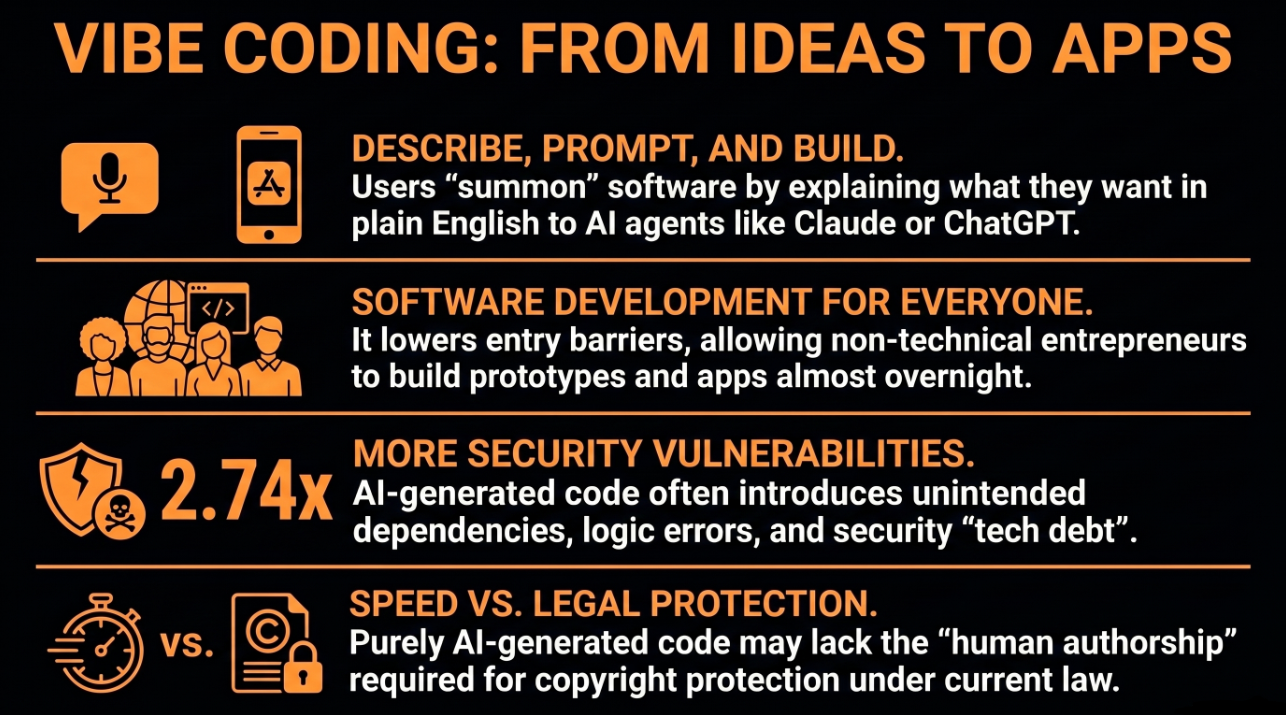
What Is Vibecoding and Why Does It Create Security Risks?
Vibecoding describes two related practices: non-technical professionals using AI tools to generate working software from a plain-language prompt, and trained developers directing AI agents to produce code as part of a larger technical workflow. A 2025 annual survey by Stack Overflow found that 84% of respondents were using AI in their development process or planned to. The productivity appeal is real. So is the security risk.
Cybersecurity firm Tenzai tested whether AI coding agents could reliably produce secure software and found that every single agent it evaluated introduced significant vulnerabilities, including weaknesses that could allow unauthorized users to access other customers’ private order data and gaps that could enable hackers to bypass login pages entirely using brute force attacks.
Ami Luttwak, Chief Technologist at Wiz, identified the structural problem: “Because people that are not developers are building the apps, the chances they have mistakes are even larger” than if trained professionals built them. Melissa Bischoping of Tanium put the governance risk plainly: “you’re going to see non-technical professionals potentially building things and introducing them into the environment without oversight and without governance,” often while handling sensitive personal or financial information.

We Have Recovered Over
$350 Million for Our Clients Nationwide.
What Does the Law Say When AI Code Causes a Data Breach?
The legal standard for data security does not distinguish between a breach caused by a human developer and one caused by flawed AI-generated code. Speaking with Bloomberg Law for a feature on vibecoding and data privacy, Wilson explained it this way: “Ultimately the question for me is were you entrusted in some way or another with private information? And if you were, did it get out?” If the answer to both is yes, there is possible liability, regardless of whether the failure was made by a human or an autonomous system. As for how the breach occurred, Wilson acknowledged it may be interesting, “but it doesn’t really matter that much to the law because it shouldn’t have happened regardless of how it happened.”
Defending against these claims requires demonstrating reasonable security precautions. Attorneys on the defense side have identified several steps companies should take now:
- Justine Phillips (Baker McKenzie): Build policy documentation that specifically covers how AI was incorporated into development and how risk was managed.
- Erin Prest (McCarter and English): Document AI prompting inputs and outputs to preserve a record for discovery, and limit AI use to areas where a failure is least likely to cause widespread damage.
- Adam Aft (Baker McKenzie): Institutions handling regulated data in healthcare and financial sectors should be especially thoughtful about combining AI-generated code with sensitive data systems.
No federal court has yet addressed a data breach that exploited vibecoded software. Wilson put the direction of travel plainly: “I haven’t yet sued anyone in a vibecoding case, but certainly it’s coming.”
How Investor Protection and Data Breach Litigation Are Converging
Not long ago, a data breach at a financial institution was primarily a privacy matter. Investor protection attorneys, focused on broker misconduct, FINRA arbitration, and securities fraud, were operating in a parallel lane. That separation has effectively collapsed.
The platforms where Americans now manage their investments and retirement accounts are built on the same digital infrastructure as any other consumer technology product. Robo-advisors, fintech brokerages, and app-based trading tools hold regulated investment data alongside the personal information that has always been at the center of data breach litigation. When those platforms are breached, the harm is not just a privacy violation. It is a direct threat to the financial security of people who trusted those institutions with their money.
The accountability question Matthew Wilson asks in a data breach context, whether private financial information was entrusted to an institution and whether it got out, is the same foundational question that has driven investor protection litigation for decades. The technology changes. The obligation does not.
Our lawyers are nationwide leaders in investment fraud cases.
Why Financial Institutions Face the Greatest Exposure
For companies in financial services and investing, the stakes around AI coding failures are elevated. These institutions manage some of the most sensitive personal data that exists: Social Security numbers, account balances, transaction histories, and retirement assets. A breach does not just expose names and emails. It can open the door to identity theft, financial fraud, and lasting harm that takes years to untangle. The threat is not hypothetical. The 2025 Coinbase data breach exposed the private financial information of millions of customers, illustrating precisely what is at stake when platforms that hold investment accounts and retirement assets fail to protect the data entrusted to them.
The convergence of investor protection litigation and consumer data breach class actions is accelerating. As fintech platforms, robo-advisors, and digitally native brokerage services rely increasingly on AI-assisted development, the attack surface grows with every line of code those tools generate. Legal standards governing financial data security make no exceptions for new technology. As Bischoping stated: “You’re not going to be able to get away with saying, ‘well, the AI did it, it’s not our fault'” when the underlying failure was one the company had a duty to prevent.
We Are The firm other lawyers
call for support.
AI Is Improving. It Is Not There Yet.
AI coding tools are not static. Jody Bailey, Chief Product and Technology Officer at Stack Overflow, noted that tools like Anthropic PBC’s Claude Opus and OpenAI’s Codex have improved substantially, and Bischoping acknowledged that AI is advancing on security tasks “at a rate that is almost unprecedented.”
In March, Anthropic released an automated security review tool to help developers catch common vulnerabilities. But the company was direct about its limits: automated testing “should complement, not replace, your existing security practices and manual code reviews.” Luttwak summarized the industry consensus: “Even the AI companies are telling you, ‘wait, no, don’t assume it’s secure.'”
Until these tools can consistently produce software that meets the security standards required to protect private data, human review remains a necessary control. Companies that skip it are carrying a legal exposure that courts are about to start addressing.
If Your Private Data Was Exposed, the Law Is Already on Your Side
The companies choosing speed over security are making a calculated bet that the cost of a breach is manageable. For the individual whose financial records, Social Security number, or investment account information gets out, that calculation is not abstract. The harm is immediate, the recovery is uncertain, and the institution responsible will have legal teams ready to argue it did enough. Having experienced counsel in your corner from the start changes that equation.
Meyer Wilson Werning has recovered more than $350 million for clients across the country over more than 25 years. If your private data was exposed in a breach and you want to understand your legal options, contact us today for a free and confidential consultation. You pay nothing unless we recover for you.
Frequently Asked Questions
What is an AI data breach lawsuit?
A legal claim against a company that failed to protect private consumer data, where the security failure was connected to AI-generated software. The law does not distinguish between AI-caused and human-caused failures. Companies entrusted with private data carry the obligation to secure it regardless of how their systems were built.
Can I sue a company for a data breach?
Yes. If a company held your private information and it was exposed due to a failure to maintain reasonable security, you may have grounds to pursue a legal claim, either as an individual action or as part of a data breach class action alongside others harmed by the same breach.
What is vibecoding?
The use of AI tools to generate functional software, either by non-technical users describing what they want in plain language, or by developers directing AI agents to write code. Research has shown that AI-generated code frequently contains security vulnerabilities that can expose sensitive consumer and financial data.
What compensation can I recover in a data breach lawsuit?
Recoverable damages can include compensation for financial losses caused by identity theft or fraud, costs of credit monitoring and identity protection services, and damages for disruption and distress caused by the breach. Class action settlements may also require the company to implement improved security practices.
What does it mean that Meyer Wilson Werning works on a contingency fee?
You pay nothing out of pocket unless Meyer Wilson Werning recovers money for you. No upfront fees or costs are charged. The firm’s fee comes only from a recovery, and only if one occurs.
How do I know if I have a viable data breach claim?
The starting point is whether a company had your private information and whether it was exposed without authorization. If you received a breach notification or have evidence your financial or personal data was compromised, contact Meyer Wilson Werning today for a free and confidential consultation to discuss your options.
Recovering Losses Caused by Investment Misconduct.