



You got in the car because it was supposed to be the safe choice. Most people who use Uber and Lyft are doing exactly what they were told to do, which is avoid driving after a few drinks, avoid walking home alone, avoid the risk. The companies built their brands on that promise. For thousands of passengers, the person hired to get them home safely was the person who assaulted them.
Internal Uber records unsealed through this litigation show the company received a report of sexual assault or misconduct roughly once every eight minutes between 2017 and 2022. Uber knew the scale of what was happening on its platform. What survivors got instead was a support ticket, a refund, and in many cases a driver who stayed on the road.
Meyer Wilson Werning is helping lead the federal case against Uber, and attorney Layne Hilton sits on the Plaintiffs’ Steering Committee overseeing it. If a rideshare driver assaulted you, this page explains what these claims involve, what juries have already decided, and what happens when you call. You are not required to have reported it, and you are not required to have all the answers. When you are ready, a free and confidential conversation is the only next step.
The Assaults These Lawsuits Cover
These cases cover a wide range of conduct, and one of the most common reasons survivors never call is the belief that what happened to them was not serious enough. It very likely was. A claim may exist if a rideshare driver did any of the following.
- Raped or attempted to rape you. These are the most severe cases in the litigation and are handled with corresponding care by our team.
- Touched you sexually without your consent. This includes groping over or under clothing and unwanted contact of any kind. You do not need to describe the details to find out whether you have a claim, and when we speak you can share as much or as little as you are ready to share.
- Kissed you or touched you in a way you did not agree to, including contact you froze through rather than fought.
- Pressured, coerced, or forced you into any sexual act, including situations where you complied because you were trapped in a moving vehicle and afraid of what refusing would cost you.
- Exposed themself, masturbated, or made the ride sexual in a way you could not escape. Conduct that never involved touching still belongs in this litigation.
- Took you somewhere other than where you asked to go, locked the doors, or refused to let you out.
Consent is not a question when a passenger was asleep, unconscious, intoxicated, or under 18. A driver who assaults a passenger in that condition is responsible regardless of what was said during the ride. Claims are also available to drivers who were assaulted by passengers.

We Are The firm other lawyers
call for support.
What These Claims Have in Common
Survivors often assume they have disqualified themselves. In our experience, they usually have not. These are the things that actually matter.
- The ride was booked through the app. This is the one requirement that cannot be worked around, and the app record is what establishes it. Uber has moved to dismiss claimants who could not substantiate their rides, so an account history, receipt, or trip record matters.
- You do not need to have filed a police report. Most survivors never do. A criminal case is a separate track, and its absence does not prevent a civil claim.
- You do not need to have reported it to Uber or Lyft. Reporting helps, but many survivors were dismissed when they tried, and that failure is itself part of what this litigation is about.
- Some record of the aftermath helps. A therapist, a doctor, a text to a friend that night, a message to a family member. Contemporaneous accounts carry real weight, and more of these exist than survivors remember.
- The deadline depends on your state, and many states have extended or revived the filing window for sexual assault claims. Do not assume too much time has passed without asking.
Our Role in This Litigation
Attorney Layne Hilton, recognized in The Best Lawyers in America 2027, serves on the Plaintiffs’ Steering Committee in the federal Uber litigation, MDL No. 3084, In re: Uber Technologies, Inc., Passenger Sexual Assault Litigation. That is a court-appointed leadership position, and it means our firm is directly involved in the discovery that pried Uber’s internal records into the open, in the development of the trial strategy being tested in the bellwether cases, and in the negotiations that will shape how these claims are ultimately resolved.
Most firms advertising these cases are watching this litigation from the outside and will refer your case to someone else. We are inside it. For you, that means your case is evaluated by people who know what the internal documents actually say, what the verdicts have been worth, and what Uber has been willing to do rather than let a jury hear a particular set of facts.
We Have Recovered Over
$350 Million for Our Clients Nationwide.
What Uber’s Own Records Show
Uber has published safety reports since 2019, and they document thousands of sexual assault reports in each two-year period: 5,981 for 2017 and 2018, 3,824 for 2019 and 2020, and 2,717 for 2021 and 2022. Lyft’s reports show 4,158 for 2017 through 2019 and 2,651 for 2020 through 2022.
Those published figures are not the whole picture. Uber sorts incidents into 21 internal categories and publicly reports only the five most severe. Records unsealed through this litigation and reported by the New York Times in 2025 show that Uber logged 400,181 reports of sexual assault or misconduct in the United States between 2017 and 2022, which works out to approximately one report every eight minutes for five years.
The gap between those two numbers is the heart of these lawsuits. Plaintiffs allege that Uber understood the scale of assaults on its platform, chose background screening and complaint handling that kept costs low rather than passengers safe, marketed itself as the safe way home anyway, and treated survivors as customer service problems. Sexual assault is also chronically underreported in general, with research suggesting most assaults are never reported to anyone, so even 400,181 understates what happened.
Our lawyers are nationwide leaders in investment fraud cases.
Where the Litigation Stands
Federal cases are consolidated as MDL No. 3084 before Judge Charles R. Breyer in the Northern District of California. The MDL was created in October 2023 and has grown steadily since, from roughly 1,600 cases in early 2025 to nearly 4,000 pending as of mid-2026, making it one of the largest active products liability and mass tort cases in the country.
An MDL is not a class action. Each survivor keeps their own individual claim, and cases are grouped only so that discovery, pretrial rulings, and test trials happen once instead of thousands of times. Your case remains yours, and its value is based on your circumstances, not divided among a group.
Separately, more than 500 California cases are coordinated in a state proceeding, and litigation against Lyft is proceeding on its own track. Judge Breyer has called for an expanded pool of bellwether cases and a compressed trial schedule, which both sides requested, a signal that the court is pushing this litigation toward resolution rather than letting it sit.
What the Bellwether Verdicts Have Shown
Bellwether trials are test cases. They are tried to real juries so that both sides learn what these claims are worth before the remaining thousands are resolved. Two have now been tried in federal court, and Uber lost both.
In February 2026, an Arizona federal jury returned an $8.5 million verdict for a survivor, finding that the driver acted as Uber’s apparent agent. The jury declined to award punitive damages. In April 2026, a federal jury in Charlotte, North Carolina found Uber liable for a 2019 assault in which a driver grabbed a passenger’s thigh during a ride. That jury awarded $5,000, a figure Uber has appealed and which is stayed pending that appeal.
Those two numbers look very different, and the difference is the lesson. These cases are valued on the specific facts of what happened to a specific person, which is precisely why any website advertising an average rideshare settlement amount is inventing it. There is no global settlement, no settlement fund, and no established payout figure. The third federal bellwether, transferred to Texas, has jury selection the week of September 30 and trial beginning October 5, 2026.
Why the Common Carrier Ruling Changed These Cases
For years Uber’s central defense was that it is a technology company connecting riders with independent contractors, and therefore not responsible for what a driver does. Courts in this litigation have rejected that framing.
Judge Breyer ruled that Uber can be treated as a common carrier, the same legal category as a taxi service, an airline, or a bus company. Common carriers owe passengers a heightened duty of care, and that duty cannot be delegated away to a contractor. It is the same principle that makes an airline responsible for the conduct of its crew.
That ruling shifts what plaintiffs must prove. The question is no longer only whether Uber was careless in some general sense, but whether a company holding itself out to carry passengers met the elevated standard the law imposes on companies that do exactly that. Combined with the internal records now in evidence, it is the reason this litigation reached juries at all.
What These Claims Compensate
A civil claim is separate from a criminal prosecution and serves a different purpose. Criminal cases punish an offender, are controlled by a prosecutor, and require proof beyond a reasonable doubt. A civil claim belongs to you, uses a lower standard of proof, and is about what you lost and what it will take to recover. You can bring one whether or not anyone was ever charged.
Damages in these cases typically include medical and psychological treatment, both what you have already paid for and what you will need going forward, lost income and diminished earning capacity where the assault disrupted your work, and compensation for the emotional harm itself, which is usually the largest component. Where a company’s conduct is found to be sufficiently egregious, punitive damages may also be available.
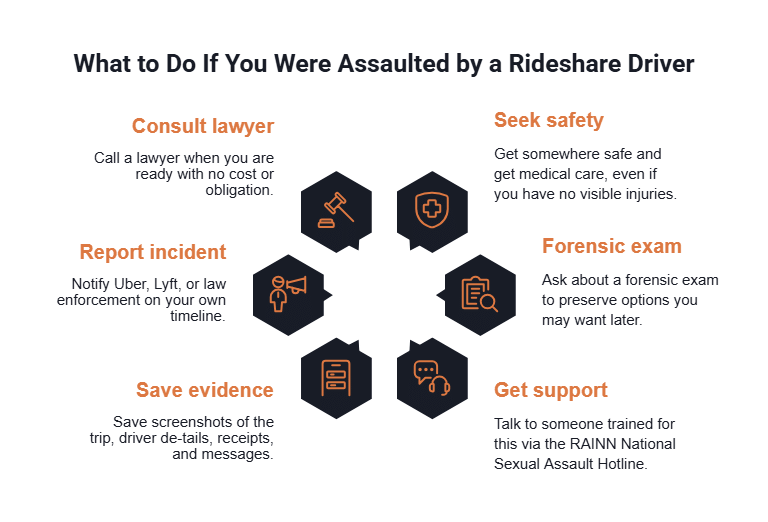
What to Do If You Were Assaulted by a Rideshare Driver
If the assault just happened, your safety and health come before anything on this list.
- Get somewhere safe and get medical care, even if you have no visible injuries. A hospital can treat you, address pregnancy and infection risk, and preserve evidence.
- Ask about a forensic exam. In most places you can have one without filing a police report, and it preserves options you may want later even if you are certain right now that you do not.
- Talk to someone trained for this. The RAINN National Sexual Assault Hotline is available 24 hours a day at 800-656-HOPE, and is free and confidential.
- Save what exists. Screenshots of the trip, the driver’s name and photo, the receipt, and any messages you sent that night. Do not delete the app or the ride from your history.
- Report if you want to, on your own timeline. You can notify Uber or Lyft, or law enforcement, or neither. None of it is a precondition to a civil claim.
- Call a lawyer when you are ready. There is no cost to the conversation and no obligation attached to it.

Contact a Rideshare Sexual Assault Attorney
If a rideshare driver assaulted you, what happened was not your fault, and it was not the price of getting home. Survivors routinely tell us they spent years deciding whether their experience was serious enough to mention. It was, and the companies counted on you concluding otherwise.
Meyer Wilson Werning is helping lead this litigation from a court-appointed leadership position, and our attorneys have spent years handling these cases specifically. You will not be rushed, questioned, or asked to prove anything to us. You can tell us as much or as little as you want, and nothing you say leaves this firm, whether or not we take your case. Contact us by phone or through our online form for a free and confidential consultation.
Recovering Losses Caused by Investment Misconduct.