


The BitClub Network cryptocurrency Ponzi scheme has reached a significant turning point after Judge Claire C. Cecchi granted the U.S. Department of Justice’s motion to dismiss all criminal charges against alleged mastermind Matthew Brent Goettsche with prejudice, permanently ending the prosecution of a 2019 indictment that accused him of orchestrating a $722 million fraud.
The dismissal comes after several co-defendants had already pleaded guilty and as Goettsche was preparing for trial. For the thousands of investors who lost money in this scheme, the development raises serious questions about accountability and what options remain for recovering lost funds.
The outcome of a criminal case does not necessarily determine what is available to investors through civil channels. Cases involving cryptocurrency fraud and Ponzi schemes can carry independent civil recovery options, particularly where a licensed broker, registered investment adviser, or other regulated financial professional recommended, facilitated, or directed the investment. Those avenues are not affected by the outcome of any criminal prosecution.

What Happened With the BitClub Network Case
Federal prosecutors alleged that BitClub Network operated as a fraudulent cryptocurrency mining investment scheme from approximately April 2014 through December 2019. According to the Department of Justice BitClub Network case overview, the scheme solicited money from investors in exchange for shares of purported bitcoin mining pools. Investors were also financially rewarded for recruiting new members into the network.
The DOJ alleged that BitClub Network’s operators used false and misleading figures, labeled as bitcoin mining earnings, to convince investors that the mining pools were generating substantial profits. In reality, according to prosecutors, the operation paid earlier investors using funds collected from newer participants, fitting the definition of a Ponzi scheme. DOJ records indicate the scheme obtained the equivalent of at least $722 million from investors before it was shut down.
The criminal case, United States v. Matthew Brent Goettsche et al., was filed in December 2019 in the District of New Jersey. Goettsche and others were charged with conspiracy to commit wire fraud and conspiracy to offer and sell unregistered securities. Several co-defendants, including Nevada resident Gordon Brad Beckstead, who pleaded guilty to money laundering and tax offenses tied to funds solicited for BitClub Network, have accepted responsibility for their roles. Meanwhile, Goettsche maintained his innocence and was preparing for trial.

We Have Recovered Over
$350 Million for Our Clients Nationwide.
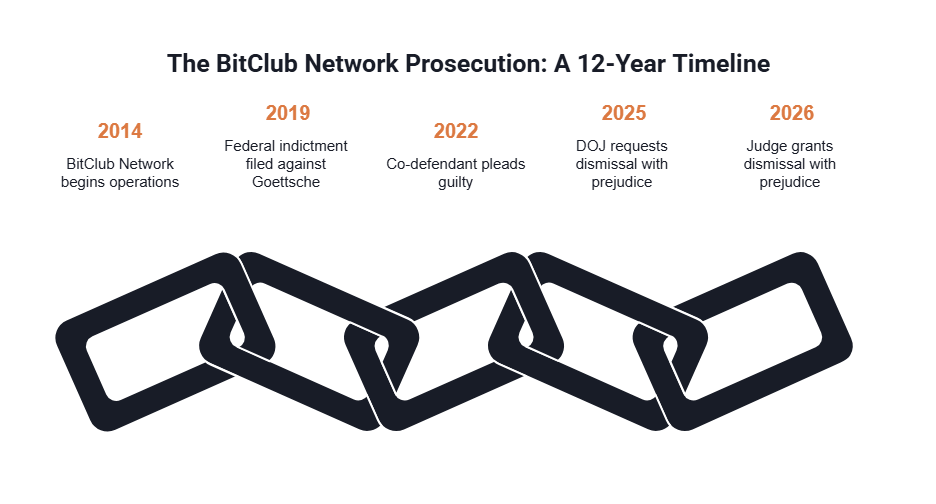
The BitClub Network Case Timeline
According to Bloomberg Law, DOJ leaders in Washington instructed the New Jersey U.S. attorney’s office to seek dismissal with prejudice of the longstanding charges against Goettsche. Prosecutors subsequently filed a motion asking Judge Cecchi to dismiss the case with prejudice. On July 28, 2026, Judge Cecchi granted the government’s request, dropping the indictment against Goettsche. The dismissal with prejudice means the same charges cannot be refiled.
- 2025: DOJ files motion requesting dismissal with prejudice of all charges against Goettsche, reversing course on the original prosecution.
- March 2022: Co-defendant Gordon Brad Beckstead pleads guilty to money laundering and tax offenses related to BitClub Network.
- December 2019: Federal indictment filed in the District of New Jersey charging Goettsche and others with conspiracy to commit wire fraud and conspiracy to offer and sell unregistered securities.
- April 2014: BitClub Network allegedly begins operations, soliciting investor funds for purported bitcoin mining pools.
What This Means for Investors
The DOJ’s decision to seek dismissal of charges against Goettsche does not close every door for investors who lost money. Civil forfeiture proceedings and civil remedies may still be available independent of the criminal case, and investors may have separate claims through civil litigation or arbitration against promoters, facilitators, or financial intermediaries who played a role in the scheme. These paths operate on their own legal track and are not affected by the government’s decision about whether to continue a criminal prosecution.
The BitClub Network case also illustrates warning signs that commonly signal a cryptocurrency Ponzi scheme: guaranteed or unusually high returns, compensation structures that reward recruiting new investors, opaque claims about mining operations or trading algorithms, and failure to register offerings with securities regulators. Any cryptocurrency investment displaying these patterns warrants careful scrutiny before committing funds.
Our lawyers are nationwide leaders in investment fraud cases.
How Meyer Wilson Werning Can Help
The dismissal of criminal charges against Matthew Brent Goettsche leaves an unresolved question for the thousands of people who invested in BitClub Network. If the government will not pursue accountability, who will? A criminal prosecution and a civil recovery claim are separate tracks. The government’s decision to exercise its prosecutorial discretion does not extinguish the rights of individual investors to seek their own remedy, and it does not erase the financial harm that the alleged scheme caused.
With more than $350 million recovered for investors nationwide, Meyer Wilson Werning has spent over 25 years holding financial professionals and institutions accountable for exactly this kind of misconduct. If a licensed broker, registered investment adviser, or other regulated financial professional facilitated or recommended your investment in BitClub Network or a similar cryptocurrency Ponzi scheme, you may have civil recovery options available to you. Contact us today for a free and confidential consultation. You pay nothing unless we recover for you.
We Are The firm other lawyers
call for support.
Frequently Asked Questions
What is the BitClub Network cryptocurrency Ponzi scheme and how did it work?
According to the U.S. Department of Justice, BitClub Network was a fraudulent cryptocurrency investment scheme that operated from about April 2014 through December 2019. It solicited money from investors for shares of purported bitcoin mining pools and rewarded them for recruiting new participants. Prosecutors allege operators used false mining earnings figures to create the appearance of profits while paying earlier investors with funds from newer members.
How much money did investors allegedly lose in the BitClub Network scheme?
Federal prosecutors and DOJ records state that BitClub Network obtained the equivalent of at least $722 million from investors through its purported mining pools and recruitment-based compensation system. That figure appears repeatedly across DOJ press materials and media coverage describing the case as a high-tech cryptocurrency Ponzi scheme.
Why is the DOJ seeking to dismiss charges against Matthew Goettsche?
Bloomberg Law reported that DOJ leaders in Washington directed the New Jersey U.S. attorney’s office to seek dismissal with prejudice of the longstanding charges against Goettsche, reversing course on the 2019 indictment shortly before trial. Prosecutors filed a motion asking Judge Claire C. Cecchi to dismiss the case, and the court’s final ruling is pending.
If criminal charges are dismissed, can investors still pursue recovery?
Yes. Commentary on the BitClub Network case indicates that civil forfeiture and other civil remedies may remain available even after a criminal dismissal with prejudice. Investors may have potential recovery options through civil litigation, arbitration, or claims against promoters and financial intermediaries, although those paths depend on the facts of each individual case.
Recovering Losses Caused by Investment Misconduct.