


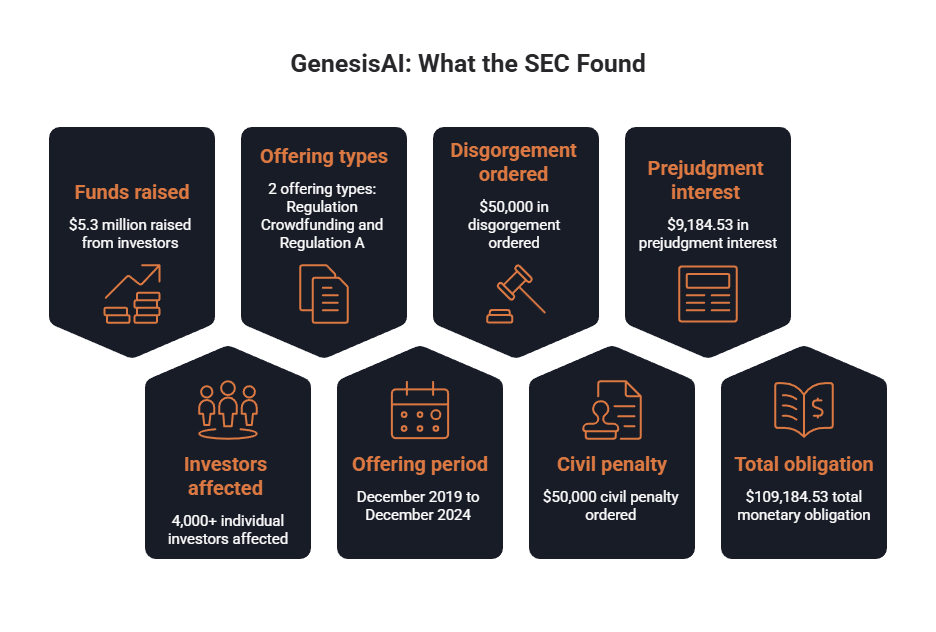
The SEC has filed settled civil charges against GenesisAI Corp. and its founder and former CEO, Archil Cheishvili, alleging that the company made negligent misrepresentations about revenue projections, company valuation, and customer demand while raising more than $5.3 million from over 4,000 investors.
The action, documented in SEC Litigation Release LR-26619, covers a series of Regulation Crowdfunding and Regulation A offerings conducted from at least December 2019 through December 2024. For retail investors who participated in these offerings, the settlement raises serious questions about the accuracy of the information they received and the options available to them now.
If a licensed financial professional, broker, or advisor facilitated your investment in a GenesisAI offering or a similar early-stage securities transaction, an alternative investment attorney can review your claim now.
What Happened With GenesisAI Corp. and Archil Cheishvili
According to the SEC Litigation Release LR-26619 for GenesisAI Corp. and Archil Cheishvili, the agency brought settled civil charges against the company and its founder under Section 17(a)(2) of the Securities Act. The SEC’s complaint alleges that GenesisAI promoted an AI marketplace platform while overstating its financial prospects and the viability of its purported partnerships and customer pipeline.
The complaint describes multiple fundraising rounds during which GenesisAI raised more than $5.3 million from more than 4,000 investors. EDGAR filings indicate that one Regulation Crowdfunding offering alone was structured to raise up to approximately $3 million in gross proceeds at a price of $4.15 per share.
Under the proposed final judgments, Cheishvili consented, without admitting or denying the allegations, to the following:
- A permanent injunction against future violations of Section 17(a)(2)
- $50,000 in disgorgement
- $9,184.53 in prejudgment interest
- A $50,000 civil penalty
Secondary reporting characterizes the total monetary obligation at approximately $109,184.53, subject to court approval.

We Have Recovered Over
$350 Million for Our Clients Nationwide.
How Regulation Crowdfunding and Regulation A Offerings Work
The SEC’s case against GenesisAI turns on how the company represented itself during two specific types of capital raises. Understanding what those exemptions are, and where they leave investors exposed, is essential context.
Regulation Crowdfunding allows private companies to raise limited capital from the general public through SEC-registered online platforms. These offerings come with streamlined disclosure requirements by design. That means investors typically receive far less information than they would in a traditional IPO, and the companies using this pathway are almost always early-stage ventures with limited operating histories and unproven business models.
Regulation A is sometimes called a “mini-IPO.” It allows companies to raise up to $75 million from both accredited and non-accredited investors, with disclosure obligations that sit somewhere between a full SEC registration and a standard Regulation Crowdfunding offering. Companies must file offering circulars and periodic reports with the SEC, but the bar is considerably lower than what fully registered public companies must clear.
Both exemptions are frequently used by startups, particularly in the AI and technology sectors. Because these offerings are often marketed directly to individual investors through online platforms and social media, the accuracy of the disclosures matters enormously. When a company overstates its revenue, valuation, or customer pipeline in these materials, large numbers of retail investors may commit capital based on a picture that bears little resemblance to reality.
Investors evaluating early-stage offerings through either pathway should know the warning signs of investment fraud, including unverifiable revenue projections and inflated valuations, both of which are directly at issue in this case.

What the SEC Alleges GenesisAI Misrepresented
The SEC’s complaint describes several categories of alleged misrepresentation, which the agency characterizes as negligent rather than intentional.
Revenue projections. The SEC alleges GenesisAI made forward-looking revenue projections without a reasonable basis, presenting optimistic revenue figures to investors without adequate support.
Company valuation. The SEC also alleges GenesisAI overstated the company’s current valuation in communications with investors. In Regulation Crowdfunding and Regulation A offerings, valuation figures affect the price investors pay per share and their expectations about future gains.
Customer demand and partnerships. The complaint further alleges GenesisAI misrepresented the extent of existing customer demand and the viability of its purported partnerships. For an AI marketplace platform, claims about established partnerships and pipeline customers can significantly influence investor confidence.
Our lawyers are nationwide leaders in investment fraud cases.
How Meyer Wilson Werning Can Help
Investors who put money into GenesisAI’s Regulation Crowdfunding or Regulation A offerings based on projected revenues, claimed valuations, and partnerships that the SEC alleges had no reasonable basis are in a difficult position. The agency’s settlement resolves the government’s case, it does not put money back in the hands of the people who invested it. For anyone who relied on those representations and suffered losses, the question of what comes next deserves a real answer.
With more than $350 million recovered for investors nationwide, Meyer Wilson Werning has spent over 25 years representing investors in securities fraud and investment loss recovery matters. If a licensed financial professional, broker, or advisor facilitated your investment in a GenesisAI offering or a similar early-stage securities transaction and you suffered losses as a result, contact us today for a free and confidential consultation. You pay nothing unless we recover for you.
We Are The firm other lawyers
call for support.
Frequently Asked Questions
What did the SEC allege against GenesisAI Corp. and Archil Cheishvili?
According to SEC Litigation Release LR-26619, the agency filed settled civil charges alleging that GenesisAI and its founder, Archil Cheishvili, made negligent misrepresentations about the company’s projected revenue, current valuation, and existing customer demand during Regulation Crowdfunding and Regulation A offerings conducted from at least December 2019 through December 2024. The charges were brought under Section 17(a)(2) of the Securities Act, and the SEC alleges these misrepresentations affected more than 4,000 investors who collectively invested over $5.3 million.
Is the GenesisAI SEC case a criminal fraud prosecution?
No. The GenesisAI matter is a civil securities enforcement action, not a criminal prosecution. The SEC alleges negligent material misrepresentations under Section 17(a)(2) of the Securities Act and seeks civil remedies including injunctive relief, disgorgement, prejudgment interest, and a civil penalty. The settlement does not involve an admission of wrongdoing, and no criminal charges have been described in the litigation release.
What penalties did Archil Cheishvili agree to pay in the SEC settlement?
Under the proposed final judgments, Cheishvili consented to a permanent injunction, $50,000 in disgorgement, $9,184.53 in prejudgment interest, and a $50,000 civil penalty. The total monetary obligation amounts to approximately $109,184.53, subject to court approval. These amounts are paid to the SEC and do not automatically flow to individual investors.
What are Regulation Crowdfunding and Regulation A, and why do they matter here?
Regulation Crowdfunding and Regulation A are SEC exemptions that allow companies to raise capital from the general public with streamlined registration requirements. Because these offerings are frequently marketed to individual, non-institutional investors, misleading statements about revenue, valuation, or partnerships can expose large numbers of retail investors to losses. The SEC focused on the accuracy and completeness of GenesisAI’s disclosures under these exemptions.
Recovering Losses Caused by Investment Misconduct.