


On November 12, 2026, the U.S. Department of Justice and the FBI announced a coordinated disruption of a North Korean social-engineering campaign known as FaceStealer, which allegedly stole more than $400 million in cryptocurrency over an 18-month period. The operation targeted individuals working in the cryptocurrency, Web3, and open-source software sectors by using hijacked accounts, prerecorded webcam footage, and fake video meetings to install malware and seize digital assets. The announcement raises serious concerns for anyone who holds cryptocurrency or participates in decentralized technology communities.
If a licensed broker or adviser recommended or facilitated an investment, there may be recovery options. Investors may want to learn more about cryptocurrency fraud and digital-asset losses.
What Happened: The FaceStealer Disruption
According to the Justice Department announcement on the FaceStealer disruption, federal authorities took action to dismantle infrastructure supporting North Korean cyber actors who allegedly operated the FaceStealer scheme. The FBI FaceStealer industry alert provided additional technical detail on the operation and its reach.
The DOJ and FBI allege that FaceStealer actors amassed a library of more than 900 secretly recorded webcam clips of real technology workers. Those recordings were then used in impersonation campaigns designed to gain the trust of targets. The operation allegedly ran for approximately 18 months before the November 2026 disruption, during which time more than $400 million in cryptocurrency was allegedly stolen.
It is worth distinguishing this action from a separate but related matter referenced in the same DOJ announcement. The department also disclosed a TraderTraitor-related seizure of more than $1.2 billion in assets connected to Binance. That action involved a different set of North Korean cyber operations and should not be conflated with the FaceStealer theft figure.

“What stands out about this scheme is how ordinary it looked. A message from someone you know, a routine video call, a quick technical fix. That’s what makes it hard to catch, and it’s why the delayed theft the FBI describes is so troubling. If you’ve been on calls like this and later noticed unexplained activity in a wallet, report it to the FBI’s IC3 and secure your accounts first. That is the most useful thing you can do right now.” – Courtney Werning

We Have Recovered Over
$350 Million for Our Clients Nationwide.
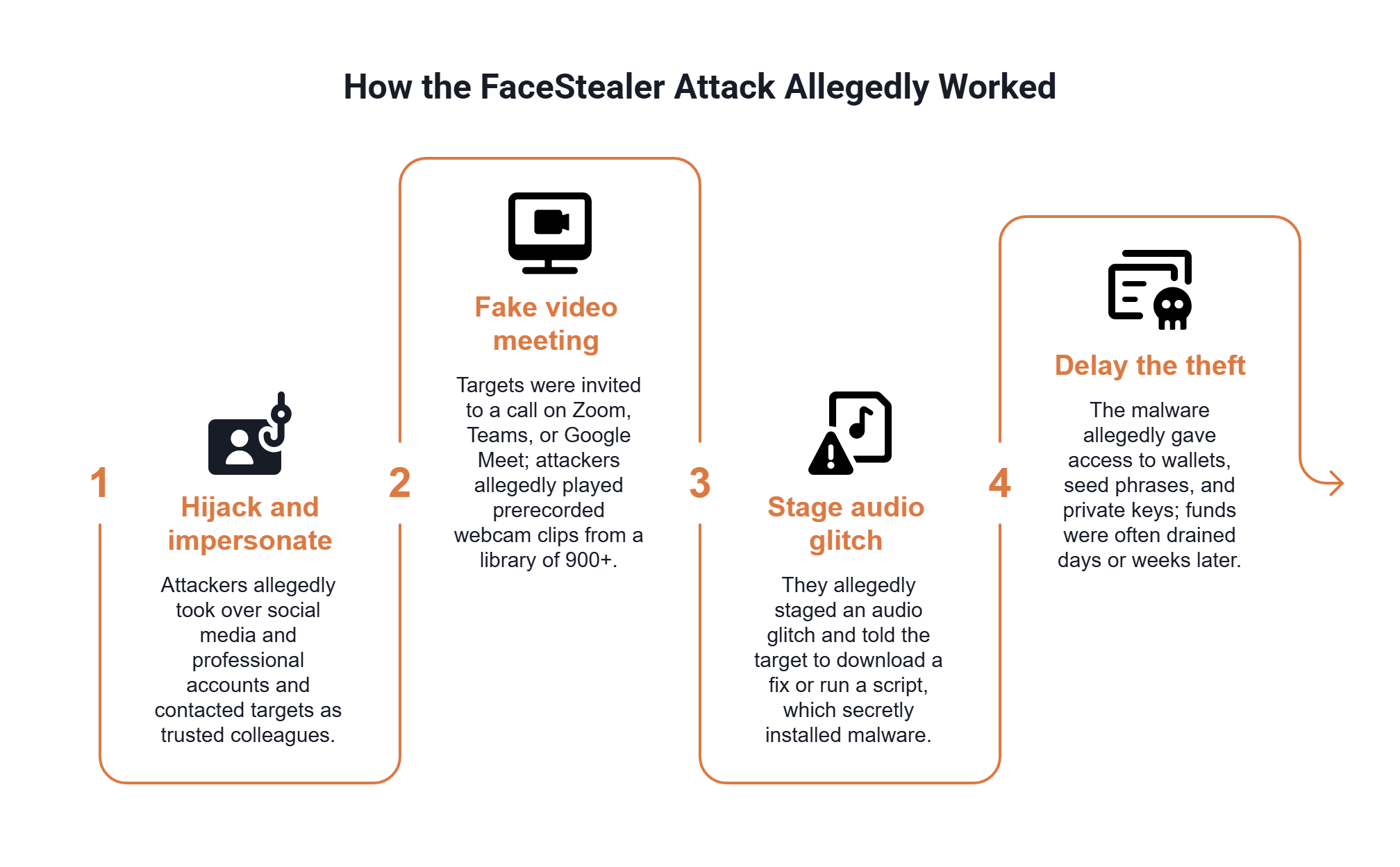
How the FaceStealer Attack Worked
The FaceStealer operation, as described by the FBI, followed a multi-step social-engineering sequence designed to bypass normal security awareness.
- Account hijacking and impersonation. Attackers allegedly compromised social media and professional networking accounts belonging to real people in the crypto and Web3 communities. Using those hijacked accounts, they contacted targets under the guise of trusted colleagues or industry connections.
- Fake video meetings. Targets were invited to what appeared to be a routine video call on platforms such as Zoom, Microsoft Teams, or Google Meet. During the call, the attackers allegedly used prerecorded webcam footage from their library of 900-plus clips to simulate a live participant.
- Malware delivery through a fake technical fix. Once a target joined the meeting, the attackers allegedly created a fabricated audio glitch or technical problem. They then directed the target to download a “fix” or run a script that secretly installed malware on the target’s device.
- Delayed cryptocurrency theft and account takeover. After installation, the malware allegedly allowed the attackers to access cryptocurrency wallets, seed phrases, and private keys. In many cases, according to the FBI alert, the theft did not occur immediately. Attackers waited days or weeks before draining wallets, making it harder for victims to connect the compromise to the fake meeting.
The FBI also warned that the FaceStealer campaign posed a broader threat to open-source software supply chains. According to the IC3 alert, the attackers allegedly attempted to compromise a widely used JavaScript library, which could have affected thousands of downstream projects and developers.
What This Means for Investors
The FaceStealer operation carries several implications for cryptocurrency holders and participants in decentralized technology.
First, the delayed theft pattern described in the FBI alert means that a compromised investor may not realize losses have occurred until well after the initial contact. By the time funds are drained, the connection between the fake meeting and the missing assets may not be obvious. This can complicate both reporting and any subsequent recovery effort.
Second, the scale of the recorded webcam library, with more than 900 clips, suggests that FaceStealer was not a one-off phishing attempt. It was allegedly a systematic campaign designed to build long-term credibility and reach a wide pool of targets. Anyone who participated in video calls within the crypto or Web3 community during the 18 months before November 2026 and subsequently experienced unexplained wallet losses should consider whether they may have been affected.
Third, the attempted compromise of an open-source JavaScript library extends the risk beyond individual investors. Developers and project maintainers who incorporated compromised code could have unknowingly passed the exposure along to their users. This kind of supply-chain risk is difficult to detect and can affect people who never had direct contact with the attackers.
The FBI recommends that anyone who suspects a FaceStealer compromise take immediate steps: secure cryptocurrency on a clean device using a new wallet and seed phrase, change all passwords, end active sessions, enable multifactor authentication, warn contacts who may have received messages from the compromised account, notify affected platforms, and report the incident to IC3.gov using the keyword “FaceStealer.”
Our lawyers are nationwide leaders in investment fraud cases.
How Meyer Wilson Werning Can Help
Cryptocurrency theft through social-engineering schemes like FaceStealer can leave investors uncertain about whether recovery is possible and where to begin. The attorneys at Meyer Wilson Werning have more than 75 years of combined experience representing investors who have suffered losses from fraud and misconduct, including losses involving digital assets. Though, firm can’t directly pursue claims against the attackers, or against unregistered entities.
We represent investors nationwide with over $350 million recovered for clients across the country over the last 26 years.
Contact us today for a free and confidential consultation to discuss your options.
We Are The firm other lawyers
call for support.
Frequently Asked Questions

What is the North Korean FaceStealer scheme?
FaceStealer is a social-engineering operation allegedly run by North Korean cyber actors that uses hijacked accounts, fake video meetings, prerecorded webcam footage, and malware disguised as a technical fix to steal cryptocurrency. The campaign targeted people in the cryptocurrency, Web3, and open-source software communities over an 18-month period before the November 2026 disruption.
How much cryptocurrency did FaceStealer allegedly steal?
The DOJ and FBI said the scheme allegedly led to the theft of more than $400 million in cryptocurrency during the 18 months before federal authorities disrupted the operation in November 2026. This figure is separate from the $1.2 billion TraderTraitor-related Binance asset seizure announced in the same DOJ release.
How can a fake video meeting install malware?
After a target joins what appears to be a legitimate Zoom, Microsoft Teams, or Google Meet session, the attackers create a fabricated audio or technical problem. They then provide a link, script, or software update that secretly installs malware on the target’s computer, giving the attackers access to cryptocurrency wallets and private keys.
Recovering Losses Caused by Investment Misconduct.