


Investors who were sold shares of Pacific Oak Strategic Opportunity REIT, a non-traded real estate investment trust formerly known as KBS Strategic Opportunity REIT Inc., are confronting a painful reality. The REIT’s reported net asset value (NAV) per share has fallen from $10.50 in September 2022 to just $5.72 as of April 2025, and those figures may no longer tell the full story. As of December 2025, the board halted its annual NAV disclosure entirely while the REIT pursues a plan of liquidation and navigates an Israeli court-supervised debt arrangement for its primary subsidiary.
The REIT’s share redemption program has been suspended since July 2024, and a going-concern warning has raised serious questions about its future viability. Many investors, particularly retirees and conservative savers who were told this was a stable income investment, now find themselves locked into a rapidly deteriorating position with no clear way out.
If you or a family member experienced significant investment losses involving Pacific Oak Strategic Opportunity REIT or a similar illiquid non-traded REIT, Meyer Wilson Werning may be able to help. Our team of experienced alternative investment attorneys focuses on representing investors who were steered into these products by a broker, financial advisor, or firm. If a financial professional recommended this REIT to you, contact us for a free and confidential consultation.
Investor Losses in Pacific Oak Strategic Opportunity REIT: What Happened
Pacific Oak Strategic Opportunity REIT was designed to invest in distressed and opportunistic commercial real estate, including discounted debt and distressed equity assets. It is publicly registered with the SEC but does not trade on a national stock exchange, a structure that severely limits investors’ ability to sell their shares.
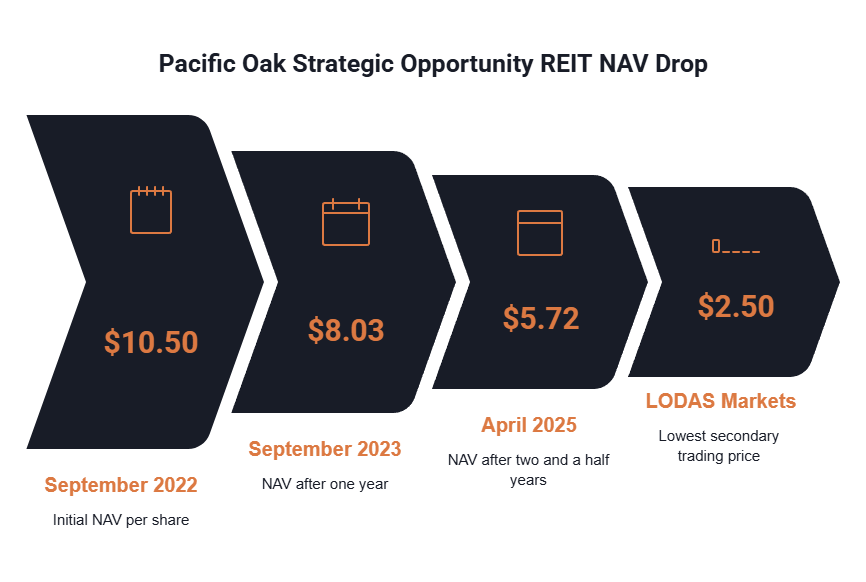
The timeline of the REIT’s value erosion tells a stark story:
- September 2022: Reported NAV of $10.50 per share
- September 2023: Reported NAV dropped to $8.03 per share
- April 2025: Reported NAV fell to $5.72 per share, a decline of more than 45% in roughly two and a half years
- LODAS Markets secondary trading: Shares reportedly traded for as low as $0.48 to $0.75 per share, representing a potential loss of more than 90% from the original offering price
In July 2024, Pacific Oak Strategic Opportunity REIT suspended its share redemption program, cutting off the primary exit route for investors who wanted to limit further losses. The REIT has also issued a going-concern warning, signaling that it may not be able to continue operations without restructuring or liquidation. According to Pacific Oak Strategic Opportunity REIT filings, the REIT’s financial condition has deteriorated amid higher interest rates, stress in the commercial real estate market, and negotiations with Israeli bondholders regarding a potential liquidation process.
Pacific Oak Strategic Opportunity REIT succeeded earlier vehicles associated with KBS Strategic Opportunity REIT Inc. Many investors may have been concentrated across multiple related non-traded REIT offerings, compounding their exposure to illiquid real estate investments.

We Have Recovered Over
$350 Million for Our Clients Nationwide.
How the NAV Decline and Frozen Redemptions Translate Into Investor Harm
The combination of a collapsing NAV and suspended redemptions creates a uniquely harmful scenario for the investors who were sold Pacific Oak Strategic Opportunity REIT, especially retirees and those with conservative risk profiles who relied on their investments for income.
Non-traded REITs like Pacific Oak Strategic Opportunity REIT carry features that make them particularly dangerous for investors who need access to their money or stable returns:
- Illiquidity: Shares cannot be freely sold on an exchange. When redemption programs are suspended, investors are effectively trapped.
- High upfront commissions and fees: Non-traded REITs typically carry commissions of 7% or more, meaning investors start in a hole from day one.
- Distribution risk: Distributions can be reduced or eliminated entirely when the underlying portfolio comes under stress, depriving income-oriented investors of the cash flow they were promised.
- Leverage amplifies losses: Many non-traded REITs borrow heavily. When property values decline, leverage magnifies the loss to equity investors.
- Secondary market discounts: When forced to sell on platforms like LODAS Markets, investors may receive far less than the sponsor.
For investors who purchased Pacific Oak Strategic Opportunity REIT at or near the original offering price, the current situation can represent losses of 90% or more based on recent secondary market trading prices. The company itself has warned that stockholders may receive nothing at all. These losses were allegedly neither disclosed as a realistic possibility nor consistent with these investors’ stated risk tolerance and financial goals.
MWW shared the situation on X:
A real estate fund sold to retirees has seen its shares drop by over 90%. Its share redemption program was suspended in July 2024, trapping investors.https://t.co/5OjOpKHUze#InvestorProtection #NonTradedREITs
— Meyer Wilson Werning (@Investor_Claims) July 11, 2026
How Meyer Wilson Werning Can Help
Investors who suffered losses in Pacific Oak Strategic Opportunity REIT do not have to accept these outcomes without exploring their legal options. If your broker or financial advisor recommended this non-traded REIT without a reasonable basis, misrepresented its risks, or over-concentrated your portfolio in illiquid real estate investments, you may have a viable claim through arbitration.
Meyer Wilson Werning represents investors nationwide who have been harmed by unsuitable non-traded REIT recommendations and broker misconduct. With more than 75 years of combined experience and over $350 million recovered for our clients, our team is dedicated to holding negligent firms accountable. Contact us today for a free and confidential consultation to discuss your path to recovery.
Our lawyers are nationwide leaders in investment fraud cases.
Frequently Asked Questions

What is Pacific Oak Strategic Opportunity REIT?
Pacific Oak Strategic Opportunity REIT is a publicly registered, non-traded real estate investment trust formerly known as KBS Strategic Opportunity REIT Inc. Its shares do not trade on a national stock exchange, which severely limits investors’ ability to sell. The REIT’s reported NAV has fallen sharply since 2022, its share redemption program has been suspended since July 2024, and the company has warned that stockholders may not realize any future value from their shares.
Why have investors in Pacific Oak Strategic Opportunity REIT suffered losses?
The REIT’s reported NAV per share dropped from $10.50 in September 2022 to $5.72 as of April 2025, while secondary market pricing on LODAS Markets had reportedly fallen to as low as $0.48 to $0.75 per share as of November 2025. The suspension of the share redemption program in July 2024, combined with defaults on its Israeli bonds and an advancing liquidation process, has left many investors with no viable exit.
How can I recover losses from an illiquid non-traded REIT like Pacific Oak Strategic Opportunity REIT?
Investors who lost money in Pacific Oak Strategic Opportunity REIT may be able to pursue recovery through an arbitration claim against the brokerage firm that recommended the investment. If the evidence shows unsuitable recommendations, misrepresentations, or over-concentration in illiquid real estate, you may be able to seek compensation for your losses.
Why are non-traded REITs like Pacific Oak considered risky for many investors?
Non-traded REITs are illiquid, carry high upfront commissions, and are highly sensitive to real estate market cycles and interest rates. Investors cannot sell shares freely, secondary market prices often fall far below reported NAV, and distributions can be reduced or eliminated entirely. These features frequently make non-traded REITs unsuitable for retirees and conservative investors who need liquidity or stable income.
Recovering Losses Caused by Investment Misconduct.