


Financial advisor Robert Scott Smith, currently associated with Emerson Equity LLC in Newberg, Oregon, is facing renewed scrutiny following significant allegations of investor harm. Recent filings indicate that retirement savings meant for stable income were reportedly steered into speculative, high-commission private placements that did not align with stated financial goals. Public records show a major damages claim seeking between $1 million and $2.3 million in a pending arbitration matter, along with a separate customer complaint filed on October 22, 2025.
Retirement savings don’t belong in speculative, illiquid private placements, and when a broker puts them there anyway, there are consequences. If Robert Scott Smith or Emerson Equity LLC cost you money, Meyer Wilson Werning wants to hear your story. Reach out today for a free and confidential consultation. There is no fee unless we recover.
What are the Details of the Robert Scott Smith Investigation?
The ongoing investigation into Robert Scott Smith centers on claims of unsuitable recommendations, misrepresentations, and breach of fiduciary duty. A high-value arbitration case, identified as FINRA #25-01880 and filed in September 2025, points to serious concerns about sales activity connected to his operations in Newberg, Oregon.
A second pending complaint dated October 22, 2025, alleges wrongful conduct, fraud by misrepresentation and omission, and violations of state and federal securities laws. These allegations echo prior disputes where investors claimed that Robert Scott Smith recommended illiquid alternative investments that caused prolonged financial instability and disrupted long-term retirement plans.

We Have Recovered Over
$350 Million for Our Clients Nationwide.
Important Points Regarding Past Settlements
Public regulatory records indicate that Robert Scott Smith (CRD 1412333) has a extensive history of disclosable events. While many of these matters reached a settlement without an admission of wrongdoing, the total payouts exceed $1.8 million. These settlements include:
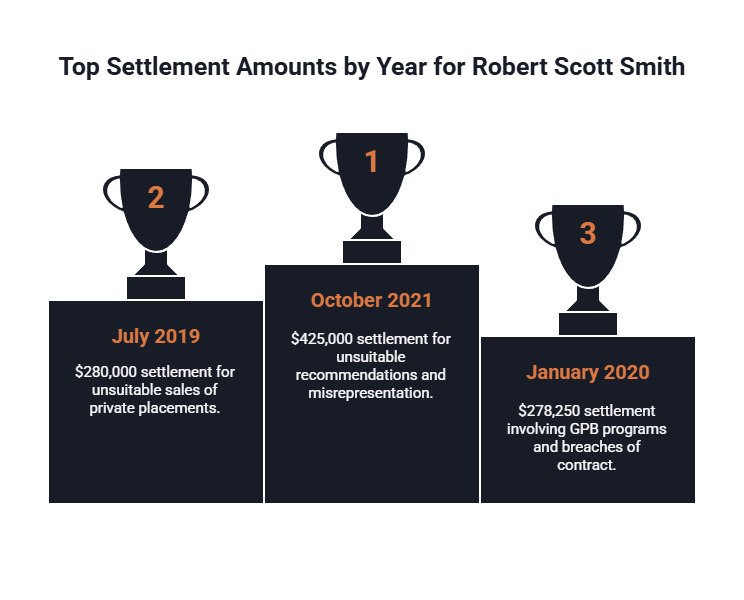
- October 2021: A $425,000 settlement for allegations of unsuitable recommendations and misrepresentation between 2013 and 2018.
- January 2023: A $300,000 settlement involving unsuitability claims related to GPB Automotive Portfolio LP and VII Peaks BDC II.
- 2024: A $117,747.88 settlement for suitability concerns involving DPP/LP investments made in November 2019.
- April 2020: A $265,000 settlement for allegations of negligence, fraud, and violations of Oregon securities law.
- January 2020: A $278,250 settlement involving GPB programs and breaches of contract.
- January 2020: A $110,000 settlement for suitability violations involving GPB Automotive Portfolio LP.
- July 2019: A $280,000 settlement regarding unsuitable sales of private placements.
- February 2019: A $90,000 settlement for fraud and negligence related to VII Peaks and GPB investments.
Which Private Placements are at the Center of Investor Losses?
Regulatory disclosures frequently mention GPB Automotive Portfolio LP and VII Peaks BDC II. These products are complex private placements that are typically illiquid, meaning they cannot be easily sold on a public exchange. Many investors in GPB programs suffered significant losses after the firm was accused of operating a Ponzi-like scheme, using capital from new participants to fund distributions to earlier investors.
For families relying on their portfolios for daily expenses, the suspension of redemptions and distribution cuts in these products can be devastating. Investors often describe being sold these products as “safe” or “income-producing,” only to find their capital locked up while the value of the investment plummets.
Our lawyers are nationwide leaders in investment fraud cases.
How do Suitability and Supervision Duties Apply to Emerson Equity LLC?
Under FINRA Rule 2111 and the SEC’s Regulation Best Interest (Reg BI), brokerage firms like Emerson Equity LLC have a legal obligation to ensure that every recommendation is in the client’s best interest. This duty of care requires brokers to understand the investor’s profile—including age, tax bracket, liquidity needs, and risk tolerance—before suggesting high-risk private placements.
Firms are also required to maintain a reasonable supervisory system under FINRA Rule 3110. If a firm fails to detect patterns of unsuitable recommendations or fails to intervene when a broker ignores red flags, the firm may be held liable for the resulting investor losses. This is especially critical in independent broker-dealer models where remote oversight can sometimes be weak.
We Are The firm other lawyers
call for support.
How Meyer Wilson Werning Can Help
A broker with more than $1.8 million in settlements and multiple pending claims is not bad luck, it is a pattern. And when that pattern involves illiquid, high-commission private placements sold to retirees as “safe” income products, investors deserve more than apologies.
Meyer Wilson Werning has recovered more than $350 million for investors harmed by unsuitable recommendations and supervisory failures. If Robert Scott Smith or Emerson Equity LLC affected your retirement savings, our attorneys will review your situation at no charge. Contact us today for a free and confidential consultation, you pay nothing unless we recover for you.
Frequently Asked Questions

Can I sue Emerson Equity LLC for losses tied to Robert Scott Smith’s recommendations?
Possibly. If your advisor recommended investments that were unsuitable for your profile or if the firm failed in its duty to supervise, you may be able to seek recovery through arbitration.
How can I recover losses from GPB Automotive Portfolio LP or VII Peaks BDC II?
Most investors pursue recovery through individual arbitration claims against the brokerage firm that sold them the investment. Building a case typically requires documentation of your financial profile and the advice provided by your broker.
Is Emerson Equity LLC responsible if my portfolio was over-concentrated?
Yes. Brokerage firms have an obligation to prevent over-concentration in risky or illiquid assets. Failure to maintain adequate supervisory controls over account concentrations can be grounds for a claim.
What evidence helps prove an unsuitable private placement recommendation?
Key evidence includes your new account forms, risk tolerance questionnaires, and communications with your advisor. These documents help establish whether the broker followed Reg BI and suitability rules.
How long do I have to file a claim against Emerson Equity LLC?
Deadlines vary depending on the nature of the claim and the jurisdiction. It is essential to act quickly, as statutes of limitation can bar recovery if too much time passes.
Recovering Losses Caused by Investment Misconduct.