

When Li Han trusted a U.S. brokerage firm with her savings, she expected the professional treatment any investor deserves. Instead, she was sold a speculative private placement through what a FINRA arbitration panel later determined involved misrepresentations and omissions. The result was financial harm that should never have happened. The outcome, was full accountability: $459,511.19 ordered against Tigress Financial Partners, LLC, with every dollar of her original investment returned, every dollar of interest paid, and the firm forced to cover her legal fees on top of it. The case was announced on June 22, 2026, and featured on Yahoo Finance.
If you were sold a private placement that turned out to be unsuitable for your financial situation, the experienced alternative investment loss attorneys at Meyer Wilson Werning can help evaluate whether your losses are the result of actionable misconduct. Contact us today for a free and confidential consultation, and you pay nothing unless we recover for you.
What Happened: A Chinese Investor, a U.S. Brokerage, and a Product That Was Never Right for Her
Ms. Han is a Chinese citizen who placed her trust and her savings in a U.S. brokerage firm. That firm, Tigress Financial Partners, LLC, sold her an investment in Participant Capital, a Miami-based platform that provides individual investor access to institutional-scale real estate ventures. On paper, a real estate vehicle. In practice, a speculative private placement with serious risks that were never properly disclosed to Ms. Han. Regulatory standards make clear it should never have been recommended to her in the first place.
Private placements are sold outside of public markets and carry no SEC registration requirement. They are inherently illiquid, offer limited transparency, and carry the potential for total loss of principal. Even Participant Capital’s own materials acknowledge that the investment is suitable only for those with adequate financial means and no need for liquidity. The allegations in Ms. Han’s case are direct: Tigress Financial sold her this product through misrepresentations and omissions, without a legitimate basis to believe it was appropriate for her.

We Have Recovered Over
$350 Million for Our Clients Nationwide.
What the FINRA Panel Ordered and Why It Matters
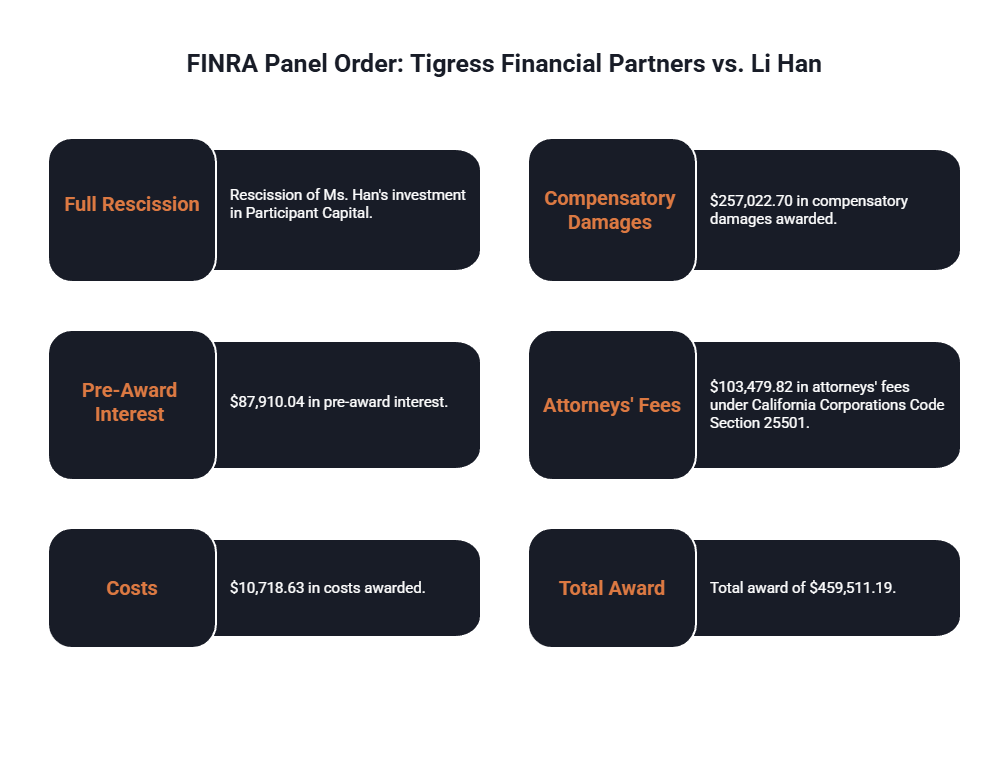
The FINRA arbitration panel delivered a result that went beyond simply returning Ms. Han’s money. The panel ordered:
- Full rescission of her investment in Participant Capital
- $257,022.70 in compensatory damages
- $87,910.04 in pre-award interest
- $103,479.82 in attorneys’ fees under California Corporations Code Section 25501
- $10,718.63 in costs
- Total award: $459,511.19
Before reaching that result, Tigress Financial attempted to have the case dismissed as frivolous. The panel rejected that position outright. The firm’s attempt to shut the case down before it could be heard is, in itself, telling.
The attorneys’ fee award deserves special attention. FINRA arbitration generally follows the so-called “American Rule,” where each side pays its own legal costs. That default creates a significant financial barrier for individual investors going up against well-resourced firms. California’s Blue Sky Law changes that calculus entirely. Under California Corporations Code Section 25501, a prevailing investor in a securities fraud case is entitled to recover reasonable attorneys’ fees. The FINRA panel’s full application of this provision, awarding the entirety of $103,479.82 in fees, is rare, and it reflects the strength of Ms. Han’s case and the severity of what happened to her.
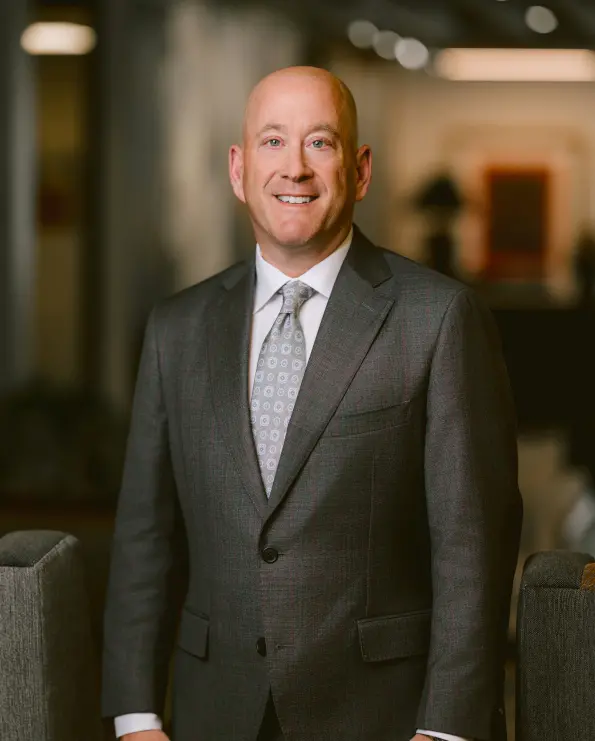
“Ms. Han trusted a U.S. brokerage firm with her savings, and that firm sold her a speculative private placement through a series of misrepresentations and omissions,” said Courtney Werning, incoming PIABA President and Principal at Meyer Wilson Werning. “This is what accountability looks like: full rescission, every dollar of interest, and the firm paying her legal fees on top of it.”
Ms. Han’s Claims Against Tigress Financial
Ms. Han’s case rested on multiple, distinct legal theories, each addressing a different dimension of what went wrong:
- Violations of California’s Blue Sky Law: California’s securities statutes impose strict requirements on the sale of investment products, with meaningful consequences when those requirements are ignored
- Breach of fiduciary duty: Brokerage firms owe their clients a fundamental obligation to act in those clients’ interests
- Negligence: Failure to exercise the standard of care required when making investment recommendations
- Breach of contract: Violations of the terms and obligations that govern the broker-client relationship
Together, these claims present a comprehensive picture of a brokerage firm that failed Ms. Han at every level: legally, ethically, and contractually.
Our lawyers are nationwide leaders in investment fraud cases.
Tigress Financial Partners: A History of Regulatory Scrutiny
A review of Tigress Financial Partners’ record on FINRA’s BrokerCheck (CRD# 154717) reveals a total of three disclosure events: two final regulatory actions and one arbitration award. Among the regulatory findings, FINRA found that the firm failed to develop and implement an AML program reasonably designed to detect and report suspicious transactions, and failed to properly disclose mark-ups and mark-downs on customer confirmations.
Supervisory failures are not minor administrative oversights. They represent cracks in the internal controls that are supposed to prevent unsuitable sales before they reach a client like Ms. Han. When a firm cannot supervise its own representatives, investors pay the price.
We Are The firm other lawyers
call for support.
A First-Hand Account of What Real Representation Looks Like
The outcome of Ms. Han’s case is meaningful. But the story of how MWW got there is equally important.
Following the conclusion of her case, Ms. Han shared her experience working with the Meyer Wilson Werning team. Her review is a direct account of what investor advocacy looks like when a firm takes it seriously.
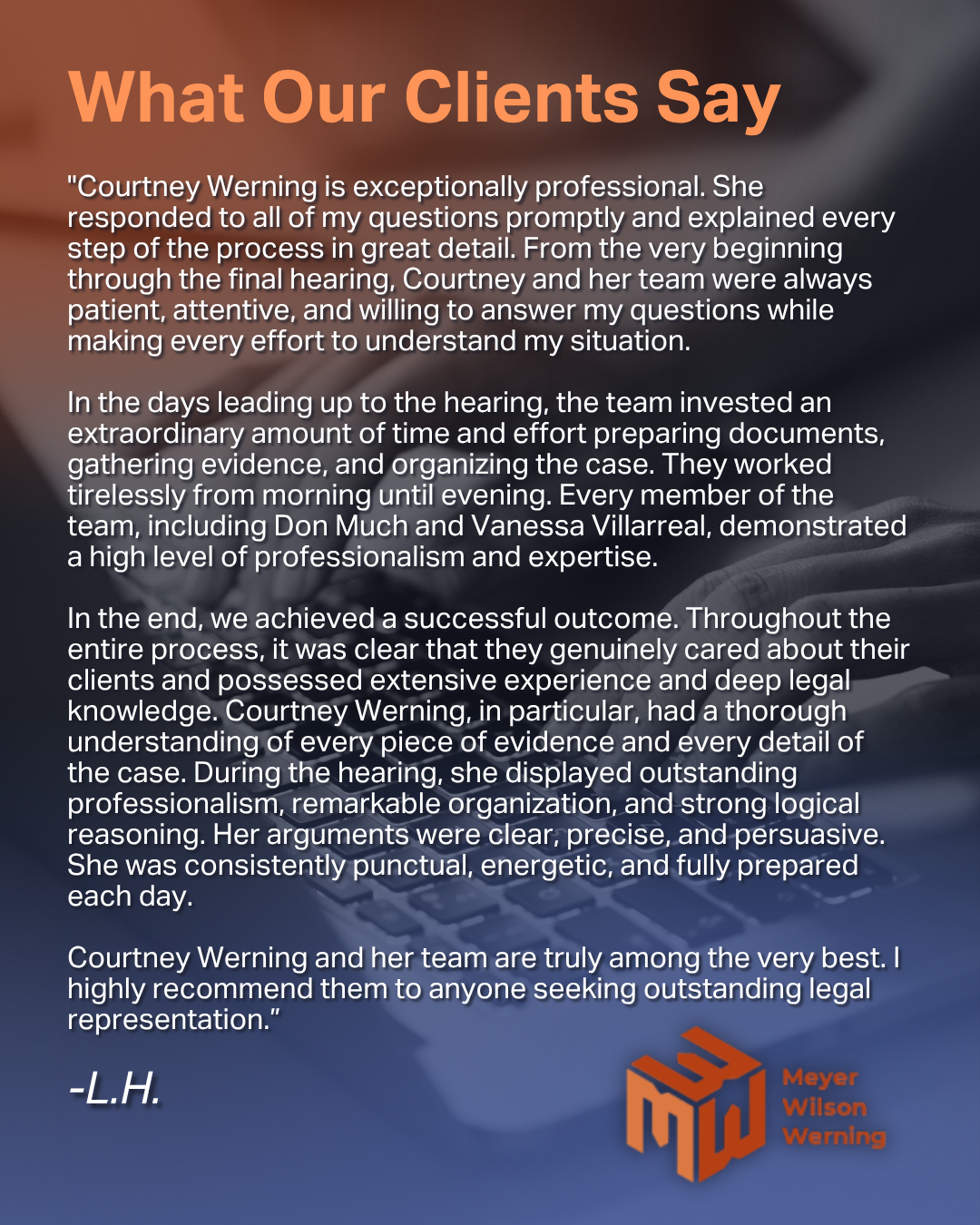
This is not a description of a law firm that shows up and hopes for the best. It is a description of a team that builds a case from the ground up, prepares at an extraordinary level, and shows up to the hearing ready to fight and win. You can read more client reviews here.
What Investors Sold Unsuitable Private Placements Should Know
This case is not an isolated incident. Private placements are sold across the country every day, and the investors who receive them are not always given an accurate picture of the risk they are taking on. If you or someone you know was sold a private placement and later experienced significant losses, there are questions worth asking:
- Was the investment presented as low-risk when it was, in fact, speculative?
- Were the fees, illiquidity, and potential for total loss clearly disclosed?
- Did the broker understand your financial situation, risk tolerance, and investment objectives before making the recommendation?
- Was the product even approved by the brokerage firm for sale to retail clients?
If the answers to any of these questions give you pause, you may have a viable unsuitability claim. Statutes of limitations apply, time matters.
Contact us today for a free and confidential consultation. Meyer Wilson Werning handles all investor protection cases on a contingency fee basis. If the firm does not recover money for you, you owe nothing.
Frequently Asked Questions
What is a private placement, and why is it considered high-risk?
A private placement is a securities offering sold outside of public markets without SEC registration. These investments are illiquid, carry limited transparency, and are appropriate only for sophisticated investors with high risk tolerance and no near-term need for liquidity. When a broker recommends one to an investor who does not meet those criteria, it may constitute an unsuitable recommendation that is actionable under FINRA rules and applicable state securities laws.
What does “full rescission” mean in an arbitration award?
Full rescission means the investor is treated as if the investment never happened. The broker or firm must return the original amount invested, not merely the difference in value. In Ms. Han’s case, rescission was paired with compensatory damages, pre-award interest, and full recovery of attorneys’ fees, making her completely whole.
What is California’s Blue Sky Law, and how did it help Ms. Han?
California Corporations Code Section 25501 entitles a prevailing investor in a securities fraud case to recover attorneys’ fees from the violating party. This fee-shifting provision removes the financial barrier that often deters investors from taking on well-funded brokerage firms. Here, it resulted in Tigress Financial paying Ms. Han’s entire $103,479.82 in legal fees.
What should I do if I believe I was sold an unsuitable investment?
Preserve your documentation: account statements, broker correspondence, and any materials describing the investment. Then speak with an experienced investor protection attorney. Meyer Wilson Werning offers free, confidential consultations and handles all cases on a contingency fee basis. You pay nothing unless the firm recovers money for you.
Can international investors bring claims against U.S. brokerage firms?
Yes. Li Han’s case is a direct example. As a Chinese citizen, she brought and won a claim against a U.S.-based brokerage through FINRA arbitration. MWW regularly represents international clients in claims against U.S. firms.
Recovering Losses Caused by Investment Misconduct.